
PETG sheet for packaging forms in a narrow window, and PVC settings will miss it. A confectionery packer replaced PVC blisters with PETG to meet a retailer specification and kept the same forming tools. The first run produced flanges that cracked when the lid was sealed, on about one pack in forty. The forming temperature had been left at the PVC setting, which is 20 °C higher than PETG needs, and the flange had been stretched thin at the edge.
PETG is a straightforward packaging material with a narrow forming window. It thermoforms at lower temperature than PVC, it does not need drying in the same way, and it seals by heat, RF or adhesive depending on the lid. Carrying over PVC settings is the most common conversion error.
Formats and thickness
Blister and clamshell packs run 0.3 to 0.8 mm. Folding cartons with a clear window run 0.2 to 0.5 mm, and a window that has to survive handling sits at 0.4 mm or above. Rigid retail boxes and display packs run 0.8 to 1.5 mm. Below 0.3 mm the pack is dimensionally unstable after forming; above 1.5 mm the material cost dominates and a different format is usually cheaper.
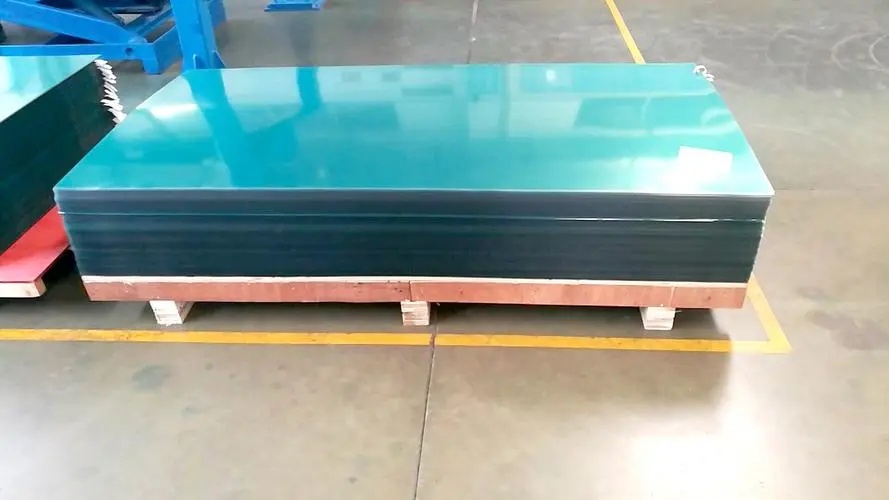
Sheet size and gauge consistency matter for forming yield. A roll-fed line wants gauge variation within plus or minus 3% across the web, because a thin band forms deeper and produces a pack that will not sit flat. Ask for the gauge profile, not just the nominal.
PETG sheet for packaging: forming window and flange
PETG forms at 120 to 140 °C sheet temperature, lower than PVC and much lower than acrylic. Heat the sheet evenly, form at the top of the window and cool in the tool rather than in air. A flange that is formed too hot stretches thin and cracks at the seal; one formed too cold springs back and leaves a wavy edge.
Flange design deserves a drawing review. A 3 to 4 mm flat flange with a 0.5 mm radius at the transition seals reliably. A sharp transition concentrates the seal force and starts a crack that appears only after the pack is palletised and stacked.
Food contact and sealing
For direct food contact, specify a grade with an FDA or EU 10/2011 declaration and confirm that the declaration covers the finished thickness and any regrind content. A declaration for the resin does not automatically cover a sheet produced with 30% regrind.
Sealing depends on the lid: a coated paper or foil lid heat-seals to PETG at 130 to 160 °C with a 0.3 to 0.6 second dwell; a PETG lid can be sealed by RF or by solvent. Test the seal on the production forming line, because seal strength depends on the flange thickness the tool actually produces.
The price conversation for a packaging programme usually comes down to gauge, and the relationship between 0.5 and 0.8 mm is set out in our note on PETG sheet pricing by thickness. For food applications the material has to tick a documentation box as well as a price box.
Send the pack drawing, forming method and lid specification to oversales@rpplexiglass.com, and we will quote PETG sheet in the gauge and food-contact grade your programme needs.
Frequently Asked Questions
What thickness PETG sheet is used for packaging?
0.3 to 0.8 mm for blisters and clamshells, 0.2 to 0.5 mm for carton windows, and 0.8 to 1.5 mm for rigid retail boxes. Below 0.3 mm the formed pack is unstable; above 1.5 mm the cost usually rules the format out.
At what temperature does PETG form for blister packs?
120 to 140 °C sheet temperature, lower than PVC. Forming at PVC settings overstretches the flange and causes cracks at the seal. Heat evenly and cool in the tool rather than in air.
Is PETG food safe for packaging?
With a grade carrying an FDA or EU 10/2011 declaration that covers the finished thickness and the regrind content, yes. Confirm the declaration names the sheet, not only the resin, before the pack goes to a retailer.