
PETG sheet weight is worth knowing because the density differs from acrylic by enough to move a freight invoice. A display manufacturer disputed a freight invoice for nine weeks. The pallet weighed 140 kg more than his calculation. His calculation had used acrylic density, which is 6 per cent lighter than PETG.
PETG sheet weight by thickness
- 1 mm: 1.27 kg per square metre
- 1.5 mm: 1.91 kg
- 2 mm: 2.54 kg
- 3 mm: 3.81 kg
- 4 mm: 5.08 kg
- 5 mm: 6.35 kg
- 6 mm: 7.62 kg
- 8 mm: 10.16 kg
- 10 mm: 12.70 kg
The arithmetic is the same as for any plastic: area in square metres, times thickness in millimetres, times 1.27. The only reason PETG is worth a separate table is that acrylic, PC and PETG densities are all within 8 per cent of each other, which is close enough to confuse and far enough to matter on a container.
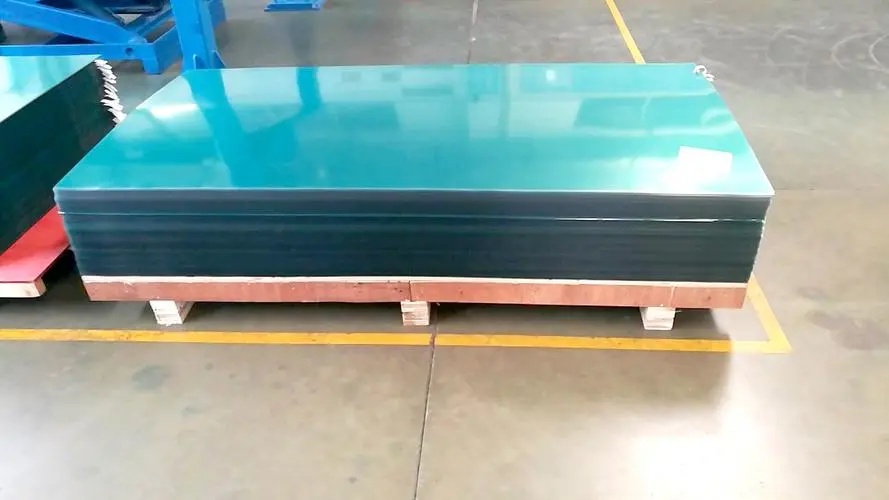
Weighing a pallet and backing out thickness
Three steps: weigh one sheet, divide by its area in square metres, then divide by 1.27. The result is the average thickness in millimetres, and it is more honest than a caliper reading taken by whoever is nearest.
A nominal 3 mm sheet should weigh 3.81 kg per square metre. At 3.55 kg the sheet is about 2.8 mm, which is inside some tolerance bands and outside others. That is exactly the ambiguity a specification is supposed to remove.
What else is on the pallet
Film at roughly 0.05 kg per square metre on each face, interleaving paper at 0.07, a pallet at 15 to 25 kg, strapping and corner boards at a kilo or two. On a 500 kg order the packing is typically 6 to 9 per cent of gross weight.
Quoting freight on net sheet weight is the classic underestimate, and it is the supplier who ends up absorbing it.
Freight arithmetic: air or sea
Air freight on volumetric weight, usually 1 cubic metre to 167 kg, punishes light bulky sheet. Sea freight charges by volume, so PETG at 2 to 3 mm almost always ships by sea, and only cut panels with high value per cubic metre justify air.
A useful check: divide the order value by the cubic metres. Below about 40,000 per cubic metre, air freight eats the margin. Above that, speed may be worth it.
Why the number matters beyond freight
Weight is the cheapest process control a buyer has. It detects short thickness, mixed grades and a supplier who has substituted a lighter recycled blend. Three checks at arrival, a scale and a tape measure, catch all three.
For price benchmarking against the same size in other thicknesses, the 3 mm price note sets out what changes with gauge, and the cut-to-size guide covers panel weights on a cut list.
Need pallet weights for a freight booking? Send formats and thicknesses to oversales@rpplexiglass.com.
Frequently Asked Questions
What is the density of PETG?
About 1.27 g per cubic centimetre for standard grades, or 1270 kg per cubic metre. Copolyester variants sit within 1.24 to 1.30.
How much does a 2 mm PETG sheet weigh?
About 2.54 kg per square metre. At 3 mm it is 3.81 kg, at 4 mm 5.08 kg, at 5 mm 6.35 kg.
Why do two pallets of the same order weigh differently?
Packing, film and pallet weight vary, and thickness tolerance is usually the larger factor. Weigh one sheet from each stack and multiply before questioning the freight invoice.