
The owner of a 42 m2 bakery in Lyon tracked three numbers for eight weeks before the remodel: crumbs collected per day, minutes spent wiping glass, and croissant sales per hour. The old case was framed glass with a sliding door that jammed. The new acrylic bakery display case cut cleaning time by roughly a third and lifted pastry sales by nine percent, mostly because customers could see the tiers from the queue.
What changes when an acrylic bakery display case replaces glass
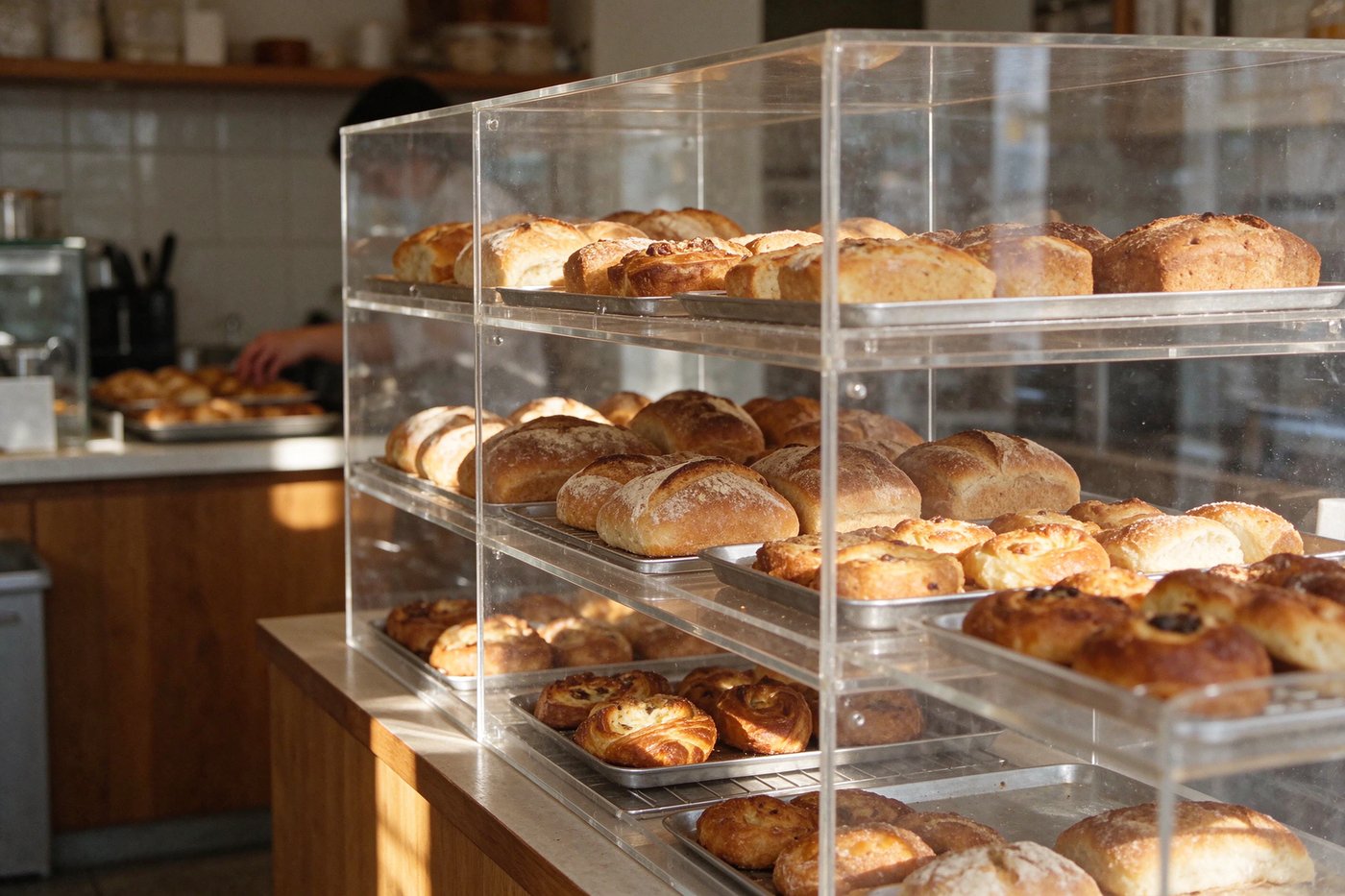
Acrylic is half the weight of glass at the same thickness and does not shatter over food, which is why bakery fit-outs keep moving toward it. The trade-off is scratch sensitivity: a 6 mm case with a raw cut edge will haze at the tray contact line within months, so the edge and shelf finish decide the service life.
- Sheet: 6 mm cast acrylic for the shell and 5 mm for shelves on 900 mm spans.
- Tiers: three levels at 150 mm pitch, front lips of 25 mm to keep trays from sliding.
- Vent: a 40 mm rear slot with a filter mesh, so warm bread does not condense on the front pane.
- Edge: flame-polished visible edges, and a 2 mm PVC band on tray-contact lines.
Crumb control and the cleaning routine
Crumbs collect in the lip, not on the shelf. A 25 mm front lip with a 5 mm drain gap lets staff brush debris into a removable tray rather than chasing it across the shelf. That detail alone accounted for most of the cleaning-time saving in the Lyon refit.
Cleaning should use a pH-neutral food-surface cleaner and a soft cloth. Ammonia glass spray leaves a film that reads as haze under warm bakery light, and alcohol on extruded sheet causes crazing. Cast sheet tolerates both better, which is another reason the specification calls for cast.
Temperature and condensation
A bakery case is not refrigerated, but bread released at 60 degrees into a closed volume will condense on the coolest surface, usually the front pane. A rear vent at shelf height, plus 20 mm of clearance above the top tray, keeps the moisture moving and the pane clear through the morning bake.
River People fabrication
River People cuts 5 mm and 6 mm cast sheet on a CNC bed, flame-polishes edges and bonds tier supports on a flat jig so shelves sit level within 1 mm. Bakery runs of 10 to 60 cases ship in 20 to 25 days, crated with shelf sets labelled per tier.
Send your counter length and tray sizes to oversales@rpplexiglass.com for a tier layout and sheet schedule.
Chilled counters bring condensation issues, covered in the acrylic gelato display guide for frozen cabinets.
Frequently Asked Questions
Is acrylic food safe for unwrapped bread?
Cast acrylic is acceptable for indirect contact with dry bakery goods. For direct contact with high-fat or hot items, a food-contact-certified sheet grade and a documented declaration are required.
How thick should the shelves be?
5 mm for spans up to 600 mm, 6 mm to 900 mm, 8 mm beyond that. A shelf carrying a full tray of loaves at 6 kg will deflect visibly if undersized.
Can the case be built into a counter?
Yes. Specify a 10 mm base and a 15 mm rebate so the case sits into the counter without a visible gap, and leave the rear vent clear of the counter back panel.