
The complaint arrived with a photo of a 1:18 Porsche with a cracked rear corner and a hazy front face. The owner had stacked six acrylic diecast car display case units on a shelf, and the top one had taken the load of the other five through its lid. The case was 3 mm extruded, and it was never designed to be stacked.
Sizing an acrylic diecast car display case for 1:18 models
A 1:18 model is about 250 to 300 mm long, 120 mm wide and 110 mm tall including the roof aerial. The case needs 20 mm clearance at each end, 15 mm at the sides, and 30 mm above the roof so the model can be lifted out without clipping the lid.
- Shell: 4 mm cast acrylic, or 5 mm above 350 mm length.
- Footprint: 350 x 180 mm for most 1:18 models, 400 x 200 mm for long-wheelbase exotics.
- Base: 12 mm MDF with a 3 mm acrylic top skin, or 8 mm cast acrylic for a full-clear look.
- Seal: 2 mm EPDM gasket in a routed channel, not a silicone bead that yellows.
The stacking problem and the UV problem
Cases that will be stacked need a load path. Either the shell carries a 6 mm internal corner post bonded top to bottom, or the lid gets a 10 mm frame that transfers load to the walls. Without one of those, the second case from the bottom always fails first.
UV is the slower failure. A model left in a window for two summers loses its decals before the case shows any haze. UV-filtering cast acrylic blocks most of the damaging range and costs a few percent more than standard sheet, which is cheap insurance on a limited-edition model.
Dust, and why the gasket matters
Dust enters through the lid seam, not the walls. A routed channel with an EPDM gasket seats the lid 2 mm into the base and keeps grit out during a shelf move. A silicone bead looks neat on day one and turns amber within three years.
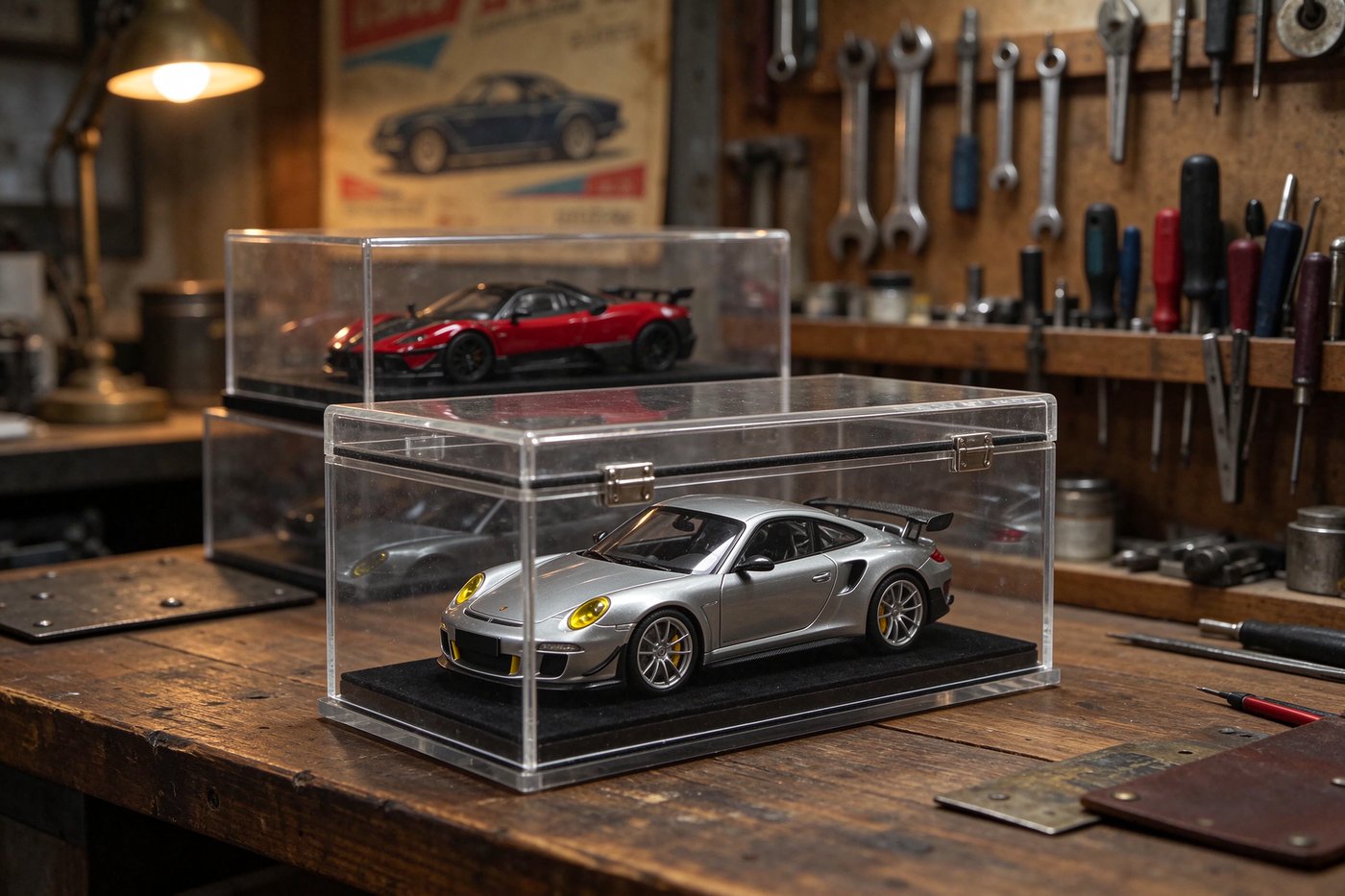
What River People supplies
River People cuts 4 mm and 5 mm cast shells on a CNC bed, bonds them on flat jigs, and routes the base channel to the gasket tolerance the buyer specifies. Display runs of 100 to 1,000 units are packed nested, with lids separated by foam to avoid transit scratches.
Send the model dimensions and whether units will be stacked to oversales@rpplexiglass.com for a case drawing and packing plan.
Smaller scale models use a related construction, described in our acrylic model case guide for 1:24 and 1:43 sizes.
Frequently Asked Questions
Is 3 mm acrylic enough for a single model?
For a 250 mm model on a shelf with no stacking, 3 mm cast works. It is not enough for a 300 mm model with a heavy resin base, and it is never enough for stacked units.
Can the case be wall-mounted?
Yes, with a 10 mm base and two keyhole slots routed into the back edge at 200 mm centres. The slot must be at least 25 mm from any corner.
Does the case need ventilation?
No. A sealed case with a gasket is better for models, because dust and humidity cause more damage than trapped air. Open the case only to change models.