
Every acrylic office partition screen programme fails on the same two details: how the panel is held, and how it is cleaned. Forty desks, one weekend, and a fit-out team that had specified 6 mm acrylic screens for every workstation. By Monday lunchtime four panels had cracked at the bracket holes and two had developed a haze where a cleaning contractor had used an ammonia glass cleaner.
Nothing was wrong with the sheet. The specification had left out how it would be held and how it would be cleaned, which are the two things an acrylic partition screen office programme lives or dies on.
Panel thickness for an acrylic office partition screen
Screens in an office are usually 6 mm for free-standing desk dividers, 8 mm for floor-mounted panels up to 1.5 m high, and 10 mm where the panel spans more than 1.5 m without a vertical support. Cast acrylic is the default because it machines and polishes cleanly and stays clearer than extruded sheet over years of cleaning.
Frosted or opal grades are chosen where the screen should read as a surface rather than a window. A 50 to 70 per cent frost hides the desk clutter behind it while still letting light through, which is the compromise most workplace designers are actually looking for.
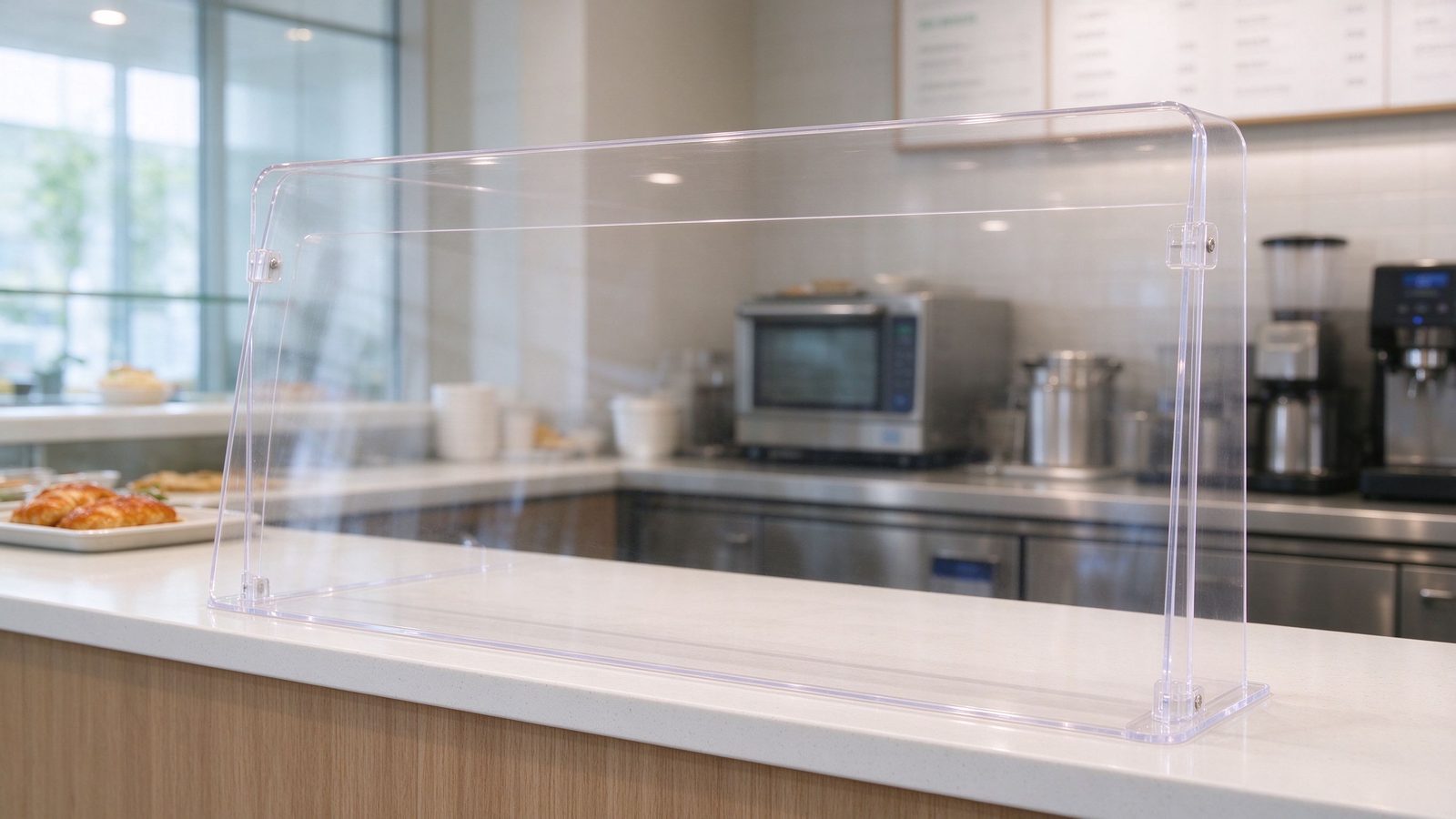
The bracket detail that decides whether panels survive
Acrylic expands about 0.07 mm per metre per degree Celsius. A 1.5 m panel that swings 20 degrees between a winter delivery bay and a heated office grows by roughly 2 mm. If the bracket clamps both ends rigidly, that movement has nowhere to go and becomes stress at the hole.
The professional detail is simple: fix one end, let the other end float in a slotted or oversize hole, and never tighten a clamp directly onto acrylic without a soft gasket. Use a rubber or EVA washer under the screw head and leave the screw snug rather than crushed.
- Hole clearance: 1.5 to 2 mm larger than the fixing diameter.
- Edge distance: at least 2.5 times the hole diameter from the panel edge.
- Support: a floor channel with 3 mm neoprene lining, not a metal channel in direct contact.
- Height: 1.2 m panels need a mid-rail or a top cap to stop torsional flex.
Acoustics: what a screen can and cannot do
A 6 mm acrylic screen blocks direct sound between two people but does nothing for the room reverberation that makes an open office tiring. Treat the screen as a speech-privacy device and specify absorptive material elsewhere if the acoustic target is real.
Where privacy matters more than sound, a frosted panel at 1.5 m height with a 100 mm gap at the desk surface reduces the line of sight without sealing the workspace. Sealing a screen to the desk edge increases both cost and condensation risk.
Cleaning agents that ruin acrylic in one pass
Ammonia-based glass cleaner, alcohol at high concentration and abrasive pads will craze or haze cast acrylic. The safe routine is warm water with a drop of neutral detergent, a microfibre cloth, and a clean water rinse.
Put that instruction into the facilities cleaning schedule, not just the installation handover. In most buildings the damage happens six months after handover, when a new contractor takes over the floor.
Our maintenance note on acrylic and PC sheet cleaning and maintenance can be handed straight to the cleaning contractor.
Planning a refit without downtime
For a 40-desk floor, the workable sequence is measure, pre-cut, pre-drill, then install floor by floor rather than desk by desk. Panels cut to a 2 mm tolerance on width and drilled from a template install in minutes each, and the office keeps working around the team that is moving.
River People cuts and edge-polishes office screens to size, drills bracket patterns from your template, and packs by floor so a fit-out crew receives a sequence rather than a pallet.
Send the desk layout, panel heights and bracket drawing to oversales@rpplexiglass.com and we will quote cut-to-size acrylic partition screen office panels with the hole pattern already drilled.
Frequently Asked Questions
What thickness should an acrylic office partition screen be?
Use 6 mm for desk-mounted dividers, 8 mm for floor-standing panels up to 1.5 m, and 10 mm for spans beyond 1.5 m or where the panel is exposed to knocks in a corridor.
Why did my acrylic screens crack at the fixing holes?
Almost always because the panel was clamped rigidly at both ends with no allowance for thermal movement, or the hole was drilled too close to the edge. Slot one end, keep 2.5 hole diameters from the edge and use a soft washer.
Can acrylic partitions be cleaned with glass cleaner?
No. Ammonia and alcohol based cleaners craze cast acrylic. Use neutral detergent with warm water and a microfibre cloth, then rinse with clean water and dry with a soft cloth.