
Walk into any modern oceanarium and you will eventually stop under a dome, looking up at rays gliding overhead. That view is possible because an acrylic underwater dome spreads water pressure through a curved shell rather than fighting it on a flat face. The curvature is not a styling choice; it is what lets the panel stay thinner than a flat window for the same depth.
Why the radius carries the load
A spherical acrylic underwater dome puts the PMMA mostly in membrane tension, so the shell resists hydrostatic load efficiently. That is why a dome over a 3 m pool can be cast thinner than a flat window across the same opening. The trade-off is in the making: the radius must be held true across the whole shell, the optical clarity must survive the forming, and the edge where the dome meets its support ring must be machined and sealed properly.
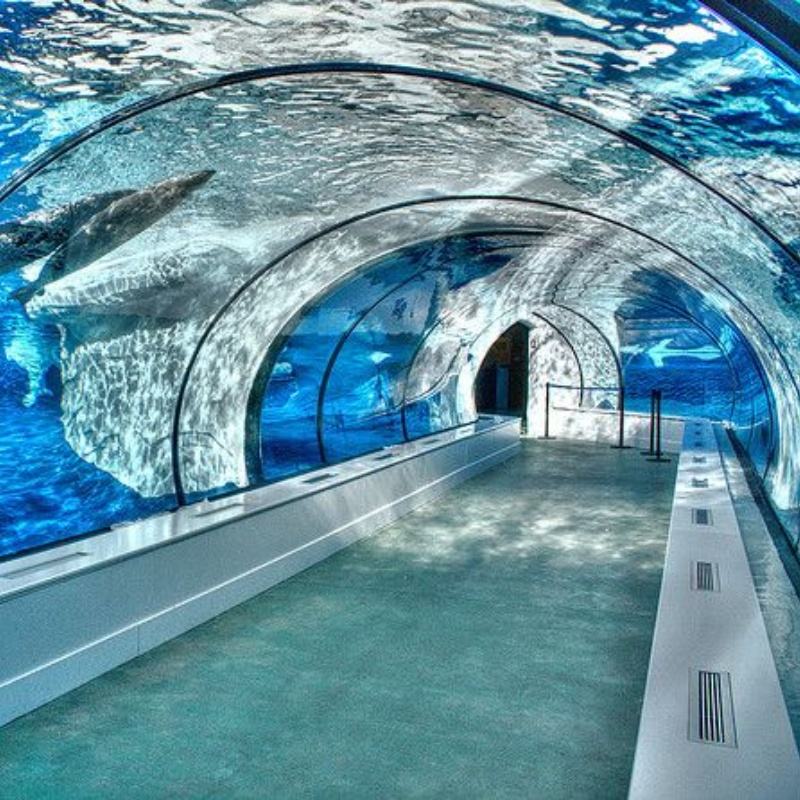
Forming and finish
RP River People forms the acrylic underwater dome from cast material to a controlled radius, then anneals or stress-relieves the shell so the formed panel does not hold locked-in stress that could craze under load. The optical grade is preserved, and the mating ring face is machined so the seal carries evenly. For larger shells, segments are bonded together to the same standard as straight tunnel walls.
Curved and straight sections share the same bonding discipline; see acrylic underwater tunnel sections for how segments are cast, joined and installed on long water-holding runs.
Frequently Asked Questions
Q: Is a dome stronger than a flat window?
A: For the same depth a curved shell carries water load in membrane tension, so it can be thinner than a flat window across the same opening.
Q: How is the dome sealed at the support ring?
A: The mating face is machined and the shell is bedded on a continuous gasket clamped evenly by the ring.
Q: Can large domes be made in one piece?
A: Very large shells are formed and bonded from segments to the same optical and structural standard.
For a project-specific quotation on cast acrylic panels, email oversales@rpplexiglass.com with your opening size, water depth, support layout and drawing.