
An underwater acrylic tunnel is the most demanding product a sheet manufacturer can take on: sections metres long, cast in thick PMMA, bonded edge to edge, and holding tonnes of water while visitors walk through. When an oceanarium shortlists an underwater acrylic tunnel manufacturer, the audit goes far beyond the sales sheet.
What a tunnel manufacturer must be able to prove
- Casting depth – tunnel walls run from 75 mm to 150 mm thick and up; the plant must cast, not buy stock sheet.
- Bonding – sections are joined with solvent and polymerised seams; the bond line must be near-invisible and rated for water load.
- Machining – mating faces, flanges and assembly registers must be held to tight tolerance.
- Project record – ask which tunnels, dome or large tanks the factory has delivered, and for the engineering basis behind each thickness.
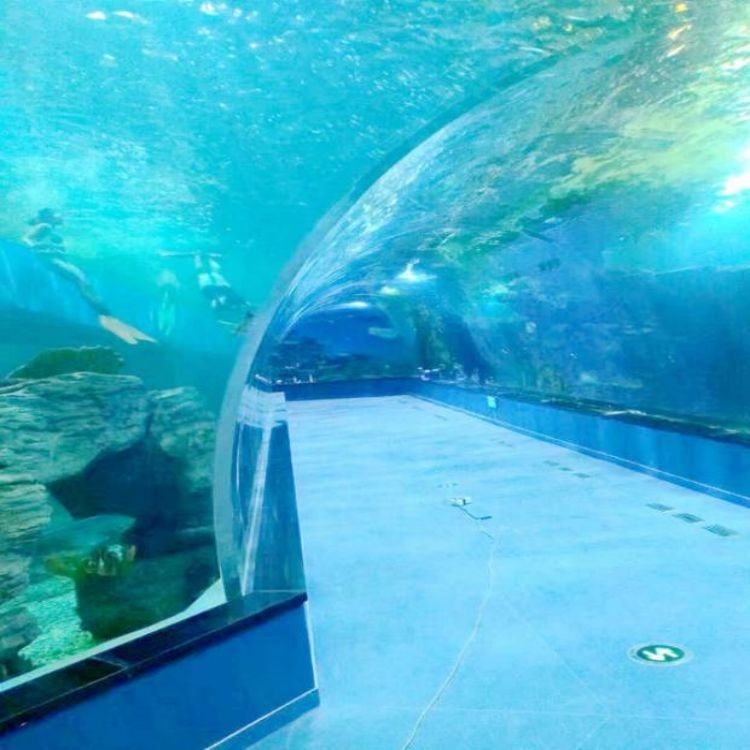
How RP River People works as a tunnel manufacturer
RP River People casts acrylic tunnel sections to the engineered wall thickness, machines the mating faces square, and performs the edge bonding under controlled temperature and humidity so the seam cures into the panel. Every section is checked for optical clarity and dimensional truth before dispatch. The client receives a joining and assembly drawing, not just panels.
The same casting and bonding logic underpins curved runs; our article on acrylic underwater tunnel sections details the casting, joining and installation sequence.
Frequently Asked Questions
Q: What thickness are tunnel walls?
A> Tunnel walls are engineered from the water depth and section span, commonly 75 mm to 150 mm for public oceanarium tunnels.
Q: How are sections joined?
A: Mating faces are machined square and bonded with solvent polymerisation under controlled conditions, so the seam cures into the panel.
Q: Can a manufacturer cast curved and straight sections?
A: Yes; casting allows straight, curved and dome sections to the same material standard.
For a project-specific quotation on cast acrylic panels, email oversales@rpplexiglass.com with your opening size, water depth, support layout and drawing.