
A stationery studio in Melbourne shipped 240 acrylic wedding invitation box units for a spring season and had 31 arrive with cloudy corners. Nothing was broken. The boxes had been bonded with a fast-setting two-part cement, packed four days later, and the solvent was still migrating when the courier dropped them.
The correction was not a thicker sheet. It was 3 mm cast acrylic, a slower cement, a full 72 hour cure before packing, and a lid that overlaps the body by 8 mm instead of sitting on top of it.
Dimensions that make an acrylic wedding invitation box look right
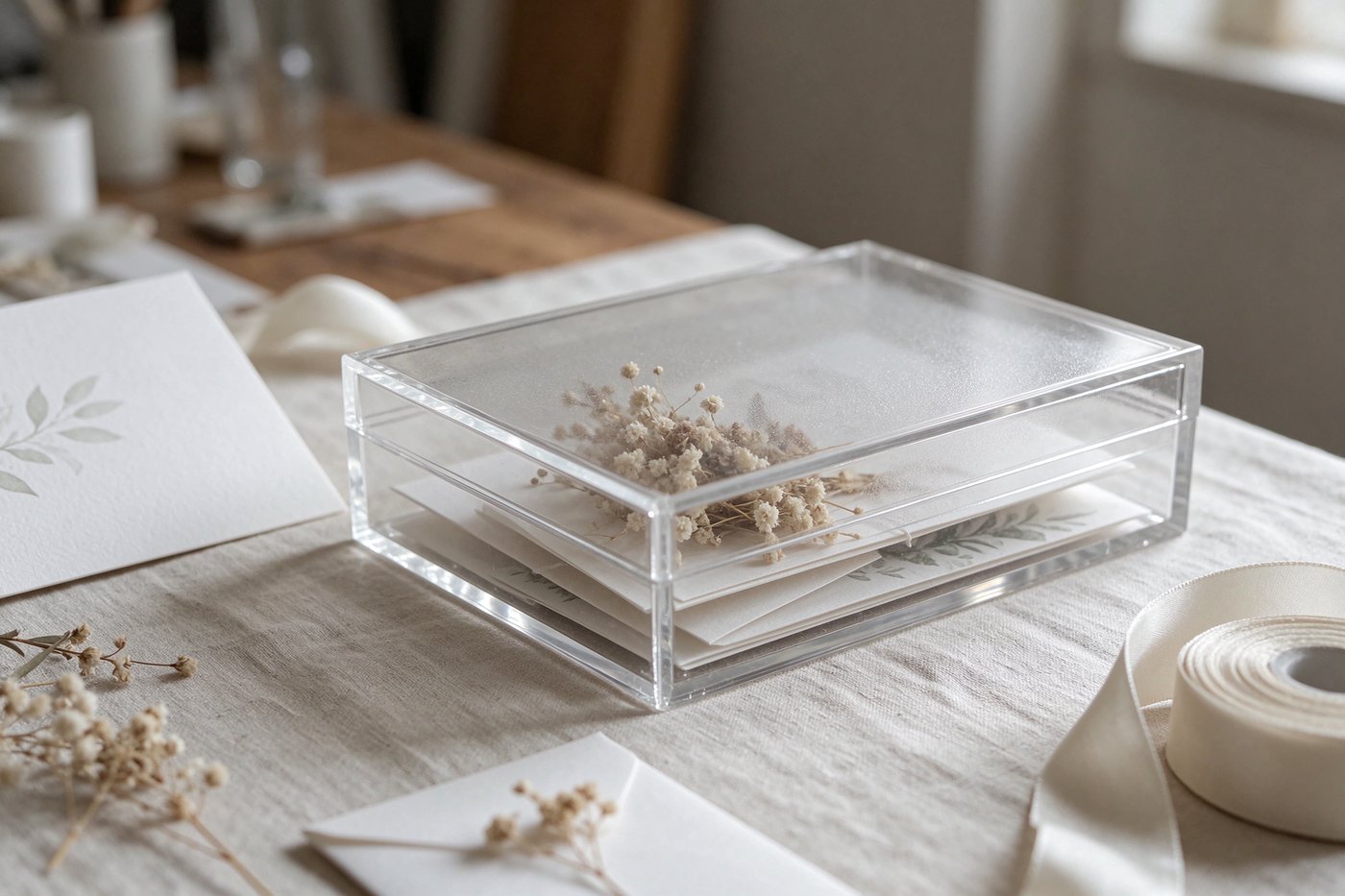
Invitation suites run 130 x 180 mm to 160 x 220 mm once the envelope, RSVP card and belly band are stacked. A box built at 170 x 230 x 35 mm internal gives 5 mm clearance on each side, which is enough for a ribbon without pressing the print against the wall.
- Body: 3 mm cast acrylic, solvent bonded, inside dimensions held to plus or minus 0.5 mm.
- Lid: 3 mm clear body with a 2 mm frost cap for a two-tone look, overlapping the body by 8 mm.
- Base: 5 mm cast plate so the box sits flat on linen without flexing under a 700 g suite.
- Edge: flame-polished on all visible faces, with the bond line kept on the back edge.
The joint line is the whole product
Buyers judge this object at 300 mm distance, so a 0.3 mm solvent line reads as a defect. The bond needs a 3 mm capillary gap, cement applied with a needle, and clamping on a flat plate so the two faces stay coplanar while the joint sets. A jig that holds four boxes at once halves the labour and keeps the squareness repeatable.
Cleaning matters as much as bonding. Alcohol wipes on a fresh joint pull solvent out of the seam and leave a white edge. A pH-neutral cleaner after 72 hours is safe; before that, dry the box with a microfiber cloth only.
Packing for courier transit
A 3 mm box with a 5 mm base survives a 1 m drop if the corners are protected. Foam corner cradles plus a snug outer carton keep the lid from racking sideways, which is the failure mode that cracks the bond at the short edge.
River People production notes
River People flame-polishes before bonding, not after, so no heat reaches a cured joint, and cures boxes for 72 hours in a dust-controlled area before packing. Runs of 100 to 1,000 units are routine, with a frost or colour cap bonded to the lid in the same batch for colour consistency.
Share your suite dimensions and finish preference at oversales@rpplexiglass.com for a box drawing and unit price.
Presentation boxes often sit beside framed prints on the same table, and the acrylic photo frame guide uses the same 3 mm cast stock and polishing sequence.
Frequently Asked Questions
Can the box be engraved with the couple names?
Yes. Laser engraving on the lid reads well on clear or frost sheet, and it is done before bonding so the box stays flat. Engraving depth is 0.2 to 0.3 mm, enough to frost the surface without weakening the lid.
Is 3 mm strong enough for shipping?
For a 700 g suite in a corner-cradled carton, yes. Above 1.2 kg, or for boxes travelling without cradles, step up to 4 mm body and 6 mm base.
How is the frost finish achieved?
A 2 mm frost cast sheet is bonded to a clear 3 mm lid, or the surface is chemically etched. The bonded cap gives a sharper edge and a more even frost than etching.