
Annealing cast acrylic is the step that turns a machined part into a stable one. The email arrives three weeks after delivery: four machined acrylic brackets have developed a hairline from the screw hole, and two have split at the bend. Nothing was dropped. Nothing was overloaded. The parts were simply cut, drilled and shipped, and the stress left behind by machining did the rest.
Annealing cast acrylic is the step that removes that risk, and it is also the step most often cut from a quote because it costs oven time and adds no visible feature.
Where the stress in cast acrylic actually comes from
- Casting: polymerisation shrinkage, mostly relieved at the factory
- Machining: cutting and drilling leave a stressed skin at the tool path
- Bonding: solvent joints shrink as they cure and pull on the surrounding sheet
- Thermoforming: stretching thins the wall and locks orientation in place
A cast sheet arrives with modest residual stress. A machined part does not. Routing a profile, drilling a hole or cutting a slot redistributes the internal balance, and the material relieves it slowly. In a workshop at 20 C that takes weeks; in a warm facade at 60 C it takes days.
A fabricator in Barcelona machining 15 mm cast acrylic instrument housings had a 6 percent field failure rate on units that were never annealed, all at the machined edges. Adding an annealing cycle before final polishing took the rate under 1 percent, with no change to the design.
Annealing cast acrylic: the practical schedule
The chamber goes to 80 C, holds, then cools slowly. The hold time scales with thickness because the centre of the sheet must reach temperature, not just the surface.
- 5 mm: 45 minutes hold, 3 C per hour cool
- 10 mm: 1.5 hours hold, 4 C per hour cool
- 20 mm: 3 hours hold, 5 C per hour cool
- 40 mm: 6 hours hold, 5 C per hour cool, supported on a flat bed
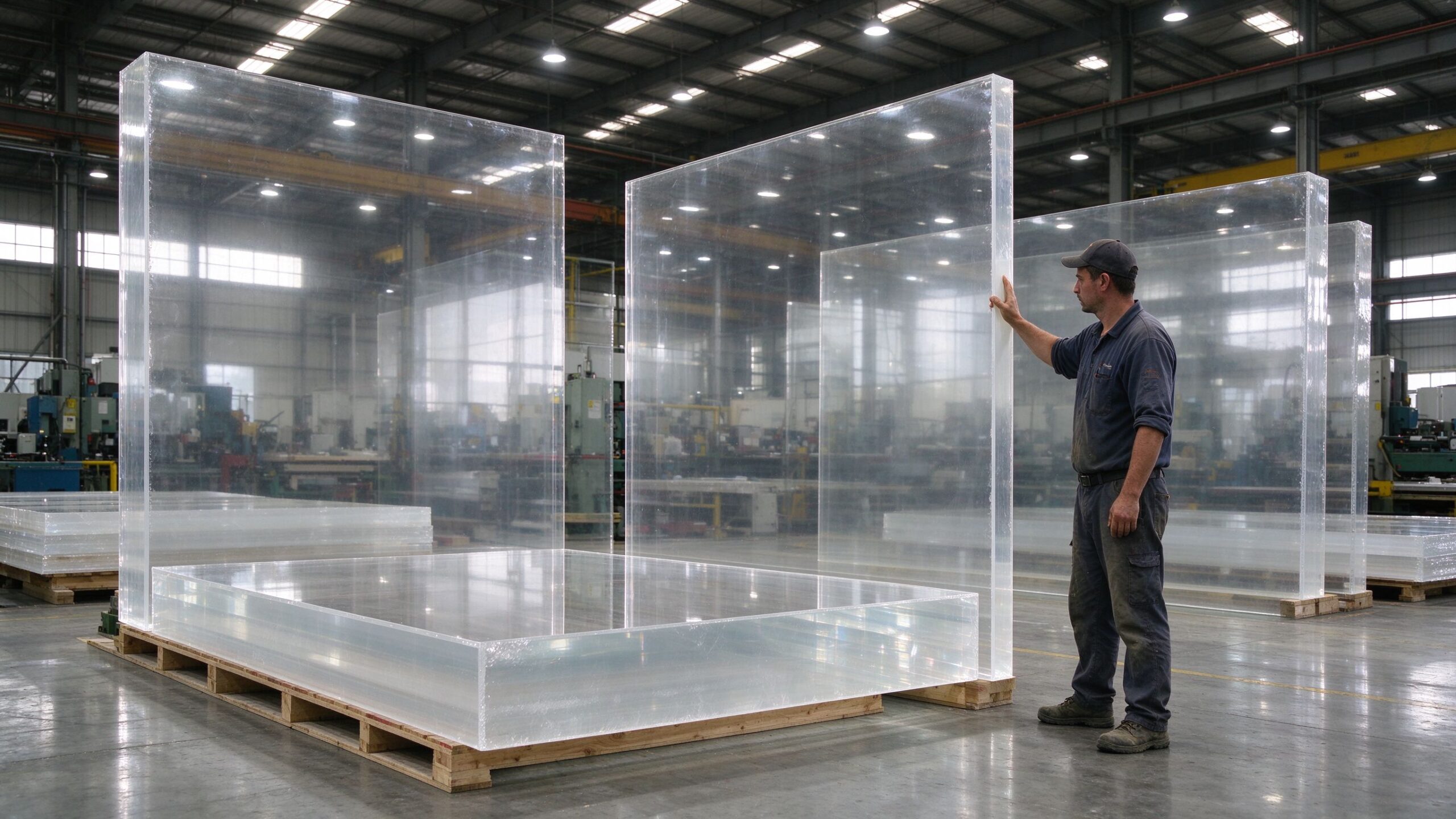
Two details decide whether the cycle works. First, support: a panel must lie flat on a bed that does not restrain movement, or it will bow as it relaxes. Second, ramp: entering the oven at full heat shocks the surface and can craze a bonded joint. Ramp at 10 C per hour going in, slower coming out.
When annealing will not help
Annealing is not a repair. A part with a visible crack or a white crazed zone has already failed and will fail again. Nor does it replace good design: a 3 mm panel spanning 800 mm will still bow, and a screw hole with no clearance will still crack from thermal movement, annealed or not.
It is also wasted on thin sheet under 3 mm that will be used flat and unstressed, and on parts that will be thermoformed afterwards, because forming resets the stress pattern.
If your routing includes bending, the sequence matters: machine, anneal, form, anneal again if the part carries load. The CNC acrylic machining guide sets out the tool and clamp choices that reduce stress at source, and the warping and stress cracking guide covers the site conditions that finish a stressed part off.
A simple incoming check: view a machined edge between crossed polarisers. A stressed part shows a bright rainbow fringe; an annealed part shows an even, faint tint. It takes ten seconds and catches the batch before it ships.
Ask us about annealing before machining at oversales@rpplexiglass.com and we will quote the schedule with the part drawing.
Frequently Asked Questions
What temperature do you anneal cast acrylic at?
Around 80 C, well below the softening point. Hold for one hour per 6 mm of thickness, then cool at no more than 5 C per hour. Above 90 C the sheet starts to sag under its own weight in the oven.
Does annealing stop acrylic from cracking?
It removes most residual stress from machining, bonding and thermoforming, which is the main cause of delayed crazing and crack growth. It does not make acrylic tougher against impact, and it cannot repair a crack that has already formed.
Can I anneal acrylic in a normal oven?
Only with forced-air circulation, accurate control and a flat support. A domestic oven cycles 15 C around set point, which is enough to warp a 20 mm panel. Industrial annealing uses a programmable chamber and a slow ramp.