
Most buyers specify glow in the dark acrylic signage by colour, when the luminance figure is what the project actually needs. A hospital in the Netherlands replaced stairwell exit signs with glow-in-the-dark acrylic panels. Two months later the fire officer asked for the luminance test report. Nobody had one. The panels glowed convincingly at midnight and could not prove a single performance figure.
Photoluminescent signage is a safety product before it is a design product. The glow is easy; the evidence is what takes engineering.
What glow in the dark acrylic signage must prove
A photoluminescent pigment absorbs light during the charging period and releases it slowly. Strontium aluminate pigments hold luminance far longer than older zinc sulphide types, which is why a modern panel is still visible hours after the lights go out.
The acrylic carrier matters as much as the pigment. Cast PMMA with a fine dispersion glows evenly; a cheap sheet with uneven pigment shows streaks and bright spots that read as damage in a dark corridor.
The figures a specifier should ask for
- Luminance after 60 minutes of decay, measured in millicandelas per square metre.
- Charge time to reach the rated luminance under a stated illuminance, typically 25 to 50 lux for 15 to 60 minutes.
- Pigment type: strontium aluminate for long afterglow, zinc sulphide only for short-duration novelty use.
- Panel thickness: 3 to 5 mm for flat signage, 8 mm where the panel is also a physical guard.
- Standard reference: the local egress marking code, quoted explicitly on the order.
A supplier who quotes glow time in hours without giving luminance at a stated time is quoting an impression, not a performance.
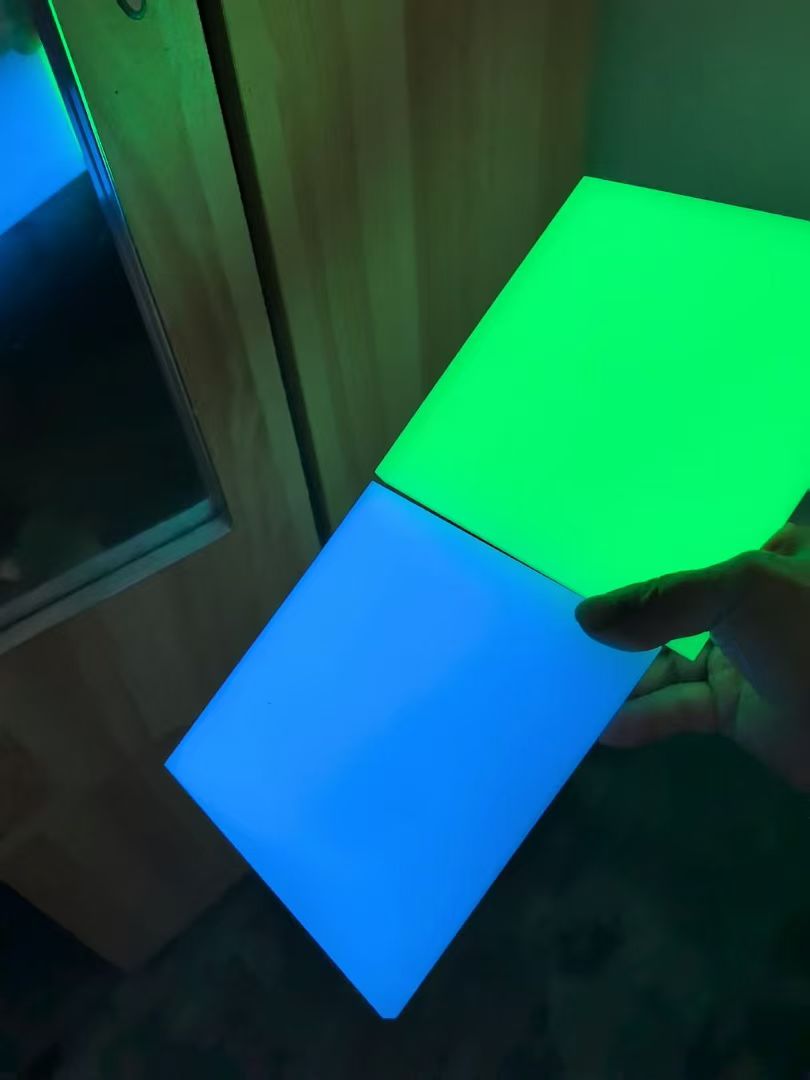
Charging conditions decide whether the sign works
A photoluminescent panel is only as good as the light it receives. In a stairwell lit by a single 20 lux emergency fitting, a panel rated at 50 lux charging will never reach its stated luminance.
Design the charging source with the sign, not after it. Keep the panel within the lit zone, avoid shadow from a handrail, and confirm the maintained illuminance at the panel face at night, which is the condition that matters.
Cutting, mounting and the edge that glows differently
Photoluminescent acrylic cuts and machines like standard cast sheet, but the cut edge exposes unpigmented material and reads as a dark line in the dark. For visible edges, specify polished edges or a border mask.
Fix panels with a mechanical clip or a neutral adhesive and keep the face free of dust. A layer of dust or a cleaning film residue cuts luminance measurably, and it accumulates on horizontal surfaces in a corridor.
Where the signage scheme also includes illuminated or wayfinding elements in daylight, our notes on acrylic wayfinding signage cover the daytime version of the same panel schedule.
Where glow signage earns its cost
The strongest applications are the ones where power is unavailable or unreliable: stairwells, basement car parks, ships, remote industrial sites and evacuation routes in buildings with long egress paths.
The weakest applications are decorative. A glowing logo in a bar looks striking for a week and then reads as dim clutter once the pigment charge falls off, because the ambient light never charges it properly.
River People casts photoluminescent acrylic in 3 to 8 mm with strontium aluminate pigment, cuts to sign size and can supply luminance test data per batch.
Send the sign schedule, the charging illuminance and the egress standard to oversales@rpplexiglass.com and we will quote glow in the dark acrylic signage with luminance figures stated per panel.
Frequently Asked Questions
How long does glow-in-the-dark acrylic stay visible?
Strontium aluminate panels remain visible for six to ten hours at low but readable luminance. The usable figure is luminance at 60 minutes, not total glow time, so ask for that measurement.
Does the panel need light to charge?
Yes. Most panels need 25 to 50 lux for 15 to 60 minutes. A sign placed outside the lit zone, or shadowed by a handrail, will not reach its rated luminance.
Can glow acrylic be used outdoors?
It can, but ambient street lighting may be too weak to charge it fully and UV exposure ages the carrier. Outdoor use should be confirmed with the pigment supplier and a UV-stabilised grade.