
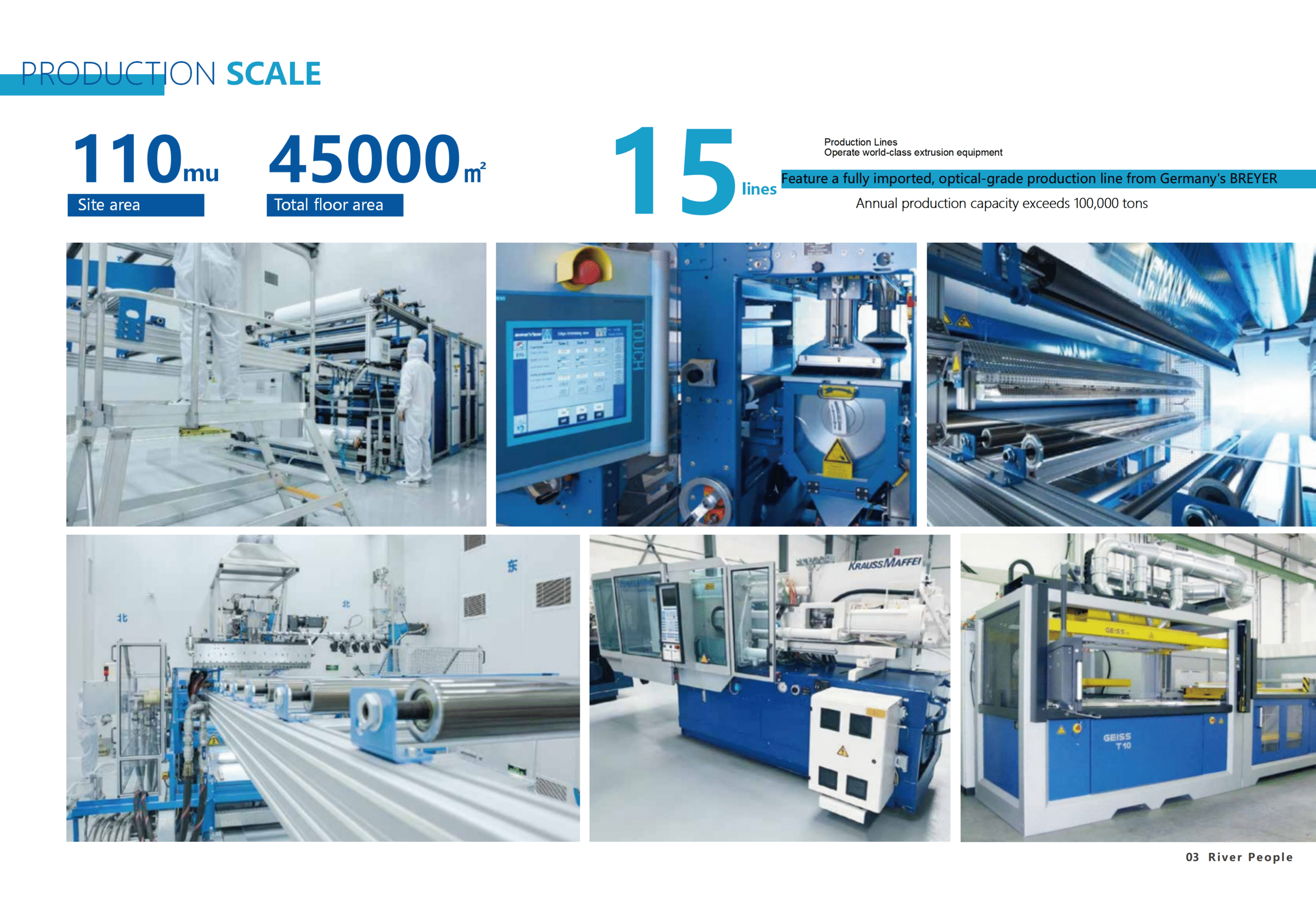
Five questions separate a polycarbonate sheet manufacturer from a relabelled trader, and all five can be answered in a short call. Nine suppliers describe themselves as a polycarbonate sheet manufacturer. On a video call, three cannot show an extrusion line, four cannot explain how the UV layer is applied, and two admit they buy from another plant and relabel.
The word manufacturer is unregulated in this trade. What separates a real plant from a trader is a short list of things it can demonstrate in fifteen minutes.
Capability questions for a polycarbonate sheet manufacturer
A polycarbonate manufacturer owns an extrusion line and knows its width, its thickness range and its realistic output per shift. Ask for the maximum sheet width and the thickness band. A supplier who quotes any width and any thickness has not looked at the line recently.
Wide-format capability matters for façade and roofing work, where joint count drives both appearance and leakage risk. A 2100 mm width against a 1220 mm width halves the joints on a typical elevation.
Capability two: how UV protection is applied
This is the single most important question, and the easiest to answer dishonestly. Co-extrusion fuses a UV-stabilised cap into the sheet during production. Film or coating is applied afterwards and can fail.
A real manufacturer can describe the co-extrusion die, the cap thickness in micrometres and the weathering data behind the grade. A trader repeats the phrase UV protected and stops there.
- Ask which side carries the UV cap and how it is marked for installation.
- Ask for the weathering statement and the test method behind it.
- Ask whether the cap survives machining, because a routed edge exposes the core.
Capability three: thickness control on the line
Thickness is measured continuously on a good line, and the data exists per roll or per sheet. Ask for the tolerance band and see whether it is written on the quotation, not just spoken on the call.
A manufacturer working to plus or minus 0.2 mm at 6 mm will say so. A trader will say standard thickness and leave the interpretation to the buyer, which is how 5.6 mm sheet arrives against a 6 mm order.
Capability four: cutting and finishing in house
Cut-to-size capability changes what a buyer has to organise. A plant that routes, saws, drills and edge-finishes sends panels that go straight to installation; a trader sends sheets and a list of local shops.
For machine guards and safety windows, in-house cutting also means the edge quality question is answered before shipping, which is where micro-cracks usually start. Our note on hard coated polycarbonate for machine guards covers the finish requirements.
Capability five: batch traceability
Ask for the batch number on the sheet, on the packing list and on the declaration. A manufacturer can tie all three together; a trader usually cannot, because the sheet changed hands twice before it reached the pallet.
Traceability is what makes a warranty claim possible. Without a batch number, a yellowing complaint two years later has no evidence trail.
The answers that reveal a trader
Vague answers about the line, no weathering data, tolerance described as standard, no photographs of the load, and a price well below the market with no grade named. Any two of those together are enough to look elsewhere.
River People extrudes polycarbonate sheet, applies UV protection by co-extrusion, cuts in house and prints the batch on the sheet, the packing list and the declaration.
Send the specification and the annual volume to oversales@rpplexiglass.com and we will answer the five capability questions in writing, including the line width and the UV method, before you compare price.
Frequently Asked Questions
How can I tell a real polycarbonate sheet manufacturer from a trader?
Ask for the line width, the UV application method, the thickness tolerance and a load photograph. A manufacturer answers all four specifically; a trader usually answers none of them with data.
Does UV co-extrusion really matter?
Yes for anything outdoors. A co-extruded cap is part of the sheet and cannot peel, while film or coating protection can be removed by cleaning and often fails within two to three years on a sunny elevation.
Can a manufacturer supply cut-to-size PC panels?
A plant with in-house routing and sawing can, and should state the edge finish and tolerance on the quotation. Traders normally supply full sheets only.