
A commuter rail operator replaced a concrete wall beside a housing estate with a transparent railway noise barrier. The concrete wall blocked the noise but also blocked the sun and the view, and residents had complained for years about the dark corridor. The transparent panel that replaced it had to hold sound reduction, survive the wind from passing trains, and stay clear in a corridor that sees salt and exhaust every day.
What the rail corridor taught us about transparent noise barrier panels
The numbers for a transparent railway noise barrier are dictated by train speed and pass-by distance. A high-speed pass by an open window creates a sharp pressure pulse, not a steady load. That pulse means the panel needs thickness and edge restraint to stop it drumming or tearing at the fixing line. We set the panel thickness from the maximum dynamic pass-by pressure, and dressed every edge and hole to keep the stress low.
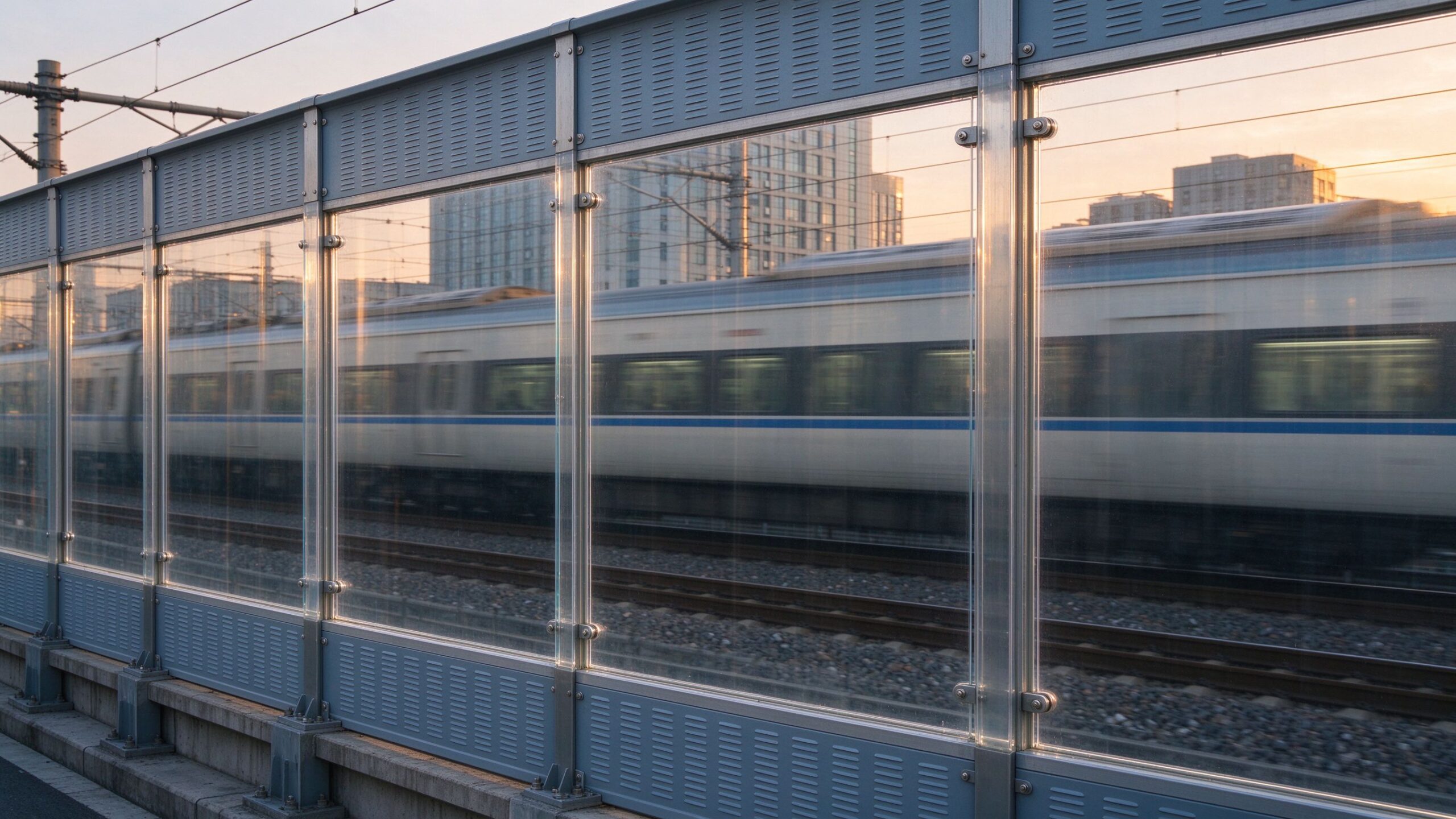
How the panels were installed on site
Each panel was delivered with protective film intact, sized to the frame’s rebate, and fixed through a continuous gasket so the dynamic load stayed on the panel edges. On site the crew bedded the panel, tightened the clamp and removed the film only after the frame was squared. The risk that surfaces again and again is a panel fixed hard against a rigid stop so every pressure pulse concentrates at the fixing; the professional method leaves a compliant edge register.
The same edge-restraint and test-report discipline applies to road walls; see our guide to transparent noise barrier panel test reports and to polycarbonate road sound barriers for the material comparison on corridors where impact risk is high.
Frequently Asked Questions
Q: Can a transparent railway noise barrier really cut train noise?
A: Yes, when the panel is correctly sized and the frame is sealed, a transparent acrylic or PC barrier measurably reduces rail noise while keeping sightlines for drivers and residents.
Q: Do rail barriers need to be stronger than road barriers?
A: Rail pass-by creates sharp pressure pulses from high-speed trains, so thickness and edge restraint are sized from the dynamic pass-by pressure rather than steady wind only.
For a project-specific quotation on transparent noise barrier panels, email oversales@rpplexiglass.com with your corridor width, required sound reduction, panel size and fixing detail.