
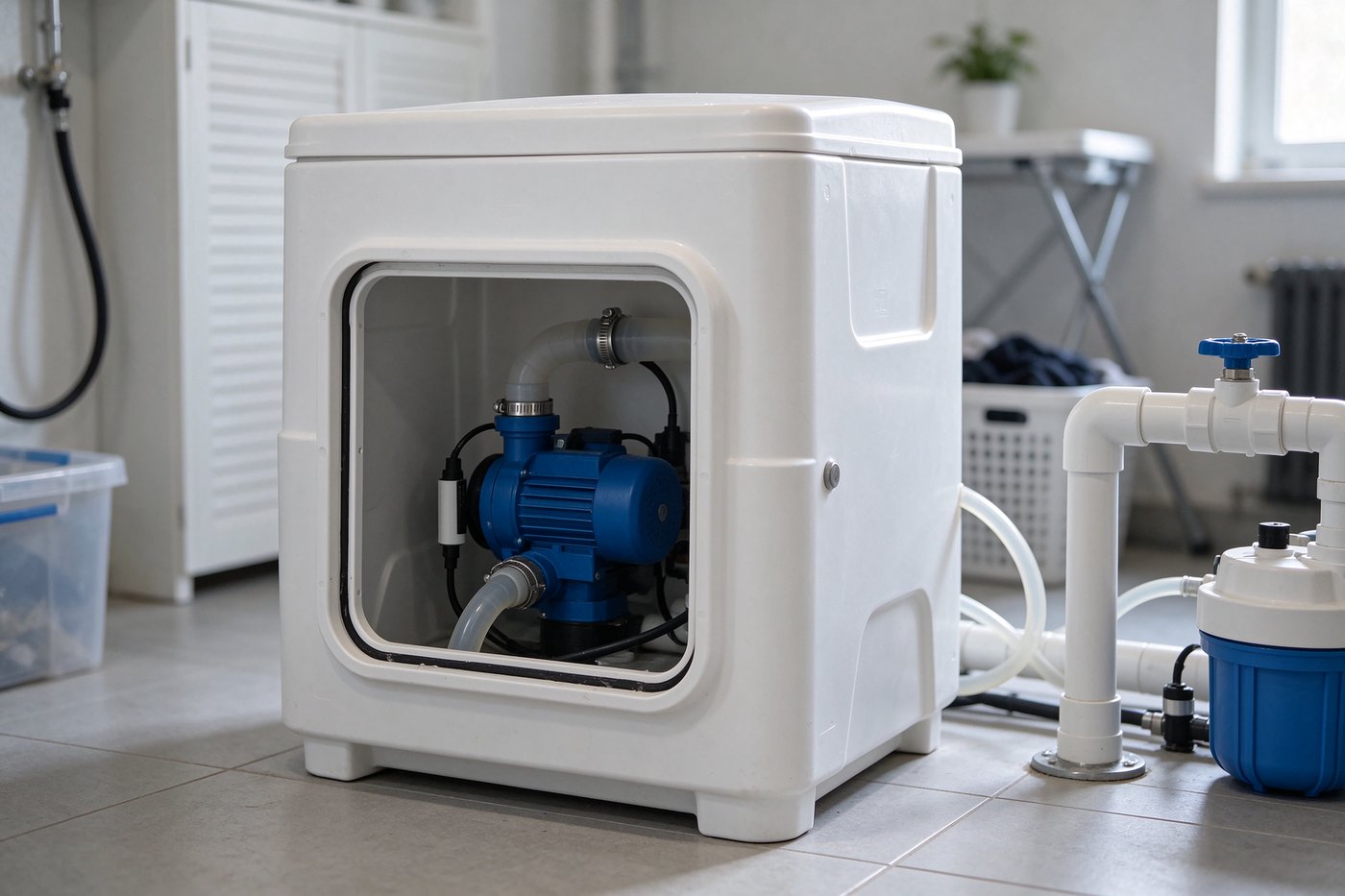
A circulation pump maker in Treviso moved from a steel housing to a thermoformed plastic shell and then spent six months chasing a noise complaint. The shell was 2 mm ABS, formed without ribs, and it amplified the motor hum instead of damping it. The abs pump housing that solved it was 3 mm, ribbed, and lined on the inside.
A housing is an acoustic part with a structural job, and the two requirements pull in opposite directions.
Build for an ABS pump housing
At 3 mm, ABS gives a wall stiff enough to hold a 2 kg motor on a bracket without visible flex, and thick enough to damp the 50 to 60 Hz hum that a thin shell transmits. Ribs on the inside face add stiffness without adding visible features.
- Gauge: 3 mm ABS for pump shells up to 300 mm; 2.5 mm for small circulators.
- Draft: 2 degrees on draw walls, 3 degrees on the deep cover section.
- Ribs: 4 mm deep, 2 mm thick, at 60 mm pitch on the inside of the cover.
- Acoustic lining: 3 mm closed-cell foam on 60 percent of the internal surface, clear of the motor airflow path.
Chemical duty and the limits of ABS
ABS handles glycol, most detergents and the water treatment chemicals found in a heating loop. It does not handle ketones, esters or concentrated aromatic solvents, and long contact with some brake fluids will soften the surface. For a pump that may see inhibited glycol at 70 C, the housing is fine; for one that may see a solvent-based cleaner, a different material is needed.
Temperature is the other limit. ABS holds shape to about 80 C and starts to soften beyond that. A pump housing next to a boiler flue needs a heat shield or a higher temperature material, not a thicker wall.
Flange flatness and sealing
The flange that meets the pump body carries a gasket, and a 0.5 mm wave in the flange leaks under 2 bar. Thermoformed flanges need a machined or trimmed land, and the tool needs a 1 mm flat step so the trim gives a true face. Checking flatness on a surface plate after 24 hours is the only reliable gate.
River People supply
River People supplies ABS sheet in 2.5 and 3 mm for housing tooling, dried and flat-packed, with gauge consistency across the pallet so the flange land forms to the same height on every part. Lots carry a certificate and a forming note on the recommended oven profile.
Send your pump outline and flange detail to oversales@rpplexiglass.com for a sheet and lining recommendation.
Housings for other equipment follow the same draft and rib rules as our ABS generator housing guide.
Frequently Asked Questions
Can the housing be used outdoors?
ABS has limited UV stability and will chalk outdoors. For an outdoor pump, a UV-stabilised grade plus a painted finish is needed, or the material changed to ASA.
Does the foam lining affect airflow?
It must not cover the motor ventilation path. Lining the cover and the lower walls leaves the airflow clear while still damping the shell.
Why vacuum form rather than injection mould?
Below about 20,000 units a year, vacuum forming on a trimmed tool is cheaper than an injection tool, and revisions to the shell are a tool change rather than a new mould.