
A pharmaceutical fill suite in Basel failed a classification audit because the differential pressure across one airlock dropped whenever the door was opened. The leak was not at the door. It was at the viewing panel, where a 5 mm polycarbonate sheet was bowing under 30 Pa and lifting off a dry gasket. The polycarbonate airlock window was respecified at 8 mm with a compressible seal, and the pressure held.
In a cleanroom the window is part of the envelope, and the envelope is what the classification depends on.
Pressure and deflection in a polycarbonate airlock window
A cascade airlock runs 10 to 30 Pa differential, sometimes 50 Pa between a Grade C and a Grade D zone. That pressure is small, but it acts on every square metre of panel all day. A 600 x 800 mm panel at 5 mm deflects about 9 mm at 50 Pa; at 8 mm the deflection is under 4 mm, which stays inside the gasket travel.
- Panel: 8 mm polycarbonate for openings to 900 x 1200 mm; 10 mm above that.
- Frame: flush, with a 20 mm engagement and a 6 mm compressible EPDM gasket.
- Seal: continuous gasket, no silicone bead, since a bead cannot be validated or replaced.
- Finish: smooth, cleanable face with rounded corners of 10 mm minimum for wipe-down.
Cleanability is a design property
A cleanroom panel is cleaned with alcohol and a validated wipe, sometimes several times a shift. A hard-coated polycarbonate face tolerates that routine; bare sheet hazes within months under IPA. Corners matter too: a sharp 90 degree internal corner cannot be wiped in one pass, so the panel and frame should present a 10 mm radius.
The gap between panel and frame is the hidden risk. A recess that traps dust behind the gasket will show up in a swab test, so the frame should be flush with the wall and the gasket should sit in a groove rather than on a ledge.
Validation and replacement
Airlock panels should be part of the change control list. A like-for-like replacement is straightforward, but any change of gauge or coating requires a pressure test and a documentation update, because the panel is part of the validated envelope.
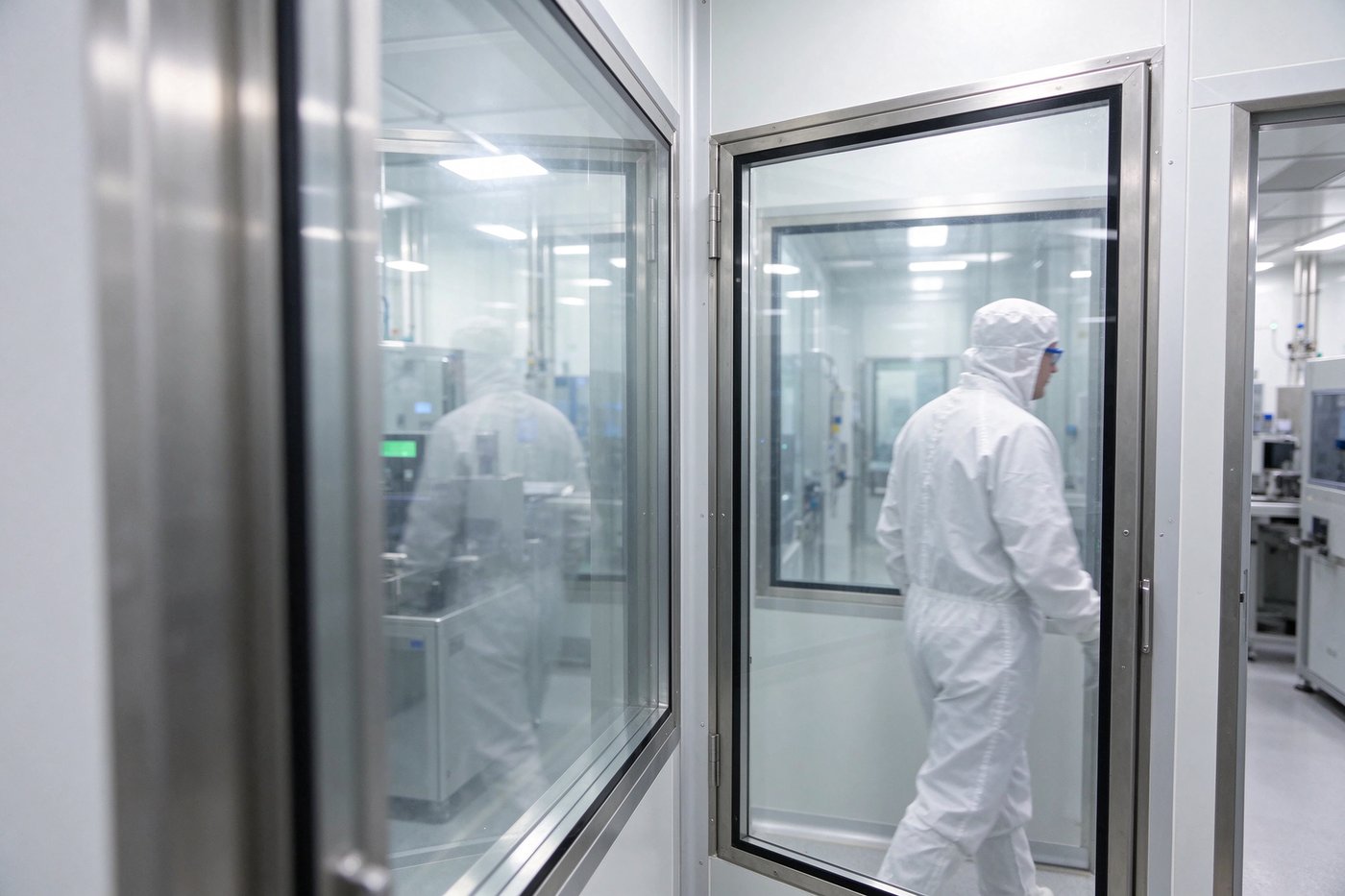
River People supply
River People cuts 8 and 10 mm polycarbonate to airlock drawings, seals edges, and supplies panels with a documented gauge and coat so the change control record can cite a lot number. Cleanroom orders of 20 to 200 panels ship in 15 to 18 days, masked and flat-packed.
Send your opening size and differential pressure to oversales@rpplexiglass.com for a panel and gasket specification.
Cleanroom envelopes rarely stop at one panel, and the partition detail is in our polycarbonate cleanroom partition guide.
Frequently Asked Questions
Is polycarbonate acceptable in a cleanroom?
Yes, hard-coated polycarbonate is widely used for viewing panels where impact resistance matters. The panel must be smooth, cleanable and sealed as part of the room envelope.
Can the panel be supplied with the frame?
A frame can be supplied as a matched set with the gasket groove cut to the panel outline, which keeps the engagement and the seal consistent across an airlock range.
What about static in a cleanroom?
Standard polycarbonate is an insulator and can accumulate charge. For ESD-sensitive areas, a dissipative grade is specified, which also reduces particle attraction on the panel face.