
A speaker brand came to us with a moulded abs speaker enclosure that looked right on the bench and buzzed at 400 Hz. The box was 2 mm wall with ribs at 120 mm pitch, and the wall between ribs was behaving like a drum membrane. The fix was not more material, it was a different rib layout and one damping pad.
Enclosure design for ABS is a set of trade offs between moulding, acoustics and appearance. These are the four that matter most.
Wall section and the abs speaker enclosure stiffness
- Wall: 2.5 mm for drivers up to 6 inch, 3 mm above
- Rib pitch: 60 mm on the rear wall, 80 mm on sides
- Draft: 1.5 degrees minimum on all vertical faces
- Damping: 3 mm bitumen pad behind the driver magnet
- Flame class: state HB or V0 on the drawing, do not leave it open
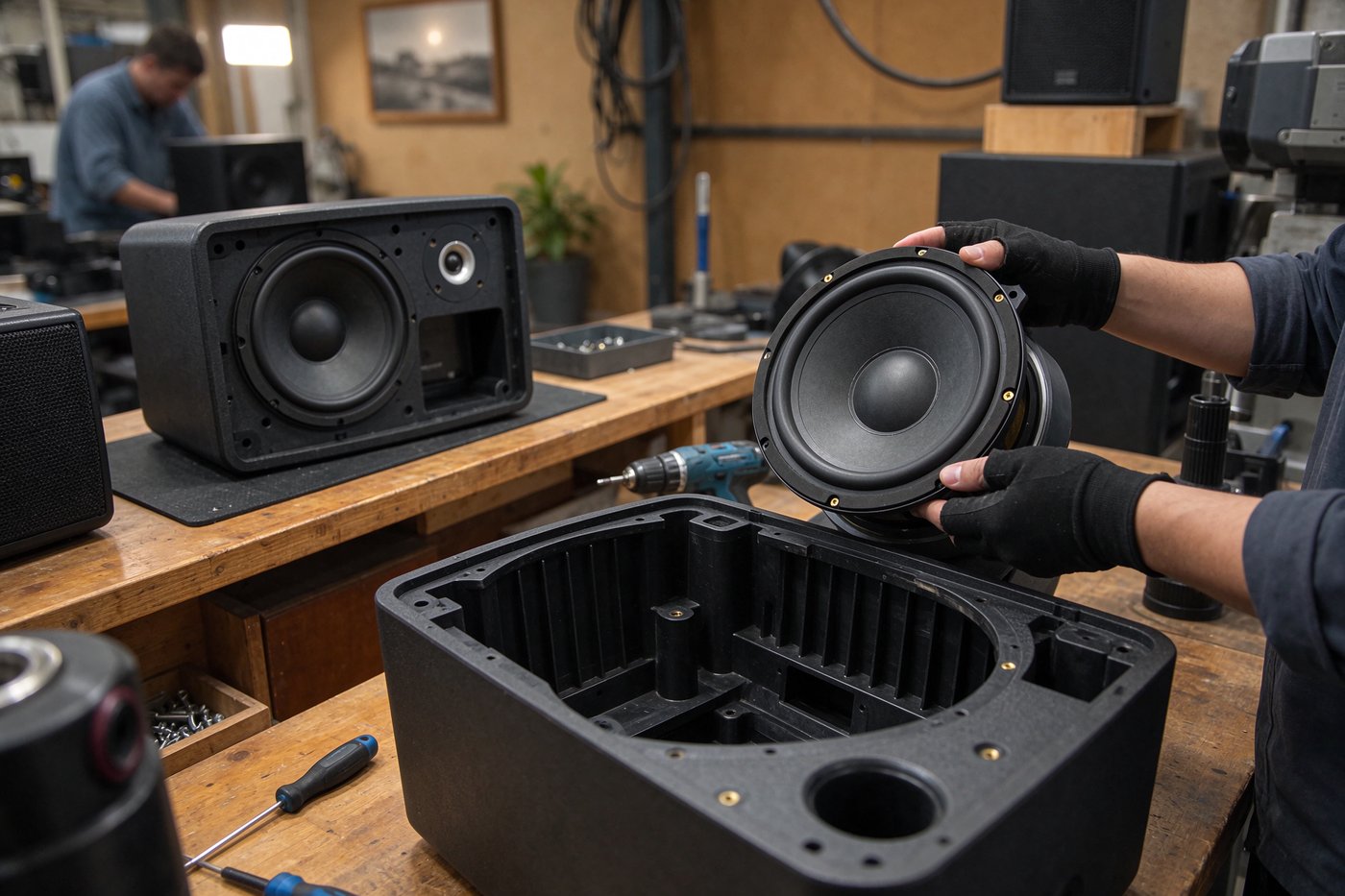
Stiffness scales with the cube of wall thickness, so going from 2 mm to 2.5 mm raises panel stiffness by nearly a factor of two. That is why 2.5 mm with a 60 mm rib pitch covers most domestic boxes and 3 mm is reserved for larger cabinets where the driver can excite a lower mode.
Cosmetics and the abs speaker enclosure surface
ABS moulds beautifully and shows every defect. Sink marks appear opposite internal ribs when the rib is thicker than half the nominal wall, so ribs are kept at 1.2 mm and the wall at 2.5 mm. A textured grain on the visible face hides the remaining sink and, usefully, also breaks up the visual read of a thin wall. High gloss finishes show scratches in transit, so a matte texture is the practical choice for anything shipped in a carton.
Assembly, service and the abs speaker enclosure in production
Screw bosses need 2.5 mm wall and a 0.5 mm radius at the base, or the boss cracks when a screw is driven by a torque controlled driver set at the top of its tolerance. Where a box is opened for service, a snap fit needs a 3 degree lead in and a 0.3 mm interference, and the snap should be on the internal part so a broken catch does not show.
We can advise on wall sections, rib layouts and grade selection, and supply sheet or moulded parts to your drawing. Send the driver specification and volume and we will respond with a section proposal.
Send the driver size, target SPL and annual volume to oversales@rpplexiglass.com for a material and wall section recommendation.
The same wall and rib logic applies to a moulded carry case, and the instrument case article shows how a portable shell is sized around its contents. ABS instrument cases covers that part of the specification.
Frequently Asked Questions
Does ABS sound worse than polypropylene?
At equal wall stiffness ABS is stiffer and rings slightly more, which reads as brightness. Ribbing and a damping pad behind the driver bring the two close, and the cosmetic advantage of ABS is usually worth it.
What wall thickness for a 6 inch driver?
2.5 mm with ribs at 60 mm pitch. Thinner walls need a denser rib pattern, which is harder to mould without sink marks on the visible face.
Which flame class is usual?
Consumer audio often requires a documented flame rating. Standard ABS is HB; a V0 grade is available and should be named on the drawing rather than assumed.