
A central sterile supply department asked for a petg sterilization tray because the stainless ones were damaging instrument tips during transport between the wash room and the packing bench. The request looked simple and it ran straight into a temperature question that decides the whole specification.
The answer depends on which route the tray takes, and there are three.
Route one: washer disinfector and the petg sterilization tray limit
- Sheet: 3 mm for transport trays, 4 mm for loaded presentation trays
- Continuous service: below 60 C, short excursions to 70 C
- Washer disinfector: 90 C cycles are possible for a limited count, not indefinite
- Steam autoclave: excluded at 121 C and 134 C
- Drainage: four 8 mm base holes plus one per corner
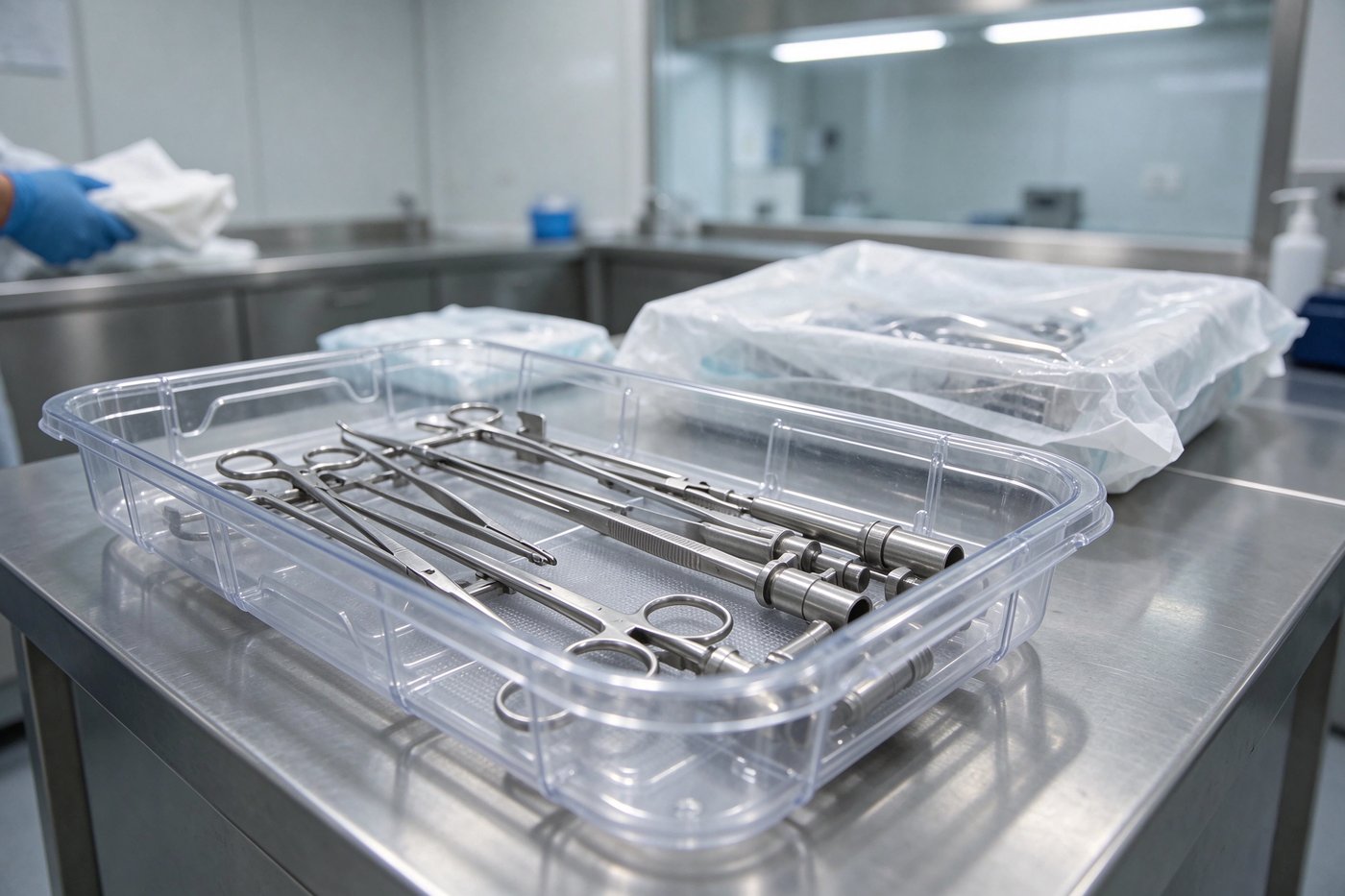
PETG softens in the seventies, and a washer disinfector that runs a 90 C thermal stage sits above that. Trays used this way distort gradually, first as a slight bow in the base, then as a loss of the stacking register. A department can accept that if the tray is treated as a consumable with a defined cycle count, and it cannot accept it if the tray is expected to last years.
Route two: cold chemical and the petg sterilization tray chemistry
Cold disinfection keeps a tray well inside its temperature range, and the constraint moves to chemistry. Glutaraldehyde and peracetic acid solutions are tolerated for contact times typical of instrument soaking, while strong solvents used in some manual cleaning steps will craze the surface. A tray used with a solvent wipe should have the solvent named in the specification, because a generic claim covers nothing.
Route three: transport, stacking and the petg sterilization tray design
The application where PETG is genuinely best is transport. A 4 mm tray with moulded ribs weighs a third of a stainless equivalent, stacks four high on a trolley without a register problem, and lets staff see the instrument set without lifting the lid. Clear PETG also makes a missing instrument visible at a glance, which is the failure that costs a department the most time.
We supply trays cut and formed to a set layout with drain holes and stacking shoulders, plus a material statement naming the temperature limits so a department can match the tray to its actual route.
Send tray dimensions, instrument load and disinfection route to oversales@rpplexiglass.com for a tray drawing and material statement.
Packaging trays and instrument trays are often ordered from the same specification, and the medical tray article covers sealing and sterile barrier requirements. PETG medical trays for sterile packaging covers that part of the specification.
Frequently Asked Questions
Can a PETG tray go in a steam autoclave?
No. PETG softens near 70 C and distorts at 121 C or 134 C, so a steam cycle removes the tray from service after one pass. Trays for steam must be polypropylene, stainless or a validated composite.
Which route suits PETG then?
Transport of cleaned instruments, cold chemical disinfection, and single use presentation trays. Those routes stay below 60 C and the material performs well.
Does the tray need drain holes?
Yes, at least four 8 mm holes in the base and one in each corner, so a washer disinfector cycle at 90 C drains rather than leaving the tray full of water.