
A sanitaryware moulder in Izmir returned a batch of 4,000 seats because the covers had warped 2 mm across the diagonal. The abs toilet seat mould was fine; the grade was a general-purpose injection ABS with a high shrinkage rate, and the cooling fixture had been removed too early. The replacement grade plus a two-minute fixture hold brought the batch inside 0.4 mm.
Grade selection for an abs toilet seat
Three properties drive the choice: impact strength at low temperature, surface gloss after moulding, and resistance to bathroom cleaners. A seat is sat on, slammed shut and wiped with aggressive chemicals, so a high-gloss general purpose grade is the wrong starting point.
- Grade: high-impact ABS with a notched Izod above 200 J/m at 23 degrees.
- Surface: medium gloss, because high gloss shows every scratch from cleaning.
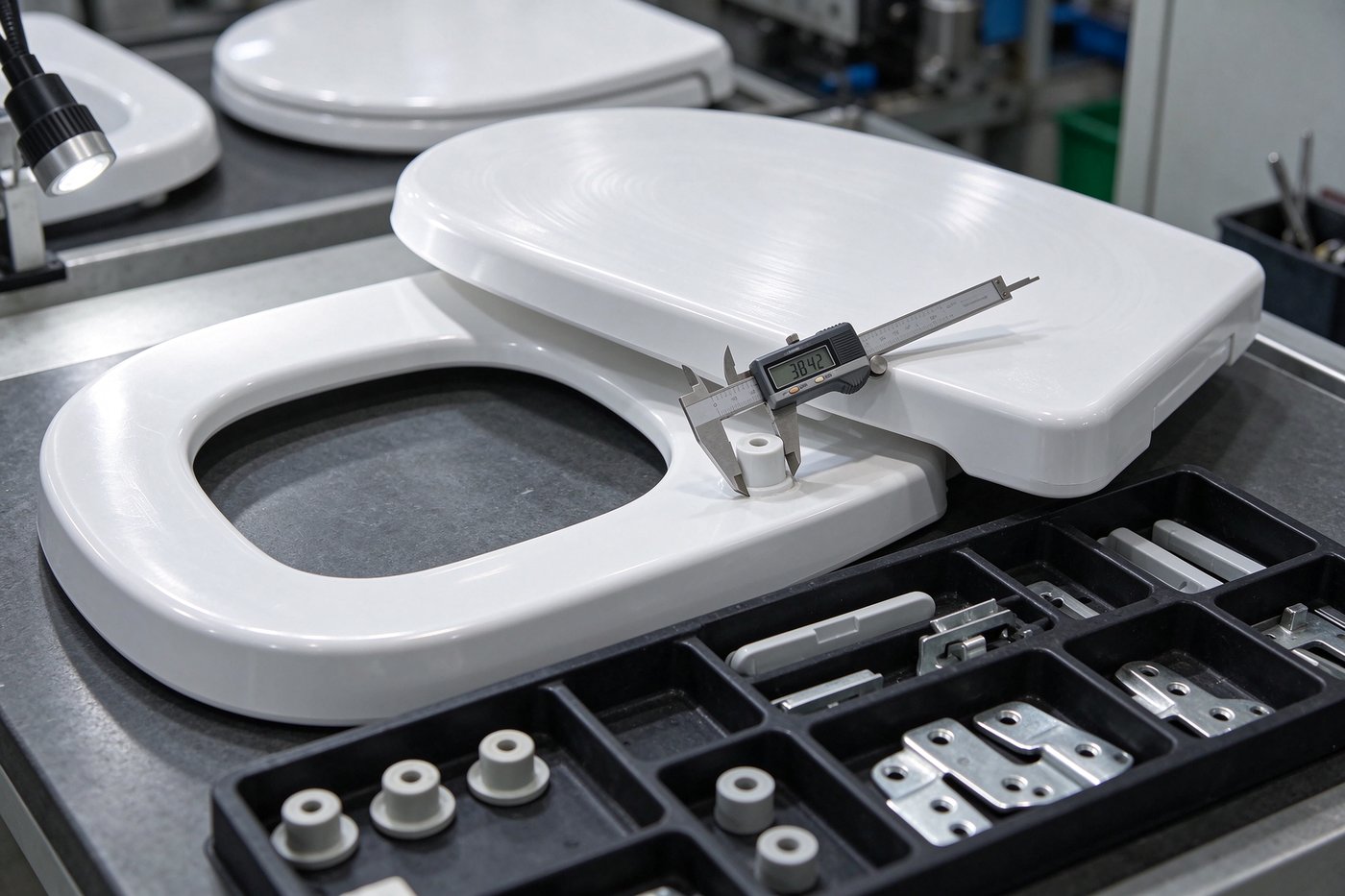
- Wall: 2.5 to 3.0 mm in the seat body, with ribs rather than thicker walls for stiffness.
- Hinge: metal insert moulded in, or a 3 mm boss with a threaded insert, never a self-tapping screw into 2.5 mm ABS.
Warpage and the cooling fixture
An ABS seat is a large flat part with uneven wall sections, so it will always want to bow. The moulder controls it by holding the part in a fixture through the first two minutes of cooling. Removing the fixture at 40 seconds, which is common on a fast cycle, leaves a 2 mm diagonal warp that shows as a rocking seat on a flat pan.
Gate position matters too. A single gate at one end fills the cavity with a long flow path and orients shrinkage along the length. Two gates balance the fill and cut warp without a fixture change.
Chemical cleaners and the warranty
Household cleaners containing strong solvents or high chlorine concentrations attack ABS and leave a chalky surface or fine cracks at the hinge. The realistic warranty position is to specify a cleaner compatibility list and test the three most common products in the market for 72 hours of contact.
River People material supply
River People supplies ABS sheet and moulded seat components with batch-level impact and shrinkage data, and can quote pre-coloured grades so a moulder avoids painting. Tooling review support is available for hinge boss and rib layout.
Send your seat drawing and cleaner list to oversales@rpplexiglass.com for a grade recommendation and sample lot.
Other sanitary and appliance mouldings share the grade logic, explained in the ABS appliance housing guide.
Frequently Asked Questions
Is ABS or PP better for a toilet seat?
PP is cheaper and more chemically inert but softer and lower gloss. ABS wins on surface appearance and rigidity, which is why most premium seats use it despite the chemical sensitivity.
Why do seats crack at the hinge?
Usually a self-tapping screw in a thin boss, or a moulded-in insert with insufficient wall around it. Both create a stress concentration that grows under repeated slamming.
Can the seat be recycled?
ABS seat bodies are mechanically recyclable where a sanitaryware stream exists, but metal inserts must be removed first. Design for disassembly helps.