
A pick and mix chain in Manchester tracked cleaning time across 40 stores and found that bins with square internal corners took 3 minutes 20 seconds to empty and wash, against 1 minute 40 seconds for rounded bins. Over a week that difference decided whether staff cleaned the bins at all. The acrylic candy dispenser bin was redesigned around the wash cycle rather than the display.
What follows is the specification that came out of that exercise, written from the cleaning station backwards.
Cleaning duty inside an acrylic candy dispenser bin
Sugar and gelatine set hard in a corner. An 8 mm inside radius lets a cloth pass in one stroke; a square corner needs a brush and still leaves residue. The scoop needs 40 mm of clear space above the candy line so a 60 ml scoop can dig without levering against the wall.
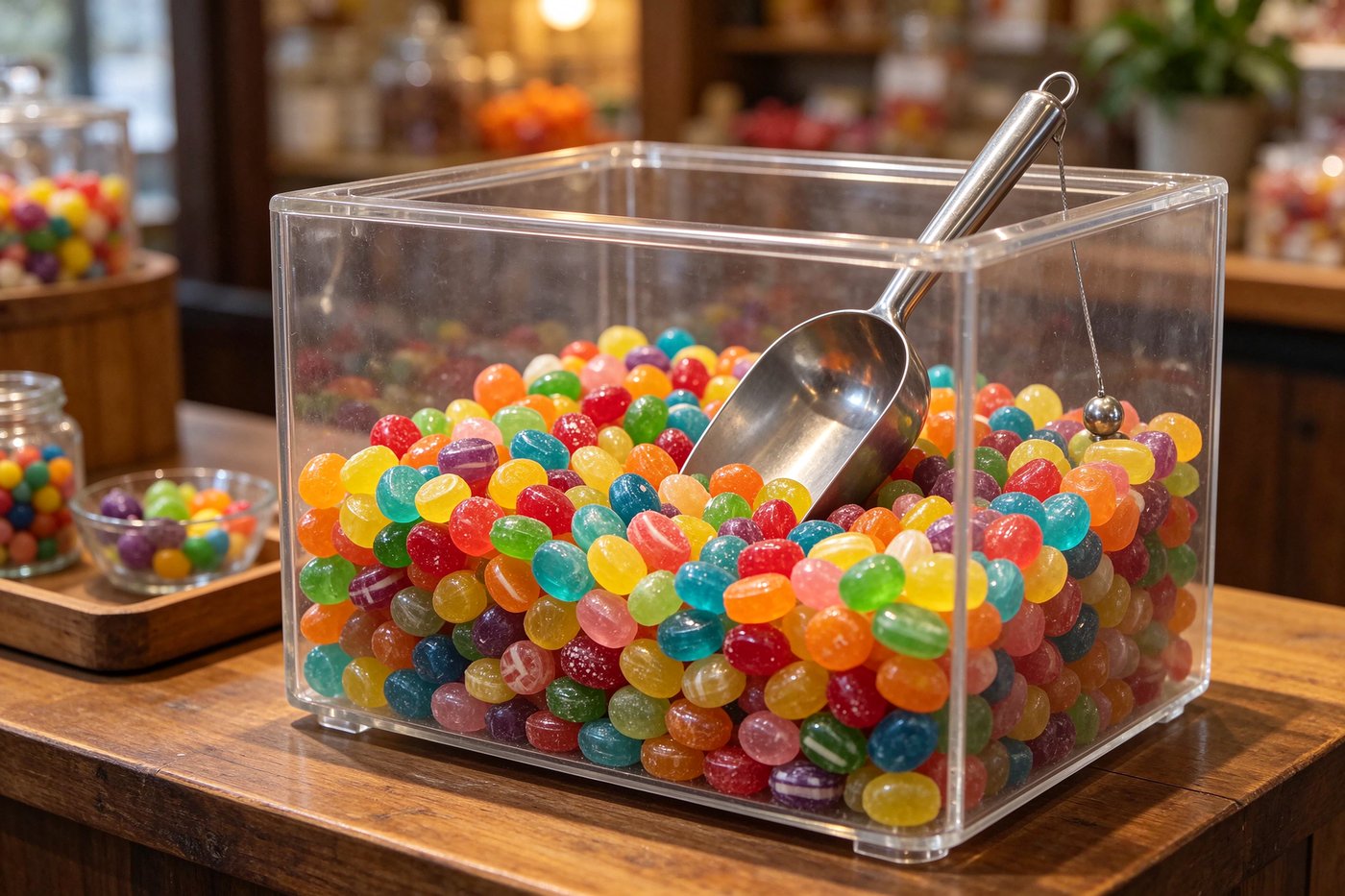
- Body: 6 mm cast acrylic, 400 x 300 x 250 mm internal, clear or tinted.
- Corners: 8 mm minimum inside radius, all four verticals and the base.
- Scoop clearance: 40 mm freeboard above the fill line, with a 12 mm lip to stop spill over the counter.
- Lid: 4 mm cast panel with a 10 mm skirt and a stainless hinge pin, so it lifts off for washing.
Why 6 mm cast and not 3 mm
A full 400 x 300 mm bin holds around 12 kg of candy. Children lean on the rim, staff stack bins during cleaning, and the wall takes a knock every hour. At 3 mm the panel flexes visibly under a 3 kg point load and the bond line at the base starts to whiten; 6 mm holds the wall flat and gives the base joint enough area to survive daily washing.
Food contact is the second reason. Cast acrylic is accepted for indirect food contact in most markets, but the surface has to be intact. A crazed 3 mm wall traps sugar in the micro-cracks and no amount of washing clears it, which is a hygiene finding waiting to happen.
Hinge and lid detail
A candy bin lid is opened 200 times a day, so a bonded acrylic hinge will fail within a month. A 3 mm stainless pin through a 3.2 mm bore in a 10 mm acrylic block, with the block bonded to the body and the lid, spreads the load and can be replaced.
River People manufacture
River People routers 6 mm cast acrylic with an 8 mm corner cutter, flame-polishes every food contact edge, and bonds base plates on a jig so the bin sits flat on a counter without rocking. Production runs of 100 to 1,000 bins ship in 15 to 20 days, with hinges pre-drilled and lids matched to the body.
Send your counter footprint and scoop size to oversales@rpplexiglass.com for a bin drawing and a quote.
Counters that carry bins usually carry a protector as well, and the sheet guidance in our acrylic countertop protector guide covers the same 6 mm stock.
Frequently Asked Questions
Is the acrylic suitable for direct food contact?
Cast acrylic is generally accepted for indirect contact, which is how candy bins are used with wrapped or hard candy. For loose unwrapped sweets, check the local food contact rules and specify a virgin cast sheet with no recycled content.
Can the bin be tinted to match a brand colour?
Yes. Tinted cast sheet is available in a range of colours, and a 3 mm colour cap bonded to a clear body gives a branded wall without hiding the product.
What causes the whitening at the base?
Solvent stress from a fast bond plus repeated flexing under load. A 6 mm wall and an eight hour clamp on the base joint prevents it.