
A keycap collector in Seoul sent back a case with a simple note: eleven artisans had shifted out of their cells in transit and two had scratched against the lid. The case was 5 mm cast, correctly bonded, and completely fit for the wrong tray. The acrylic keycap display case had been built as a box, when what the contents needed was a grid.
Keycaps are 15 to 25 mm wide and often 12 to 16 mm tall on a sculpted row. They weigh almost nothing, so inertia in a courier van moves them sideways unless each cell is closed on four sides.
Cell geometry inside an acrylic keycap display case
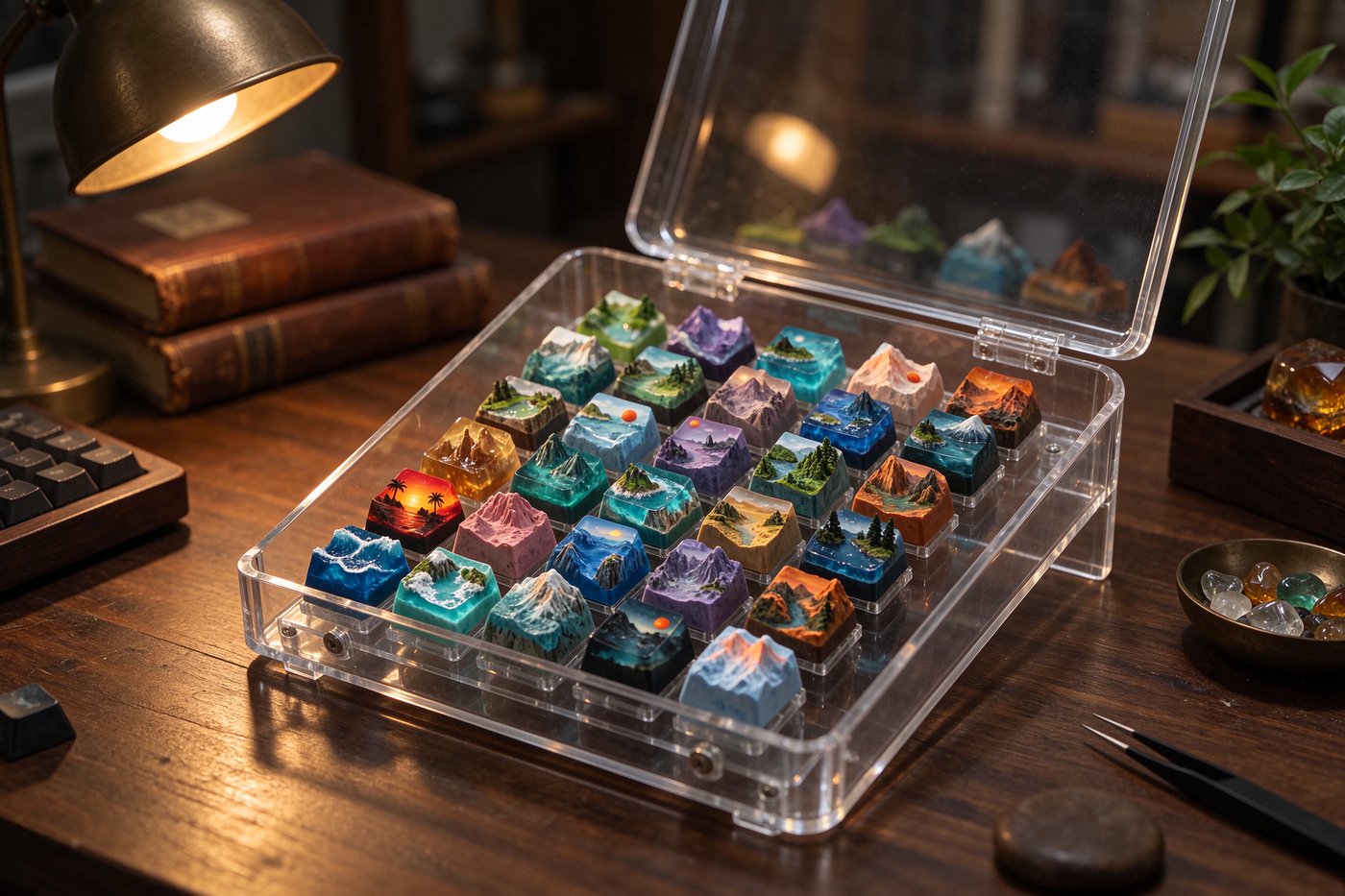
A 1.5 mm cast grid bonded to a 5 mm base gives 25 cells in a 220 x 160 mm footprint, with 1 mm tolerance around a standard 18 mm cap. Cells that share a 1.5 mm wall keep the case light while stopping sideways travel.
- Case: 5 mm cast acrylic body, 4 mm lid, 220 x 160 x 55 mm internal.
- Grid: 1.5 mm cast walls, 25 cells at 26 x 26 mm pitch for caps up to 24 mm.
- Interface: 2 mm closed-cell foam pad under the grid, so a dropped case does not transfer shock to a sharp stem.
- Lid clearance: 8 mm above the tallest sculpt, measured to the inner face, not the outer edge.
Why the lid clearance is the number that gets missed
Most cases are dimensioned from the outside. A 60 mm case with a 4 mm lid and a 5 mm base has 51 mm inside, and once a 12 mm grid and a 2 mm foam pad go in, a 16 mm cap has only 21 mm of air above it. That sounds ample until a sculpted cap with a 20 mm peak is loaded. Measure the inner face.
The lid joint matters too. A lid that sits on the body rim with no register will slide 2 or 3 mm in a bag and rub the top row. An 8 mm overlapping skirt, bonded as a rim rather than a full panel, keeps the lid located and lets the collector lift it without touching the contents.
Handling and cleaning
Static is the collector complaint. Wiping the inside of a clear case with a dry cloth charges the panel and pulls dust onto the caps. A damp microfiber pass, then air drying with the lid off, avoids it. Never use alcohol on a bonded grid, since the solvent reaches the joint through capillary action.
River People build
River People cuts grids on a CNC router with a 1.5 mm cutter and bonds them on a granite jig, so cell pitch repeats within 0.3 mm across a 25 cell tray. Cases run from 50 to 500 units in 14 to 18 days, packed with the grid installed and a foam pad already cut to the cell pattern.
Send your cap count and tallest sculpt height to oversales@rpplexiglass.com and we will lay out the grid and the internal height.
The keyboard itself is usually cased to the same standard, and the cover specification in our acrylic keyboard display case guide covers the larger format.
Frequently Asked Questions
Can the grid be made for a 40 percent keyboard layout?
Yes. Grids are cut to the layout, so a 40 percent set can use wider cells for 1.75u and 2u caps. Send the layout drawing and the pitch follows it.
Will the case protect against UV?
Standard cast acrylic filters some UV but not all. For caps displayed near a window, specify UV-filtering cast sheet; the artisan dye is usually the first thing to fade.
Is a hinged lid better than a lift-off lid?
A lift-off lid with an 8 mm skirt is simpler and has no metal parts to scratch a cap. Hinges suit cases that are opened daily and can be bonded in with a 10 mm register.