
An acrylic church hymn board is a slot system before it is a sign, and the slot decides whether digits slide or stick.
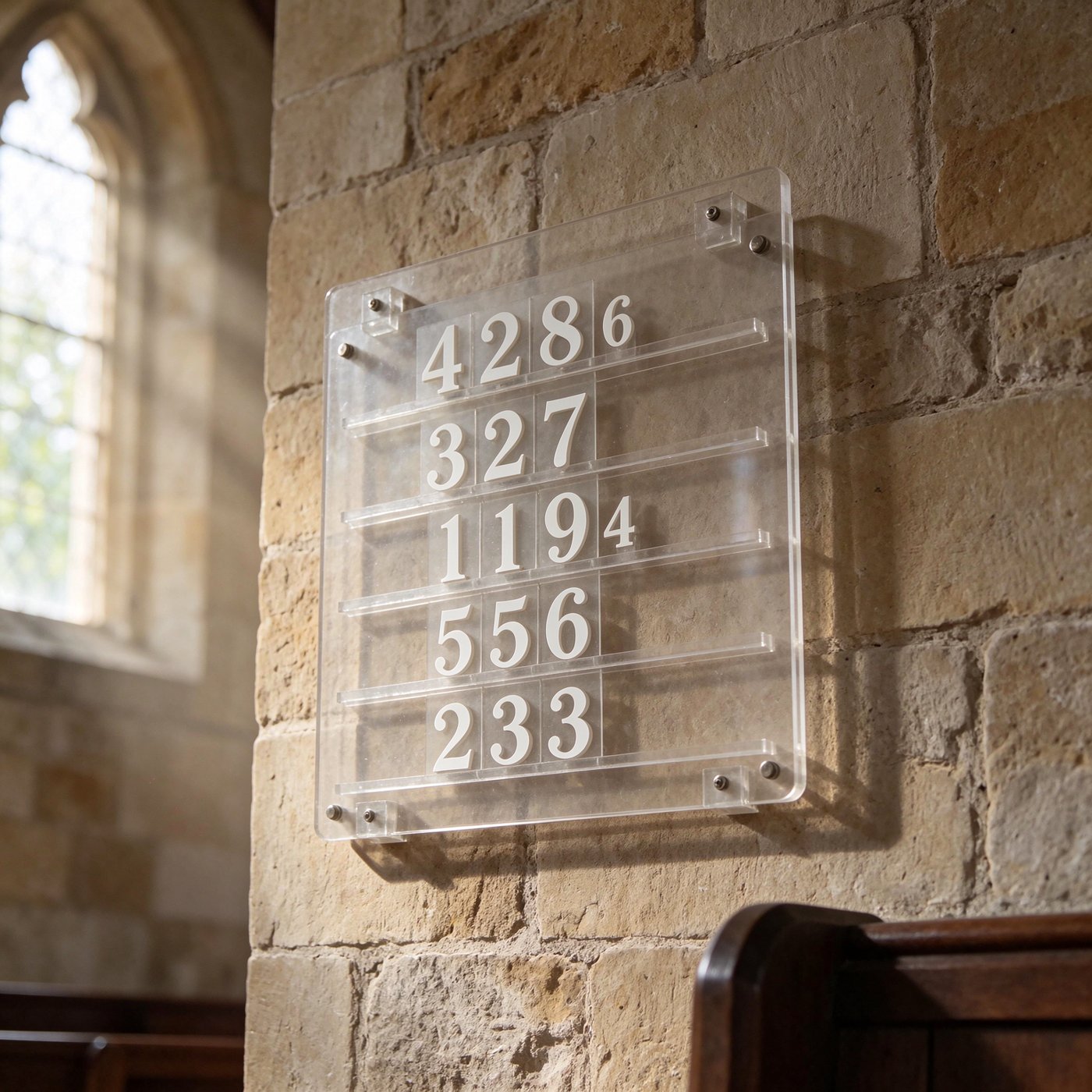
Every acrylic church hymn board starts with the same complaint from the person who changes the numbers: the slots grip too hard, the digits stick, and by the third Sunday the board has a scratch map of where a fingernail was used. Slot width, sheet thickness and the number stock have to be designed as one system, and that system is decided before the first sheet is cut.
Slot geometry that lets a digit slide and still stand up
A 5 mm cast acrylic face with 6.5 mm routed slots accepts 5 mm white acrylic digits with 0.75 mm clearance on each side. That is enough to slide a digit in with one hand and tight enough that the number does not tilt when the board is read from the nave. Slots cut at 7 mm, a common shortcut, let the digits lean and shadow the row below.
Slot depth matters as much as width: route 2.5 mm into a 5 mm board and leave 2.5 mm of material behind. Cutting deeper leaves a 1.5 mm web that flexes every time a digit is pushed in, and that web is where the board eventually cracks after two winters in a cold porch.
acrylic church hymn board: four rows, two materials, one decision
- Face: 5 mm cast acrylic, clear or 3 mm opal if the board is lit from behind; opal hides the slot cuts and reads better at 15 m.
- Slots: 6.5 mm wide, 2.5 mm deep, spaced on a 90 mm pitch for 70 mm digits.
- Digit stock: 5 mm white cast acrylic, laser cut, with a 0.5 mm chamfer so a thumb finds the edge.
- Backing: 3 mm white acrylic or 6 mm ply, fixed 20 mm behind the face so digits drop into a closed pocket and cannot fall out.
A Cornish parish that replaced three boards in nine years
A listed church went through three hymn boards in nine years. The first was 3 mm acrylic with slots cut at 8 mm; the digits leaned and the face bowed between the mounting screws. The second was 5 mm but with slots routed to 4 mm depth, and a crack opened from the bottom slot after a January cold snap. The third, still in service, uses 5 mm cast face, 6.5 mm slots at 2.5 mm depth, a 20 mm closed pocket behind and eight mounting points rather than four.
The mounting change was the one the fabricator had not expected to matter. Four screws on a 900 mm wide board leave the centre unsupported, and a hand pressing a digit into the middle row flexes the sheet. Eight points, or a 20 mm aluminium angle along the bottom edge, takes that load out of the acrylic entirely.
Where the board hangs in a porch that drops below freezing, specify cast rather than extruded sheet. Extruded acrylic becomes noticeably more brittle at low temperature and a slot edge is exactly where a brittle sheet fails.
Ordering a board that matches the digits already in use
The most common return is a board that does not fit the existing number set. Send the digit height, digit thickness and the number of rows, and the slot width follows. River People PLEXIGLASS cuts 5 mm cast faces up to 1200 by 900 mm, routes slots to your pitch, polishes the outer edge and supplies matching digit stock in the same order. Send the digit dimensions and the hanging position and we will quote board, digits and packing together.
Send digit height, thickness and row count and we will quote the board, slots, digit stock and export packing in one reply: oversales@rpplexiglass.com.
Boards that are lit from behind follow the same diffusion rules as our acrylic LED signage note.
Frequently Asked Questions
What slot width does an acrylic hymn board need?
Roughly 1.5 mm wider than the digit stock: 6.5 mm slots for 5 mm digits. That gives 0.75 mm clearance each side so a digit slides in one-handed without leaning in the row.
How deep should the slots be routed?
About half the sheet thickness, so 2.5 mm into a 5 mm face. Deeper routing leaves a thin web that flexes with every digit change and cracks at the slot end after a cold season.
Will a hymn board bow between fixings?
It will if it is fixed at four points only. Eight fixing points, or a 20 mm aluminium angle along the bottom edge, carries the hand pressure and keeps the face flat across a 900 mm span.