
An acrylic companionway hatch board has to drop into a frame that has moved over twenty seasons without jamming after a wet week.
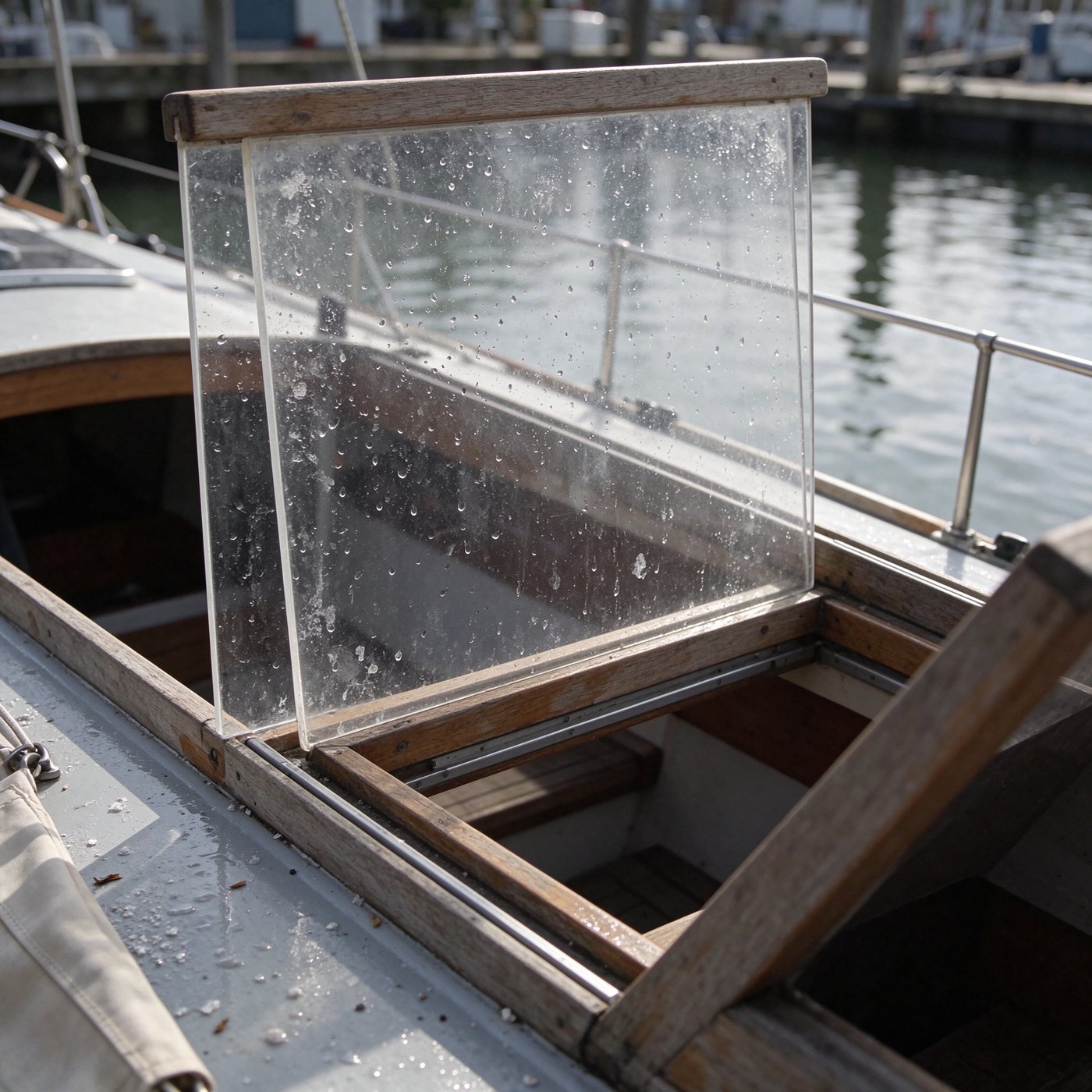
A yacht delivery skipper in Hamble keeps a spare acrylic companionway hatch board in the chart table drawer, and the reason is simple: the plywood board that came with the boat swelled after a week of rain, jammed in its slot and had to be cut out with a knife. The replacement, 10 mm cast acrylic, has been in the companionway for six seasons and still drops in with two fingers.
Why cast acrylic replaces plywood in a wet slot
A companionway board lives in a slot that sees rain, spray and sun, and it has to seat against a washboard frame that is rarely square after twenty years of boat movement. Plywood absorbs water, grows across the grain and then jams. Cast acrylic takes up no water, holds its dimension to about 0.2 percent across a 40 C range, and can be cut 1.5 mm undersize so it drops in without force.
The trade is weight and impact. Ten millimetre acrylic at 1.19 specific gravity is heavier than 12 mm ply but far lighter than glass, and it will crack if struck hard by a loose fitting rather than deform like polycarbonate. In a companionway that is stepped over rather than kicked, that trade is acceptable; where the board is also a sea barrier in a boarding sea, laminated polycarbonate is the correct material and acrylic is not.
Acrylic companionway hatch board: slot, drainage and vent
- Thickness: 10 mm cast for boards up to 700 mm wide; 12 mm where the board spans the full companionway without a centre batten.
- Fit: 1.5 mm undersize on width and height, so the board moves in a swollen frame without binding.
- Drainage: a 6 mm chamfer on the bottom edge and two 8 mm drain holes at the low corner, so water does not stand against the seal.
- Vent: optional 40 mm vent window with a 3 mm acrylic plug, for a board that stays in place at anchor.
- Edge: flame polished on the top and sides, square on the bottom so it registers.
A 1978 sloop in Chichester harbour
The owner of a 9.5 m sloop replaced three boards over four years before settling on cast acrylic. Board one was 8 mm extruded sheet, which crazed along the handle holes within one season. Board two was 12 mm ply, sealed on the edges, which still swelled and jammed in a September downpour. Board three, the acrylic board now in use, is 10 mm cast, cut 1.5 mm under the slot, with 10 mm clearance holes and rubber washers at the two retaining pins.
The detail that made the difference was not the material alone. The handle holes had been drilled tight in the first two boards, and every lift put load into a 10 mm hole in a sheet that was being twisted as the board came out of a jammed slot. Moving to 10 mm holes with rubber washers removed the cracking.
The owner also added a 6 mm chamfer along the bottom edge, which stopped water sitting against the seal and staining the lower third of the board with harbour water.
Replacing a board without the original
Trace the slot opening onto cardboard, add the frame depth, and note whether the board seats on a sill or hangs on pins. Two millimetre of extra height at the top is useful where the spray hood sags. River People PLEXIGLASS cuts 10 mm and 12 mm cast acrylic hatch boards to a traced outline, polishes exposed edges and drills vent and drain holes to your positions, with each board packed flat between foam sheets. Send the trace and the pin layout and we will quote the board and the packing.
Send a traced outline of the slot plus pin positions and we will quote the 10 mm or 12 mm board with polished edges and drilled vents: oversales@rpplexiglass.com.
Where a board also has to take boarding seas, the material choice changes, as our boat windshield guide explains.
Frequently Asked Questions
Is acrylic suitable for a companionway hatch board?
Yes where the board is stepped over and seats in a sheltered slot. Ten millimetre cast sheet does not absorb water and holds dimension in a swollen frame. Where the board must resist boarding seas, laminated polycarbonate is the right material instead.
How much undersize should the board be cut?
About 1.5 mm on width and height. That is enough to drop into a frame that has moved over twenty seasons without leaving a gap that rattles, and it stops the board jamming after a wet week.
Why did the handle holes crack?
Tight holes in a board that is twisted out of a slot concentrate load at the hole edge. Drill 10 mm holes for 6 mm pins, fit rubber washers and lift the board square rather than levering it.