
An acrylic pastry display case is only as cleanable as the radius where its curved front meets the base.
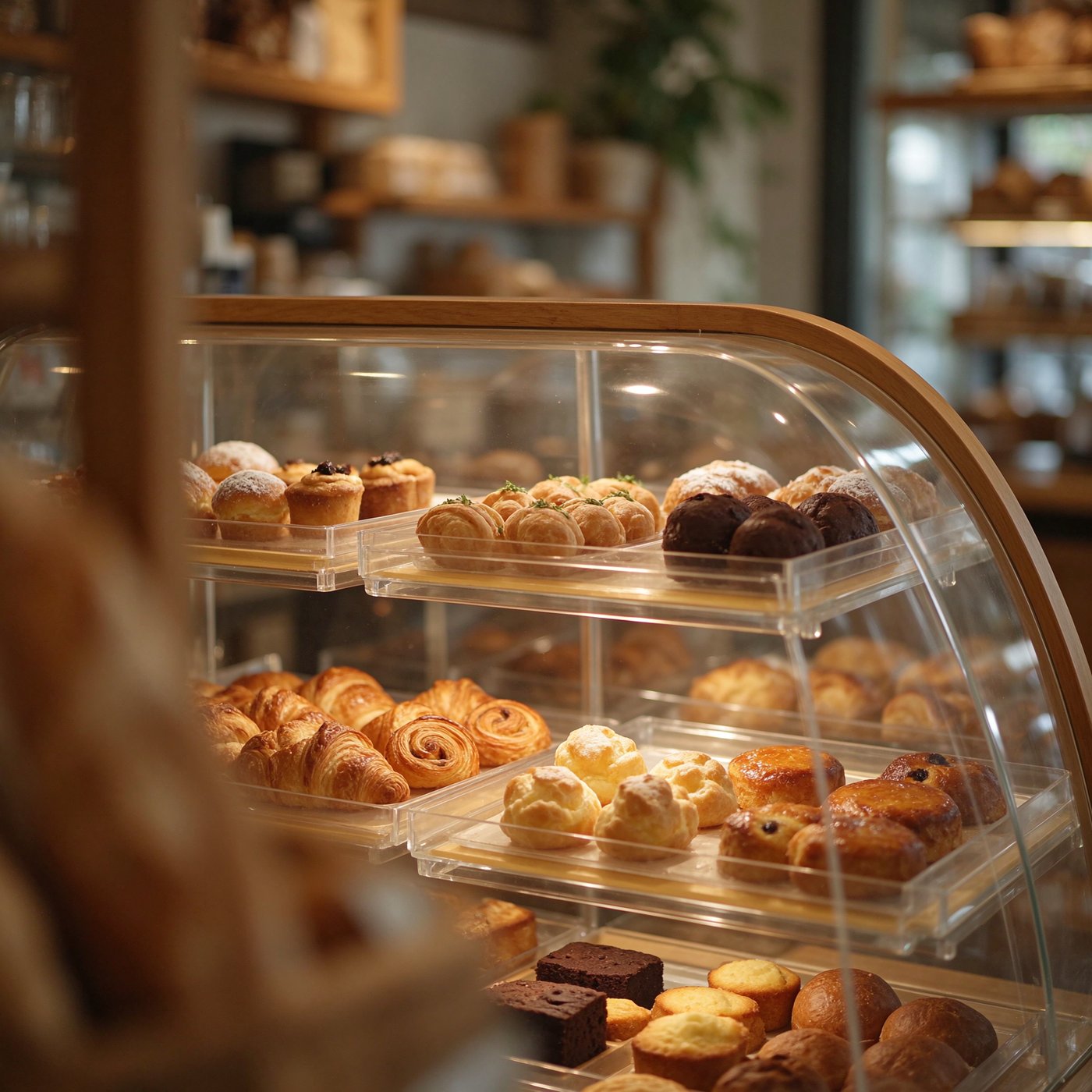
The curved front is the part of an acrylic pastry display case that customers actually look at, and it is also the part that determines whether the case can be cleaned properly. A radius below 150 mm looks sharp on the counter but creates a dead zone at the base where crumbs collect and a cloth cannot reach. Most bakery refits that fail do so on that base line, not on the glazing.
Choosing the radius before choosing the sheet
Four millimetre cast acrylic bends cold to a 150 mm radius without crazing, and to 100 mm if the bend is done warm. Below 100 mm the outer face starts to show fine stress lines that catch light and read as scratches. For a counter case 400 mm deep and 350 mm high, a 150 mm front radius plus a 20 mm flat at the base is the geometry that lets a cloth follow the curve into the corner.
Thickness is decided by the span, not the curve. A 4 mm front on a 900 mm wide case deflects about 1.5 mm under a hand lean; 5 mm halves that. Where the case is more than 1200 mm wide or the front is unsupported between end panels, 6 mm is the specification that keeps the curve true.
acrylic pastry display case: shelves, gaps and airflow
- Front: 4 mm cast, 150 mm radius, 20 mm flat base for cleaning access.
- Shelves: 5 mm cast with a 1 mm fall toward the back so crumbs migrate to one cleanable line.
- Shelf pitch: 120 mm for tarts, 90 mm for petits fours, measured clear height not centre to centre.
- Air gap: 25 mm between the outer case and any refrigerated well, or condensation forms on the inner face within a shift.
- Joint: solvent-cement only on straight seams; curved front bonded to end panels with a 3 mm acrylic gusset, never a butt joint.
A bakers dozen cases in Antwerp, and the base line problem
A bakery group fitted thirteen curved cases across four shops. The first six had a butt-jointed curved front and no base flat; within four months three showed a white crazed line along the bottom curve where cleaning cloths had been pushed into the dead zone, and one front had separated from its end panel.
The second seven were built with the 20 mm base flat, a 3 mm gusset at each end and a 25 mm gap to the refrigerated well. None crazed. Two of the older cases were subsequently rebuilt to the same detail rather than replaced.
The group also changed the daily routine: a soft brush along the base line before the wipe, and no spray cleaner applied directly to the curve. Solvent sprayed onto a stressed bend finds every micro-crack in the surface within a month.
Ambient or refrigerated, two different cases
An ambient case can be 4 mm throughout with a simple frame. A refrigerated case needs 5 mm on the front and 6 mm on the shelves, because the cold face condenses and the wipe load doubles. Mixing the two specifications on one order is the most common source of a case that fogs on one side and stays clear on the other.
Send the counter footprint, the number of shelves, whether the case sits over a refrigerated well and the cleaning routine. River People PLEXIGLASS forms cast acrylic fronts to a 150 mm radius, bonds gusseted ends and supplies shelves cut to your pitch, with the case shipped flat where freight allows. Send the footprint and shelf count and we will quote the front, the shelves and the joint detail.
Send the counter footprint, shelf count and whether the case is refrigerated and we will quote the curved front, shelves and gusset detail: oversales@rpplexiglass.com.
Curved display fronts raise the same glazing questions as a museum case, covered in our display case glazing guide.
Frequently Asked Questions
What radius can acrylic pastry display case fronts be formed to?
Four millimetre cast sheet bends cold to 150 mm and warm to about 100 mm. Below 100 mm the outer face shows stress lines that catch light, and the base corner becomes too tight to clean properly.
Why does the bottom of a curved acrylic case craze?
Crumbs collect in the dead zone where the curve meets the base, and a cloth pushed into that corner stresses the bend while solvent cleaner attacks it. A 20 mm flat at the base plus a soft brush before wiping removes both causes.
Does a refrigerated pastry case need thicker acrylic?
Yes. Five millimetre on the front and 6 mm on the shelves, with a 25 mm air gap to the refrigerated well, because the cold face condenses and is wiped far more often than an ambient case.