
An acrylic dining table protector fails on expansion, not on load, and 3.6 mm of growth across a 1200 mm top has to go somewhere.
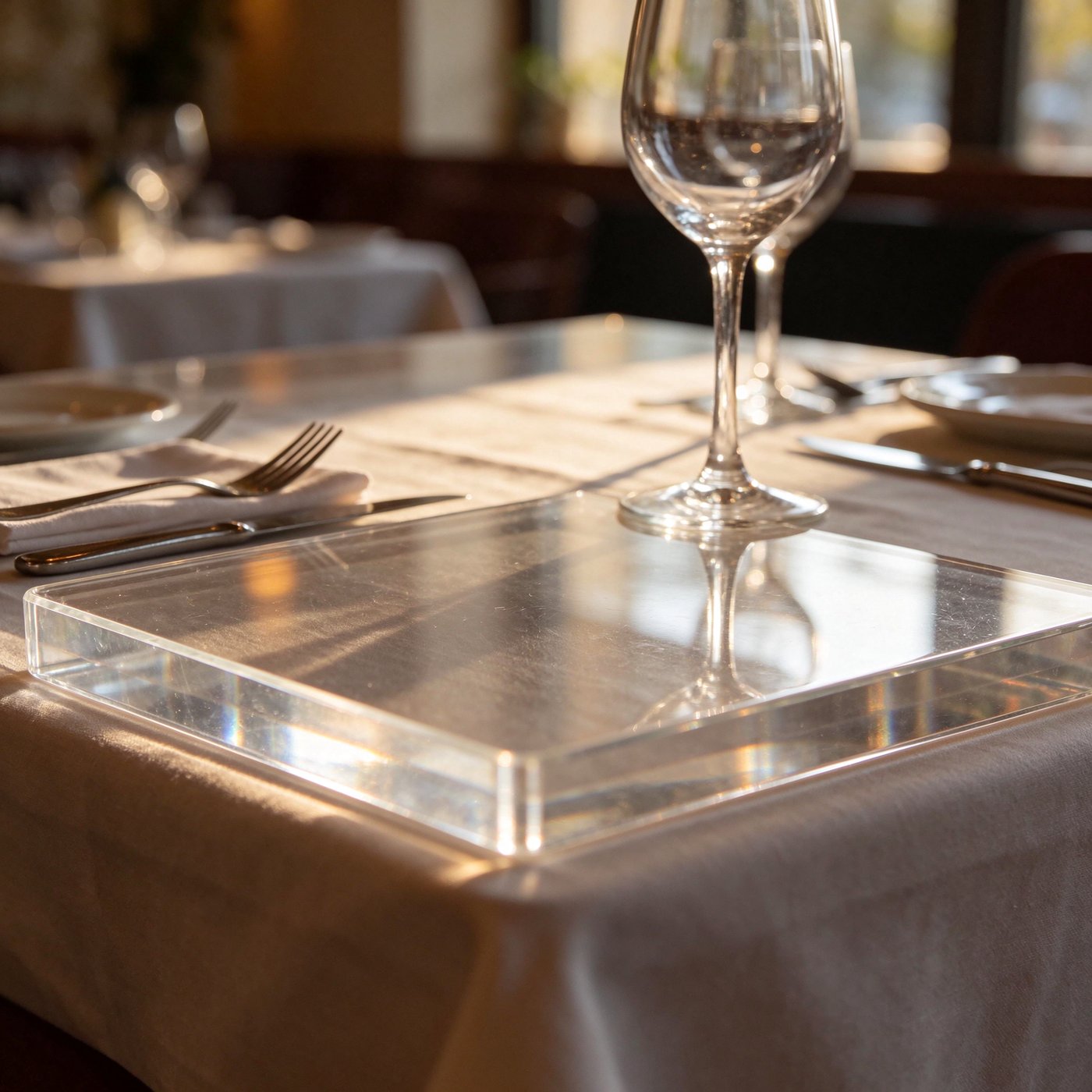
A hotel in the Cotswolds ordered thirty acrylic dining table protectors at 8 mm and sent back six because they had gone convex. The cause was not the sheet: the protectors had been cut to the exact table dimension with no allowance for the 0.3 percent expansion a cast acrylic top shows between a cold delivery bay and a dining room at 24 C. At 1200 mm that is 3.6 mm of growth, and on a table with a raised lip the only place for it to go is upward.
Clear top, hidden load path
An 8 mm cast acrylic protector over a 1200 by 800 mm table carries a 12 kg centrepiece and the elbows of six diners without visible deflection, provided the sheet is supported continuously rather than on four pads. A 2 mm foam or felt interlayer under the acrylic distributes point loads, and a 1.5 mm gap at the edge of any raised lip gives the sheet somewhere to expand.
Eight millimetre is the practical floor for a dining table. At 5 mm a 1200 mm span flexes enough to see the seam of the tablecloth underneath and rings when a glass is set down; at 6 mm it is acceptable for a 900 mm table but marginal above that. Ten millimetre is worth the extra where the table is also used as a service station and sees hot plates.
Heat, cutlery and the four marks that always appear
The four marks that show up on every unprotected acrylic table top are a ring from a hot plate at 70 C, a knife score from a hurried waiter, a haze patch from an alcohol spray left to dry, and a crescent from a stack of chairs pushed against the edge. All four are preventable with detail rather than material changes:
- Hot plates: a 150 mm mat under each service point, or specify 10 mm so the surface heat spreads before it reaches the sheet.
- Cutlery: a 0.5 mm chamfer on the top edge stops a knife catching the arris.
- Cleaning: neutral detergent and a microfiber cloth; alcohol is fine occasionally but not as a daily spray left wet.
- Storage: felt pads at the four corners so protectors stacked overnight do not grind against each other.
A restaurant terrace in Hampshire, one season later
A twenty four seat terrace restaurant fitted 8 mm protectors over oak tables in April. By September two had visible scratches from cutlery and one had a white haze where a lemon-oil cleaner had been used daily. The three that failed were all on the sun-facing side of the terrace, where the surface reached 58 C in direct afternoon sun and the cleaner evaporated to a residue.
The refit replaced those three with 10 mm sheet and moved the cleaning to a diluted neutral detergent with a clean-water rinse. The remaining seventeen, all in shade, showed no change. The pattern is consistent: acrylic on a table is a UV and chemistry problem far more often than a mechanical one.
Where the table sits outdoors year round, an acrylic protector will hold clarity for two to three seasons before a slight yellow cast appears, and that is the material behaving as expected rather than failing. A UV-stabilised cast grade buys another two seasons.
Measuring a table for an acrylic protector
Measure the table at its widest point, subtract 1 mm at each edge if the surface is flat, and add 2 mm at each edge if the protector is meant to overhang a lip. Send the dimension, the number of tables, whether the surface is indoors or exposed, and the cleaning chemical in use. River People PLEXIGLASS cuts 8 mm and 10 mm cast acrylic table tops up to 2030 by 3050 mm, flame polishes the edge and delivers with PE film on both faces. Send the table dimensions and we will quote the tops and the interlayer.
Send table dimensions, indoor or outdoor position and the cleaning chemical, and we will quote 8 mm or 10 mm protectors with edge finish and interlayer: oversales@rpplexiglass.com.
The expansion and flatness figures behind this specification are explained in our acrylic thickness tolerance note.
Frequently Asked Questions
What thickness should an acrylic dining table protector be?
Eight millimetre for tables up to about 1200 mm; ten millimetre where the table also takes hot plates or sits in direct sun. Five and six millimetre sheets show deflection and ring under a glass on a span above 900 mm.
Why did my acrylic table top bow upward?
Exact-size cutting leaves no room for thermal expansion. Cast acrylic grows roughly 0.3 percent between a cold store and a warm room, so a 1200 mm top grows 3.6 mm; leave 1.5 mm clearance at any raised lip and support the sheet on a foam interlayer.
Can an acrylic table protector be used outdoors?
For two to three seasons before a slight yellow cast appears. A UV-stabilised cast grade extends that to four or five seasons, and a neutral detergent rinse rather than a daily alcohol spray keeps the surface clear.