
An acrylic dollhouse display case is a thin box around a detailed interior, and the panels are the whole problem.
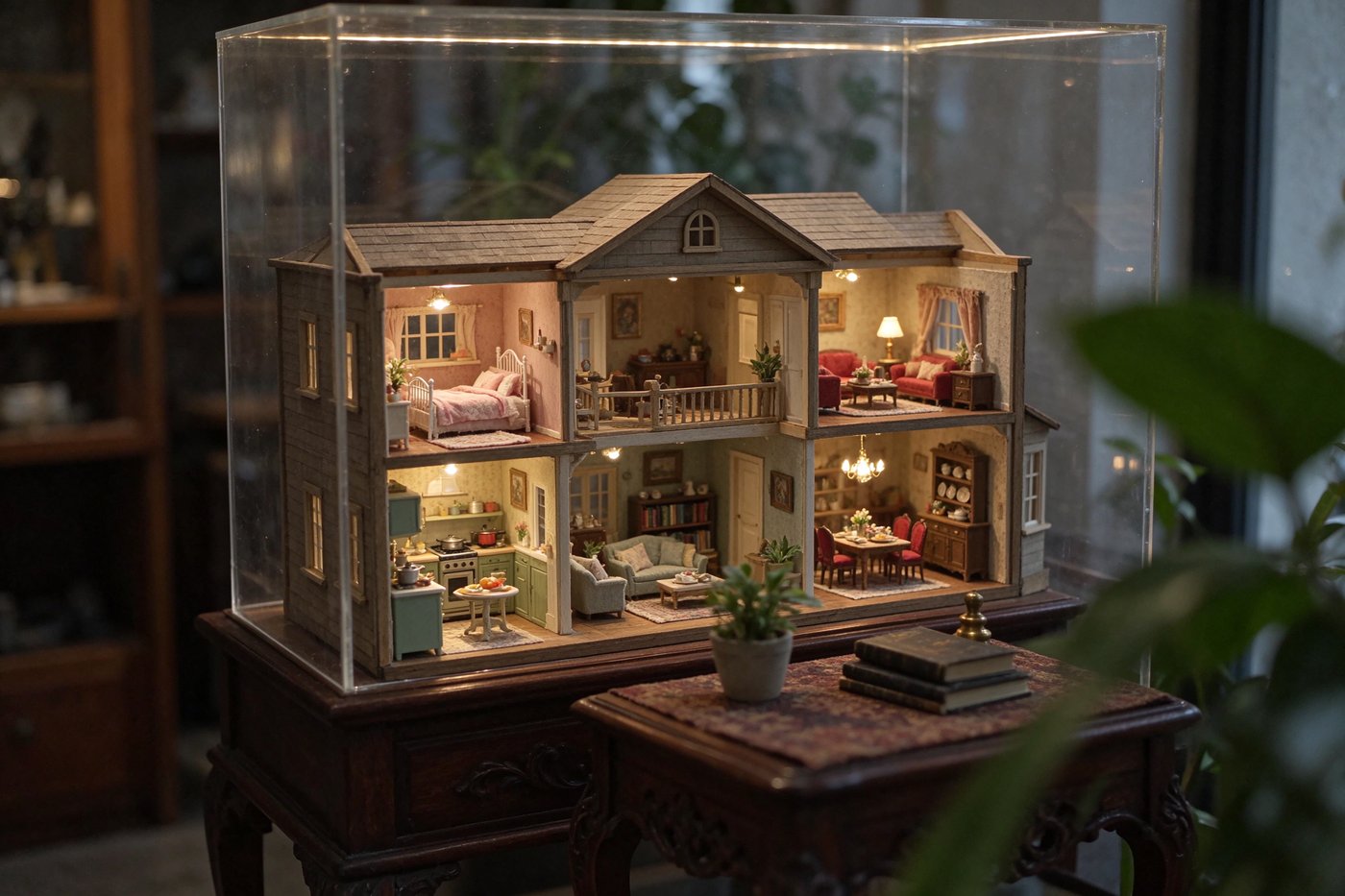
A collector in Kent commissioned a case for a 1:12 scale house with a working staircase and 42 tiny picture frames. The first case was 2 mm acrylic, made as a simple sleeve, and it bowed inward at the centre of each long side. Three of the frames were knocked off by the bowing panel during the first month.
An acrylic dollhouse display case is a small box with a large interior, and the panels are thin relative to their span. That is the whole engineering problem: keep the box light enough to lift off, stiff enough not to touch the contents, and clear enough to see into the back rooms.
Proportion and thickness
Three millimetre cast suits a house up to about 450 mm wide and 500 mm tall. Above that, 4 mm is the practical minimum, or add a top frame that ties the four walls together. A sleeve with no top frame behaves like four independent plates and bows at the middle of each span.
The base should be 6 mm and stand 20 mm proud of the table, with felt on the underside. A thin base flexes when the case is lifted off, and flexing is what transfers movement into the walls.
Access: sleeve, lift-off or hinged front
- A full lift-off sleeve is the cheapest and gives the best view, but needs two hands and clear headroom
- A lift-off top with fixed walls lets you reach in from above without moving the house
- A hinged front panel is best where the case is tall and the house is heavy, but the hinge line must be outside the viewing area
- Whichever route, leave 60 mm of clear space above the tallest roof so nothing is knocked when the lid goes on
The Kent collector went to a lift-off top with fixed walls, which removed the bowing problem entirely because the walls were tied at the top by a frame. The three damaged frames were repaired and the case has been in use since.
Light, glare and the small details
Lighting from outside the case produces glare on the front panel and shadows in the back rooms. Put a low-heat LED strip inside the top frame, angled toward the back, and keep the room light dim. Do not use halogen: the heat will yellow the acrylic and dry the miniature furnishings.
RP River People Plexiglass cuts dollhouse covers to the footprint, with framed tops, felted bases and predrilled LED positions. Send the house dimensions and the lighting plan for a quotation.
Send the house footprint, height and lighting plan to oversales@rpplexiglass.com for a framed cover quotation.
Glass and acrylic are both used for display cases, and the comparison is in our display case glazing guide.
Frequently Asked Questions
Is 2 mm acrylic enough for a dollhouse case?
Only for a very small house. Two millimetre panels bow at the centre of any span over about 300 mm and can touch the contents. Three millimetre is the realistic minimum.
Should the case be sealed against dust?
A locating top with a felt strip is enough. Fully sealing the case traps humidity, which is worse for furnishings and wood than a little dust.
Can the case be lit from outside?
It can, but the front panel will reflect the room and the back rooms will be dark. Internal low-heat LED is the better solution.