
A polycarbonate hedge trimmer guard takes close-range impact every working day.
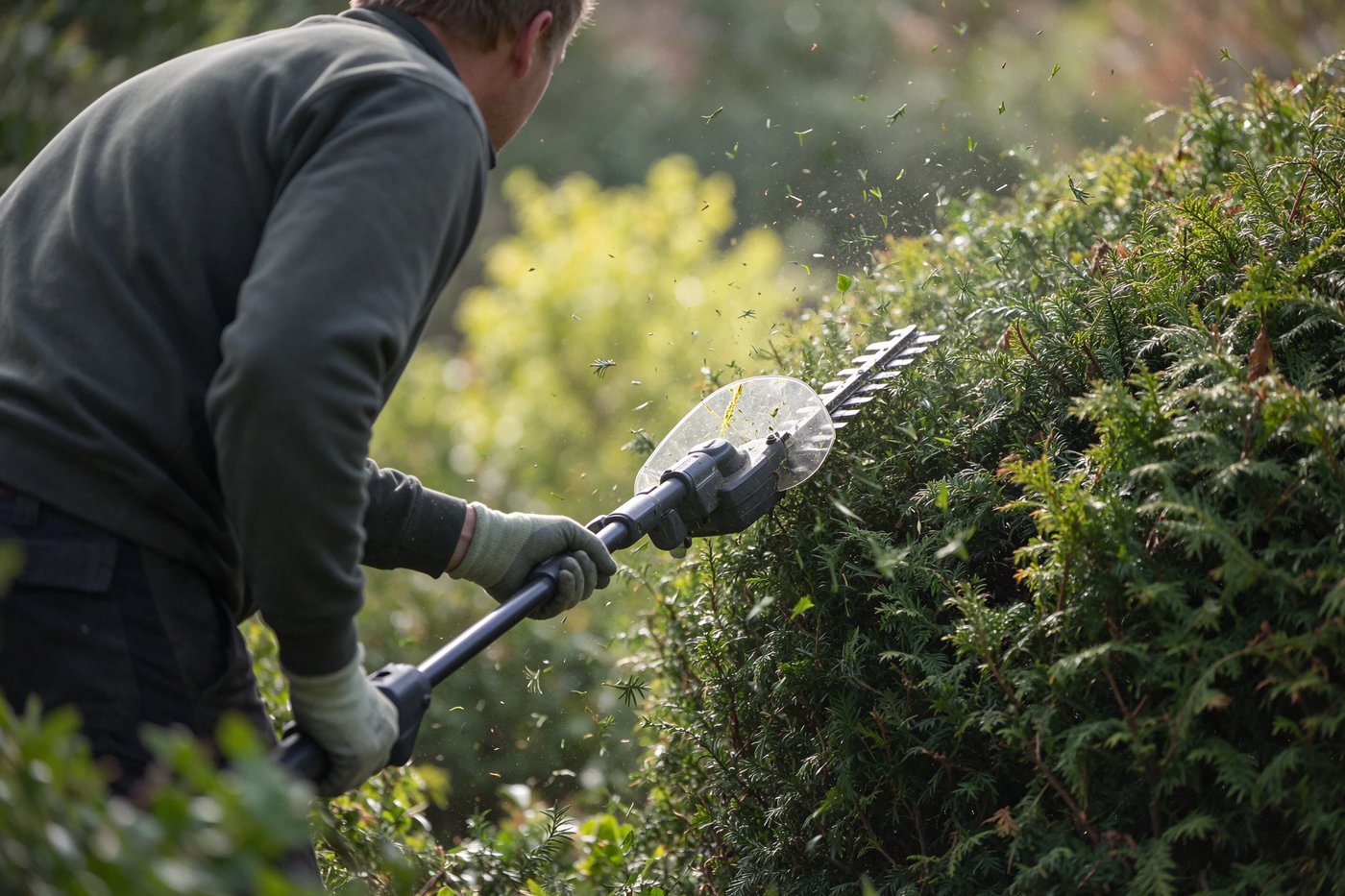
A grounds team in Surrey fitted flat polycarbonate guards to six long-reach hedge trimmers. Within a season, three had cracked at the mounting bolts and one had been pulled into the cutter bar by a branch, jamming the machine. The panels were 4 mm, bolted straight through with no bracket and no clearance.
A polycarbonate hedge trimmer guard is a moving-machine part. It meets branches, it gets knocked against hedges, and it is carried on a bar that vibrates. The sheet is the easy part; the bracket and the clearance decide whether the guard survives.
Guard shape and coverage
Five millimetre polycarbonate is the usual thickness for a guard on a professional trimmer, because it resists impact without adding a kilogram at the end of a long bar. The guard should cover the cutter from the operator side and wrap 30 to 40 mm past the blade tip, with the lower edge clear of the branch path so cuttings fall away rather than collect.
A flat panel bolted to the gearbox flexes with every cut. A curved or angled guard, braced at two points, keeps the panel out of the blade and spreads the vibration. Where the guard is removable for transport, use a bracket with a captive pin rather than bolts through the panel.
Cold, UV and the cracking question
- Polycarbonate stays tough well below freezing, which is why it suits outdoor equipment, but it does scratch and craze under UV over years
- Use a UV-stabilised sheet, or a hard-coated grade where the guard will be cleaned often
- Never notch the panel at a bolt hole to clear a bracket; a notch is where a crack starts
- Keep 3 mm of clearance around every fastener for movement
The Surrey failures all started at bolt holes with no clearance, in panels that had been drilled with a standard twist bit at high speed. Drilling polycarbonate needs a slow speed, a sharp bit and a backing block, and the hole should be 2 to 3 mm larger than the fastener.
Cleaning a guard that lives outdoors
Sap, dust and hedge juice all sit on the panel. Wash with mild soap and water, rinse, and dry with a soft cloth. Solvents and abrasive pads destroy the surface and, on a hard-coated sheet, remove the coating in patches that then craze.
RP River People Plexiglass cuts and drills hedge trimmer guards to the machine outline, with edge polishing and bracket-ready hole patterns. Send the machine model and the guard sketch for a quotation.
Send the trimmer model and guard sketch to oversales@rpplexiglass.com for a cut and drilled polycarbonate guard quotation.
Outdoor equipment guards follow the same risk logic as factory barriers, set out in our machine guard and safety barrier guide.
Frequently Asked Questions
Why polycarbonate rather than acrylic for a trimmer guard?
Polycarbonate absorbs impact without shattering and stays tough in cold weather. Acrylic is clearer but brittle, and a guard that cracks in the field is a hazard.
How thick should the guard be?
Five millimetre is the usual professional thickness. Four millimetre works on a small domestic trimmer if the guard is braced at two points.
Can the guard be cleaned with solvent?
No. Solvents craze polycarbonate and strip hard coats. Mild soap, water and a soft cloth only.