
When a chain optician in Kuala Lumpur re-laid a 24 bay floor, the measured problem was not stock depth but try-on time: customers asked staff to fetch frames because the shelves were too deep to read the temple width. The new fixture was a stepped acrylic eyewear display, three risers per bay, with frames opened and pitched so the temple and bridge face the customer.
Riser heights and pitch on an acrylic eyewear display
- Risers: 60, 120 and 180 mm above the counter
- Pitch: 140 mm between frame centres
- Step body: 8 mm cast acrylic, polished front edge
- Front stop: 6 mm upstand to keep frames from sliding
- Bay length: 1,200 mm, twelve frames per step
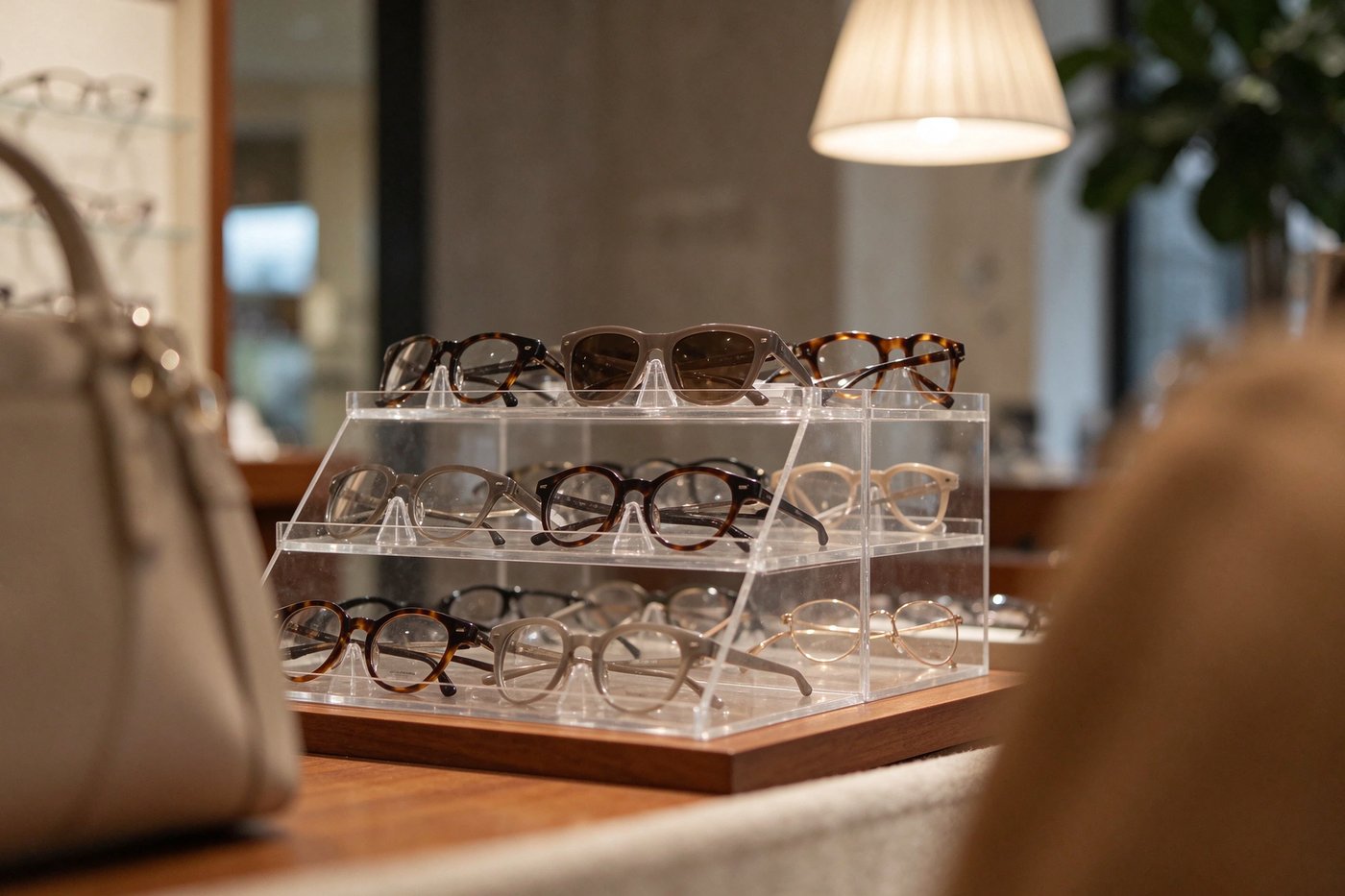
The 180 mm top riser puts the third row at eye level for a standing adult, which is where premium frames belong. Lower rows are angled 12 degrees so the frame face reads from two metres away, the distance at which a customer decides whether to walk over.
Glare, edge polish and the acrylic eyewear display
Flame polishing the front edge removes the saw marks that scatter spotlights into a bright line across the lenses. The step surface itself is left matte, because a polished horizontal face under a 3000 K downlight throws a reflection exactly where the frame bridge sits.
One mistake repeats across fit-outs: the bay is measured to the shelf, not to the frame. A 1,200 mm bay at 140 mm pitch holds eight frames comfortably, not twelve, unless the frames are narrow readers. We ask for the frame list before cutting, and we set the pitch from the widest temple in the range.
Sets are supplied per bay, with numbered position labels optional and a removable locking bar for unattended floors.
Send frame count per bay and shelf depth to oversales@rpplexiglass.com and we will quote a stepped display set.
Frames that leave the counter for a window follow a different brief, set out in the sunglasses display note covers that part of the specification.
Frequently Asked Questions
What frame pitch works on a step?
A 140 mm pitch suits most acetate and metal frames up to 148 mm wide. Frames are stored open at a slight angle, so the pitch is set by the temple length rather than the lens width.
Why 8 mm sheet for the steps?
A step carrying twelve frames takes a point load at each bridge. At 6 mm the front edge bows and the frames lean inward; 8 mm holds the edge straight over a 1.2 m bay.
Does the display need to be locked?
Only if the bay is unattended. Locking bars are cemented to the top step and keyed at the rear, and the acrylic eyewear display still lifts out for cleaning.