
An acrylic hamster cage panel is not tested by the animal biting the sheet but by the gap beside it.
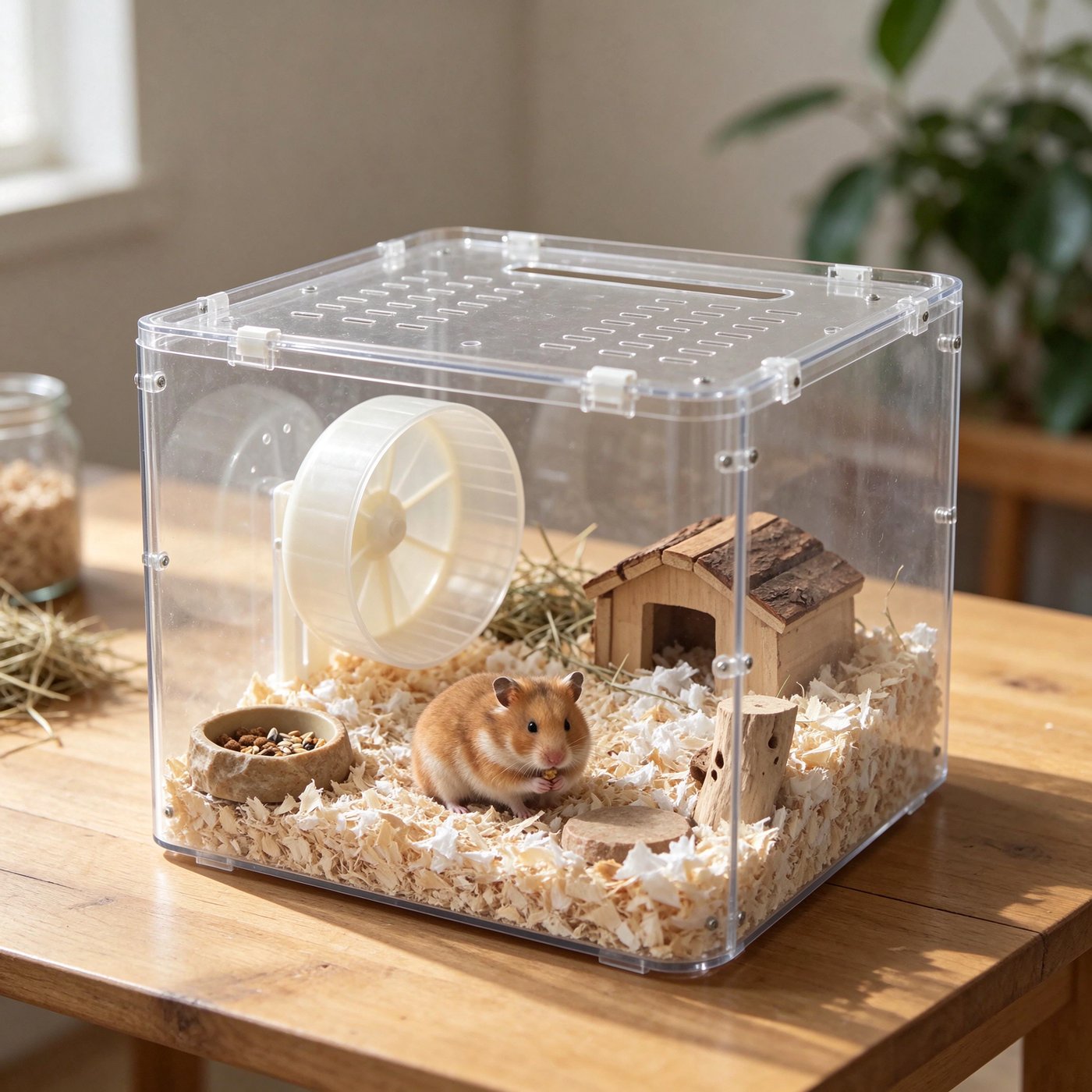
Hamsters do not chew through a 4 mm acrylic cage panel. They chew the gap beside it. Every return we see on an acrylic cage comes from a 3 mm slot at a corner joint, a cable entry or a lid lip, where an animal can get an incisor behind the sheet and lever it. The material is rarely the failure; the seam is.
Chew path, not chew strength
A Syrian hamster applies a bite of roughly 15 to 20 N, which a 4 mm cast acrylic panel shrugs off. What it will not shrug off is a 2 mm gap: once an incisor enters a joint, the animal works it wider and the panel either separates or cracks from the fixing. Seams therefore have to be closed to under 1 mm, which means a bonded or solvent-cemented joint rather than an overlap held by clips.
Four millimetre cast sheet is the practical thickness for a panel up to 600 by 400 mm. It is rigid enough that a hamster standing on a shelf bracket does not bow it, and it leaves enough depth to machine a 3 mm vent slot without making the panel fragile. Two millimetre sheet is sold as cage glazing and is the source of most cracked panels sold online.
acrylic hamster cage panel: vents, seams and lid detail
- Panel: 4 mm cast, 600 by 400 mm maximum per panel before a centre brace is needed.
- Vent slots: 3 mm routed, 40 mm long, in rows of five, kept 15 mm clear of any edge.
- Joint: solvent cement on a 3 mm gusset strip, or a 1 mm tongue machined into the mating panel; no clip-only joints.
- Lid: 4 mm with a 20 mm overlap and a 1 mm foam gasket, so an animal cannot get a tooth under the lip.
- Fixings: M4 with 2 mm clearance and nylon washers, 20 mm from any slot.
A rescue in Norfolk and forty cages
A small animal rescue built forty modular cages from 3 mm acrylic with clip-together corners. Within three months eleven had chew damage, all at the corner clips, and two panels had cracked from a fixing hole. The rebuild used 4 mm panels, solvent-cemented gussets at every corner and a 20 mm lid overlap with foam. Eighteen months later, none of the forty rebuilt cages had a chew entry.
The rescue also learned something about ventilation. The first version had six 3 mm slots per panel, which kept humidity at 62 percent in a warm room. Adding a second row of five slots on the top panel brought it to 45 percent and stopped the bedding from moulding.
Cleaning was the other change. Panels were being wiped with a 70 percent alcohol spray weekly, which is fine on cast acrylic but was being left wet in the joints. A dry wipe after the spray stopped the cement line from going white.
Building a cage from replacement panels
Measure the internal footprint, decide panel height and note where the wheel and shelf brackets land, because a bracket hole within 20 mm of a vent slot is a crack waiting to happen. Send those three items and the vent layout. River People PLEXIGLASS cuts 4 mm cast acrylic cage panels with routed vent slots, machined tongue joints and drilled fixing holes, and can supply matching gusset strips. Send the footprint, height and bracket positions and we will quote the panel set and the packing.
Send the cage footprint, panel height and bracket positions and we will quote 4 mm panels with routed vents and joint strips: oversales@rpplexiglass.com.
Vent layout for a small animal box follows the same logic as a terrarium, worked through in our terrarium panel guide.
Frequently Asked Questions
Can a hamster chew through 4 mm acrylic?
Not through the sheet. Damage happens at gaps of 2 mm or more at corners, cable entries and lid lips, where an incisor gets behind the panel and levers it. Close every seam to under 1 mm and the panel holds.
How much ventilation does an acrylic hamster cage need?
Enough that humidity stays under 50 percent in a warm room: two rows of five 3 mm slots per panel is a workable starting point, with the top panel carrying the second row. Too few slots leads to damp bedding, not to a chew problem.
Why did my acrylic cage panel crack at a screw hole?
A tight hole plus a fixing close to an edge or a vent slot concentrates load into a 4 mm sheet. Use 2 mm clearance holes, nylon washers and keep fixings 20 mm clear of slots and edges.