
A regional museum in Leeds audited 400 labels across six galleries and found that 61 were being read from the wrong angle: either flat on the shelf or leaning so far back that visitors had to crouch. The labels were not damaged and the holders were not broken. The geometry was simply wrong, and the acrylic museum label holder specification had never been written down.
The rebuild treated the holder as an optical device rather than a plastic stand. Panel thickness, tent angle, surface finish and distance from the object all interact, and each one has a defensible number.
Optical requirements for an acrylic museum label holder
A standing visitor reads a label at roughly 1.0 to 1.3 m, looking down at 30 to 40 degrees. A tent at 78 degrees to the shelf puts the label plane close to perpendicular to that line of sight, which is the difference between comfortable reading and a squint.
- Panel: 2 mm cast acrylic, which carries an A6 label without visible bow over a 105 mm width.
- Tent angle: 78 degrees, with a 35 mm foot on each side so the holder cannot be knocked flat.
- Face: anti-glare matte on the front panel only, keeping the back clear so the label shadow does not double.
- Distance from the object: 100 mm minimum, and never inside the object footprint, so the holder does not read as part of the artefact.
Materials that will not interact with a collection
Cast acrylic is chemically inert once cured, which matters in a sealed vitrine where solvent vapour has nowhere to go. The risk is in the fabrication: a freshly bonded holder that goes into a case within 24 hours will release trace solvent and can leave a haze on adjacent glass. Holders should be bonded at least 72 hours before installation, and the bond line should sit on the outer edge only.
Surface charge is the other issue. Dry wiping a clear panel builds static that pulls dust to the label face. A matte front face scatters enough light to hide fine dust, and a damp microfiber wipe once a month keeps the rest off.
Mounting inside a vitrine
A holder inside a case usually needs no fixing at all: the foot sits on the deck and the angle does the rest. Where the deck is sloped, a 1 mm silicone pad under each foot holds the angle without adhesive, which curators prefer because nothing is left behind when the display changes.
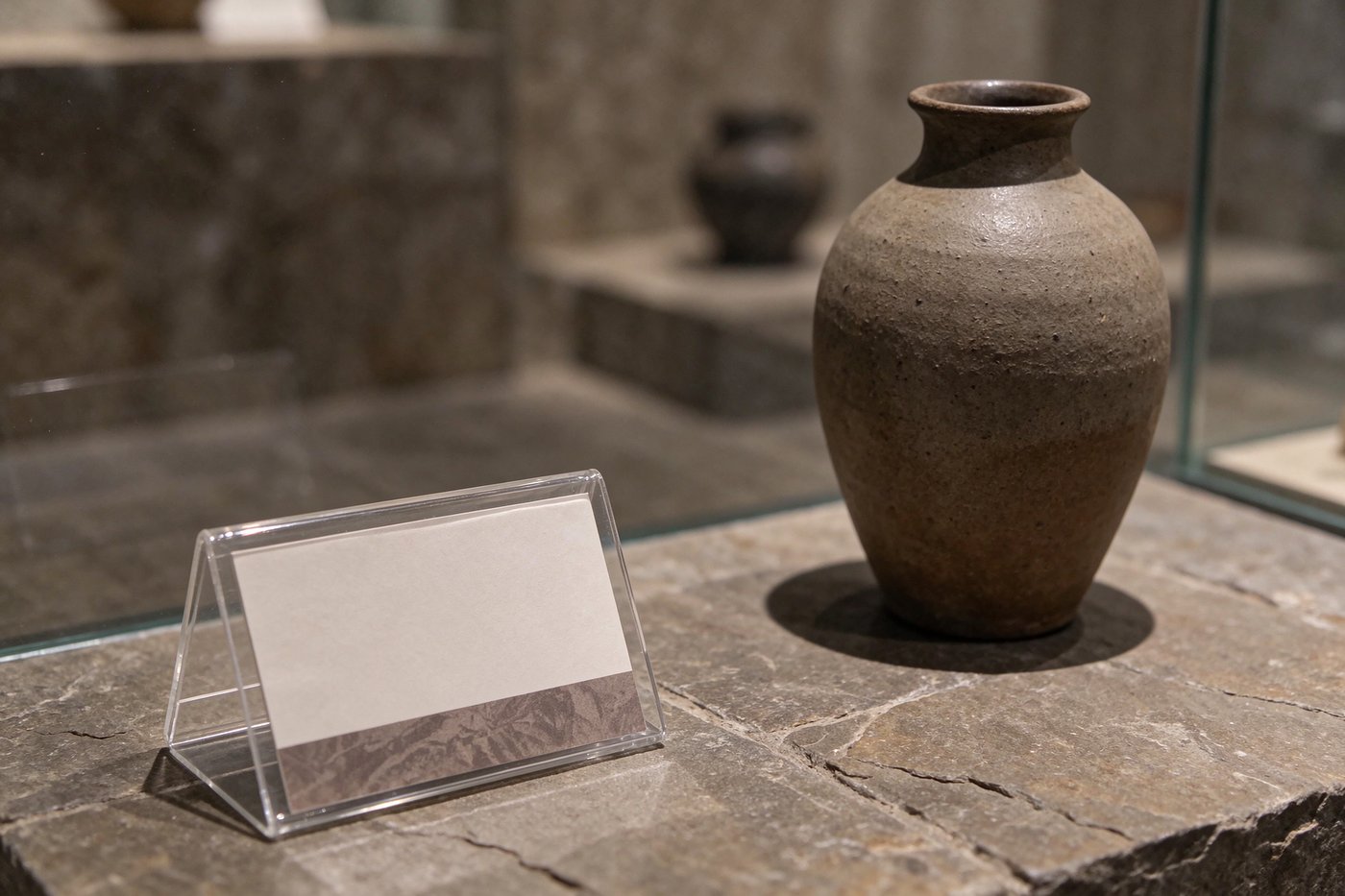
River People supply
River People line-bends and flame-polishes 2 mm cast acrylic to a 78 degree tent, holds the foot width to plus or minus 0.5 mm, and can supply the matte front face on one side only. Runs from 200 to 5,000 units ship in 12 to 16 days, with holders nested and interleaved so no matte face is rubbed in transit.
Send your label size and shelf angle to oversales@rpplexiglass.com for a folded sample and unit pricing.
Curators pairing labels with cases will find the case dimensions and sealing detail in our acrylic museum vitrine guide.
Frequently Asked Questions
Does cast acrylic emit anything inside a sealed case?
Cured cast acrylic is stable and is widely used inside museum vitrines. The emission risk comes from fresh solvent bonds, so specify a 72 hour cure before the holder enters a case.
Can the holder be made for a sloping shelf?
Yes. The foot can be cut at the shelf angle so the label plane still lands at 78 degrees to the viewer, rather than to the shelf.
Is 2 mm enough for an A5 label?
An A5 label at 148 mm wide needs 3 mm panel; at 2 mm the panel bows and the reflection line distorts the text.