
Three cracked acrylic machine guard panels reached us in one month, from three countries, and none had failed in service as the buyer described it. Each had failed at a fixing: a 6 mm hole drilled 9 mm from an edge, tightened against a stamped steel frame with no elastomer, and loaded by a hinge spring.
Three failures, one geometry
Acrylic is hard, clear and cheap to cut, which makes it the default for guarding a low-energy cell. It is also notch-sensitive: a hole near an edge concentrates stress, and thermal movement against a steel frame adds a slow load that never appears in a catalogue.
The first case was a labelling line in Spain. A 5 mm guard, 800 x 500 mm, cracked corner to corner in eleven weeks, always on the operator side where the panel was opened twice a shift.
The second was a CNC lathe in Turkey running a 6 mm guard at the spindle window. The crack started at a vent slot cut with a saw and never deburred, and propagated on the first chip strike.
The third was a packaging machine in Mexico, where the guard was cleaned each night with an alcohol wipe. That one did not crack mechanically; it crazed across the whole face in a month, which is a chemical failure wearing a mechanical disguise.
Where acrylic machine guard panels genuinely win
Low energy, high visibility, frequent inspection: that is the acrylic brief. A conveyor transfer point, a rotary indexer, a labelling head, a small press with an interlocked gate. In those positions a clear 5 mm cast panel performs for years and lets an operator see a jam before it becomes scrap.
Cast rather than extruded matters here. Cast sheet machines and drills without the stress pattern that makes extruded sheet split along the extrusion line.
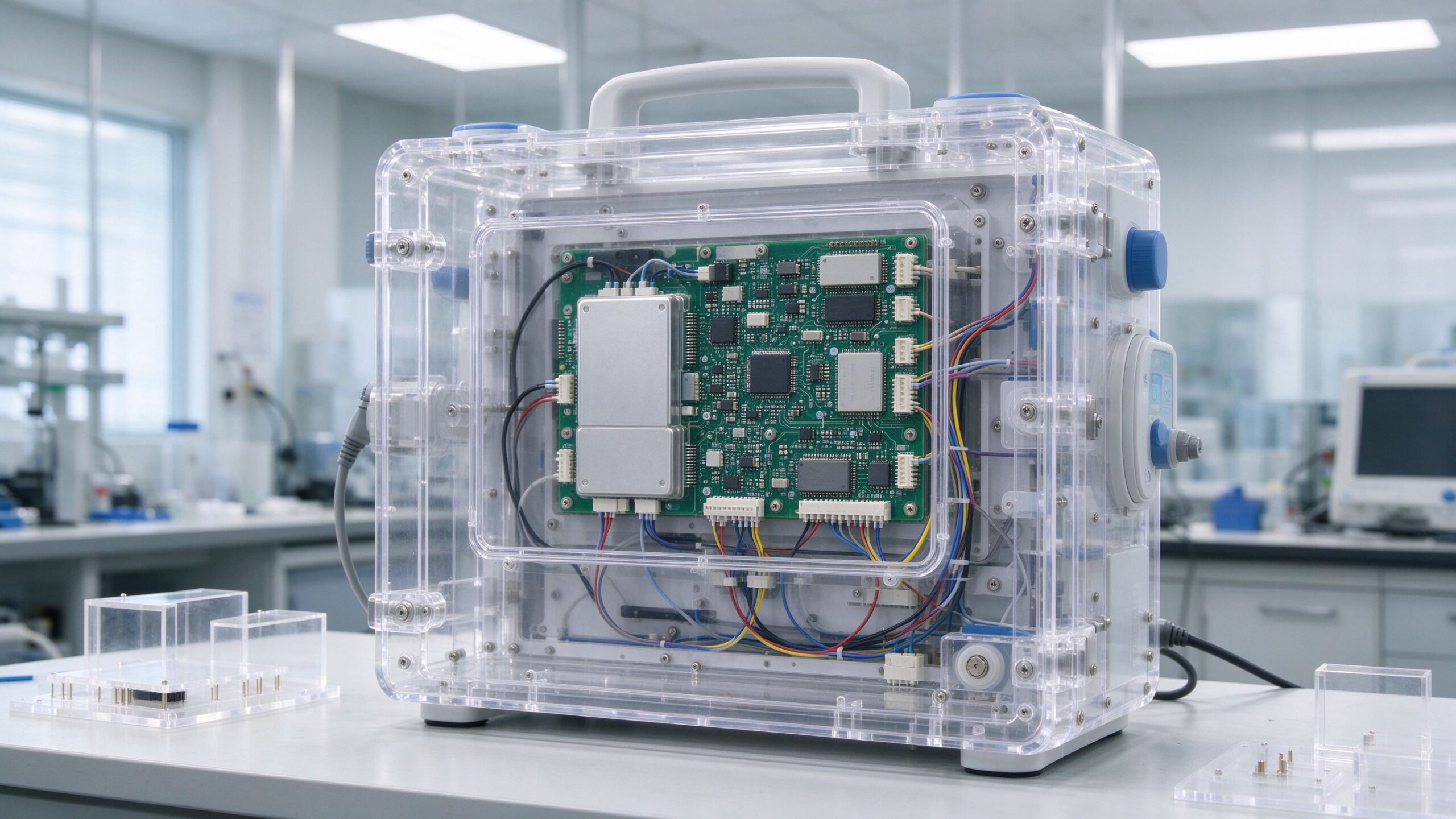
Thickness, holes and edge distance
- 5 mm for panels to roughly 600 x 400 mm with four supported edges
- 8 mm for spans near 1 m, or where the panel is handled weekly
- 10 mm where the panel is hinged daily or carries an interlock bracket
- Hole diameter at least 1.5 times the fastener, with an elastomer washer
- Edge distance at least 2.5 times the hole diameter, and never under 15 mm
- All cut edges deburred and lightly polished to remove saw marks
Those six lines prevent most of the failures we see. The seventh rule is movement: leave 2 mm of clearance per metre of panel against a steel frame, because acrylic expands roughly five times as much as steel over a 30 degree swing.
Ventilation and the cleaning question
A guard that seals a hot spindle needs airflow, but slots cut with a saw are crack starters. Drill a radiused pattern or mill slots with rounded ends, and deburr both faces before the panel goes into service.
Cleaning is the second trap. Alcohols, ketones and ammonia-based glass cleaners attack cast acrylic under residual stress. Neutral detergent, soft cloth, no dry wiping. If the site cannot control that, the guard should be polycarbonate. Our note on polycarbonate machine guarding covers the duties where PC has to take over, including swarf and coolant.
Ordering guards that fit
Send a drawing with the fixing centres, not a photograph. Panel size, hole pattern, edge radius, vent positions, hinge side and the cleaning chemical are the six data points that decide whether a quote is accurate. Cut-to-size supply with drilled holes and polished edges is standard for us, and the tolerances we hold are described in the cut-to-size service note.
Guards are safety components. Interlock selection, risk assessment and the machine directive remain the integrator responsibility; the sheet supplier responsibility is to deliver a panel that does not fail before the interlock does.
Send your guard drawing, panel size and cleaning regime to oversales@rpplexiglass.com and we will quote cast acrylic guards cut, drilled and edge-polished.
Frequently Asked Questions
When should a guard be polycarbonate instead of acrylic?
When the panel faces thrown parts, abrasive swarf or alkaline cleaning at concentration. Acrylic is harder and clearer but brittle under point impact; polycarbonate absorbs energy and survives, at the cost of scratch resistance.
What thickness is normal for a machine guard?
5 mm for panels up to about 600 x 400 mm with a supported edge, 8 mm for 1 m spans, and 10 mm where the panel is hinged and handled daily. Thicker panels need wider edge support, not just more material.
Can acrylic guards be cleaned with solvents?
No. Alcohols and ketones stress-crack cast acrylic under load, often within days. Use a neutral detergent with a soft cloth, and specify an anti-static additive if dust is the real problem.