
A good acrylic rod supplier is chosen on diameter tolerance, not on stock photographs. A lighting fixture designer in Copenhagen needed 4,000 acrylic rod segments, 12 mm diameter, 180 mm long, both ends polished, and she had been quoted four weeks by three suppliers who had never asked what the rod would do next. It went into a machined socket with a grub screw. That single detail decided the specification.
Four lines that make an acrylic rod supplier quote accurate
- Diameter and tolerance, stated as a band rather than a nominal
- Length and cut tolerance, plus whether ends are sawed, faced or polished
- Cast or extruded, and the clarity grade required
- What happens next: machining, threading, bonding, or nothing
The fourth line is the one buyers leave out. A rod that will be tapped needs annealing and a different diameter allowance than a rod that will sit inside a tube.
Diameter range and what changes at the top end
Clear cast rod is routine from 6 mm to 50 mm, available to 100 mm on scheduled runs, and above that it becomes a moulded or cast-to-shape discussion with a longer lead time and a real tooling cost. The tolerance band typically moves from plus or minus 0.3 mm at small diameters to plus or minus 1 mm at 80 mm and above, which matters if the rod is a bearing surface.
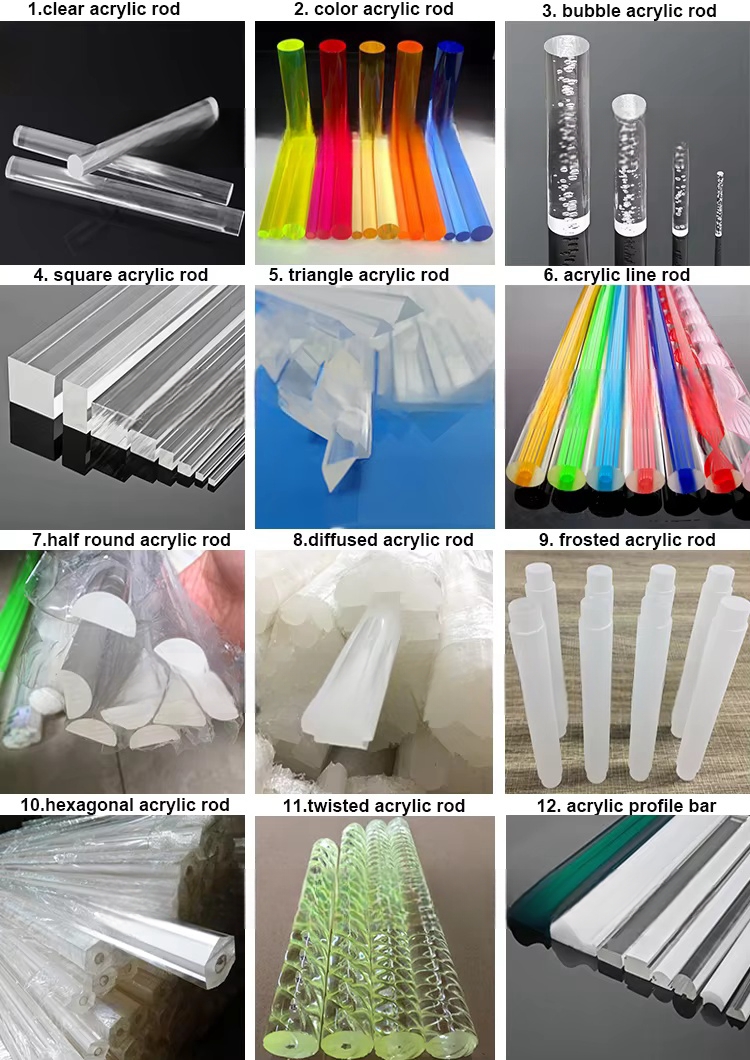
Cast versus extruded, in one paragraph
Cast rod is poured, so it has no extrusion line and no directional stress. It polishes to optical clarity and machines predictably. Extruded rod is pushed, so it carries a faint flow pattern and a memory of that direction; it is cheaper per metre and entirely adequate for spacers, standoffs and non-optical work.
End finish is a specification, not a courtesy
Sawed ends carry marks and a slight burr. Faced ends are flat but dull. Polished ends are clear and are what most display and lighting work actually needs, at roughly double the cut cost on small diameters because each end is handled twice.
State the finish per end. Half our rework enquiries come from an order that said cut to length when the drawing expected a polished face.
Annealing before the lathe
Machining introduces local stress, and stress plus a solvent is how acrylic crazes. For any rod that will be drilled, threaded or press-fitted, specify annealed stock and a slow ramp: heat to about 80 degrees Celsius, hold according to section, cool at under 10 degrees per hour.
A rod supplier who cannot describe that cycle is selling cut stock, not engineered stock. The same principle governs rod cut to length orders, where length tolerance and end condition travel together.
Where the rod usually ends up
Display hardware, light guides, furniture spacers, prototype shafts, cosmetic applicators. Display work is the largest single use, and it is also the most demanding on appearance: a 12 mm rod seen end-on magnifies every internal defect. The retail display note covers how rods are socketed without visible metalwork.
For that duty, ask for rods cut from the same cast batch. Two batches will differ in faint tint, and end-on viewing makes that difference visible across a shelf.
Send diameters, lengths, end finish and quantity to oversales@rpplexiglass.com; we will return a cut-to-length quotation within one working day.
Frequently Asked Questions
Should a rod be cast or extruded?
Cast rod is clearer, machines without internal stress patterns and is the right choice for optical or polished parts. Extruded rod is cheaper in long runs and better for non-critical spacers. Diameter tolerance differs between the two, so state which you accept.
How straight is a 2 m acrylic rod?
Cast rod is supplied straight within roughly 1 to 2 mm per metre over 2 m lengths. If your assembly needs better, specify a maximum bow and expect cutting from longer stock as the solution rather than a promise.
Can rods be annealed before machining?
Yes, and they should be for any part that will be drilled or threaded. Annealing at 80 degrees Celsius with a controlled ramp removes the internal stress that causes crazing around a machined hole.