
Two mirror panels, same size, same thickness, one 60% dearer. The buyer assumed the supplier was padding. The difference was a gold coating and a protective backing, and neither showed in the sample photograph the buyer had approved.
What the coating contributes to price
- Silver on acrylic — the reference finish, neutral colour, highest reflectivity, lowest cost per m²
- Gold on acrylic — warm tint, used where silver reads cold against timber or brass, adds a coating premium
- Silver with hard coat — adds scratch resistance for high-traffic retail and gym use
- Silver with adhesive backing — adds a laminating step and a release liner, priced per sheet not per m² of mirror
The two thicknesses that matter
2 mm mirror is the volume product: light, easy to cut, and it conforms to a flat substrate. 3 mm is chosen where the panel spans more than about 600 mm without support, because 2 mm at that span shows a wave that reads as a distorted reflection. Neither thickness is a structural product — mirror acrylic is a facing, and the flatness of what is behind it decides how the reflection looks.
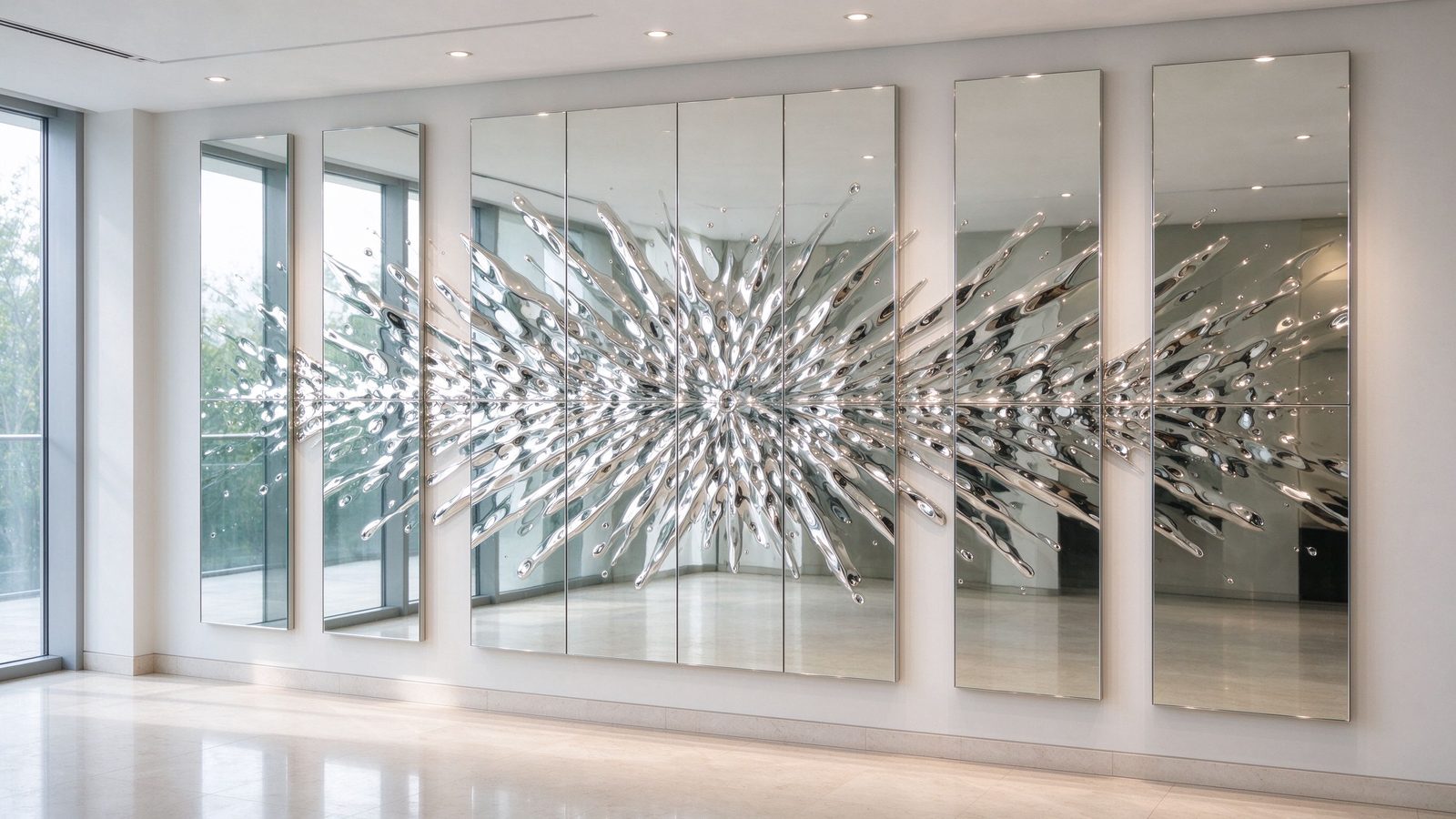
Where mirror grade fails at the fixing line
The coating is on the back, so every fixing point is a potential blind spot from the front. Adhesive pads that are not fully compressed leave a gap that shows as a halo. Screws tightened through the panel pull a dimple into the reflection that cannot be corrected later. The professional sequence: laminate to a flat substrate first, then fix the substrate, then never touch the mirror face.
A price comparison that holds up
Ask for the price per square metre at 2 mm and 3 mm for silver, gold and hard-coated silver, with the backing stated. Then add the substrate and laminating cost, because a mirror quoted without a backing is a mirror that will show every imperfection of the wall behind it. Weight matters too: acrylic mirror is roughly half the mass of glass mirror at the same thickness, which changes the fixing and the freight. The mirror versus glass comparison works through that trade.
Freight packaging is a real cost line on mirror. The reflective face cannot touch anything, so sheets ship with an interleaving film and a crate that holds them vertically; flat stacking marks the coating under its own weight. That is why a mirror quote carries a packing charge that a clear sheet quote does not, and why the per-sheet price is never quite comparable.
Warranty terms follow the same logic. A mirror laminated to a substrate and fixed correctly will hold its reflection for years; a mirror fixed directly to a rough wall will show every undulation within a month, and no supplier covers that. Ask what the warranty covers before comparing the last five percent of price.
Cutting mirror is its own discipline. A saw cut leaves a micro-burr that lifts the coating at the edge, and the lift propagates inward as a dark border within a season. Cut from the back with a sharp blade, leave the film on until fixing, and seal the cut edge on any panel that will see humidity.
For a silver or gold mirror quote with a backing and thickness recommendation, email oversales@rpplexiglass.com with the panel sizes and the lighting condition.
The finish and fixing questions come up in almost every mirror enquiry.
Frequently Asked Questions
Q: Why is gold acrylic mirror more expensive than silver?
A: The coating, not the acrylic. A gold tint requires a different deposition process and a tighter colour control, so the premium sits in the finish rather than the sheet.
Q: Should I choose 2 mm or 3 mm acrylic mirror?
A: 2 mm for panels up to about 600 mm span on a flat substrate. 3 mm where the panel is larger and unsupported, because 2 mm shows a visible wave in the reflection.
Q: Why do spots appear around fixings in acrylic mirror?
A: The reflective coating is on the back, so any uncompressed pad or over-tightened screw shows through as a halo or dimple. Laminate to a substrate and fix the substrate instead.