
A design studio approved an iridescent panel from a 100 × 100 mm swatch on a desk. The installed wall read green from the entrance and purple from the lift lobby, and the client rejected it. Nothing was wrong with the sheet. The swatch had been judged at one angle under one light.
Two families, two behaviours
- Metallic-pearlescent coatings — a pigment effect that shifts subtly and reads as a coloured metallic; stable at most angles
- Thin-film interference coatings — a multi-layer optical effect that shifts strongly with angle, from green to violet at 30° off normal
- Embossed or textured iridescent — the shift is broken up by the surface, giving a glitter rather than a smooth gradient
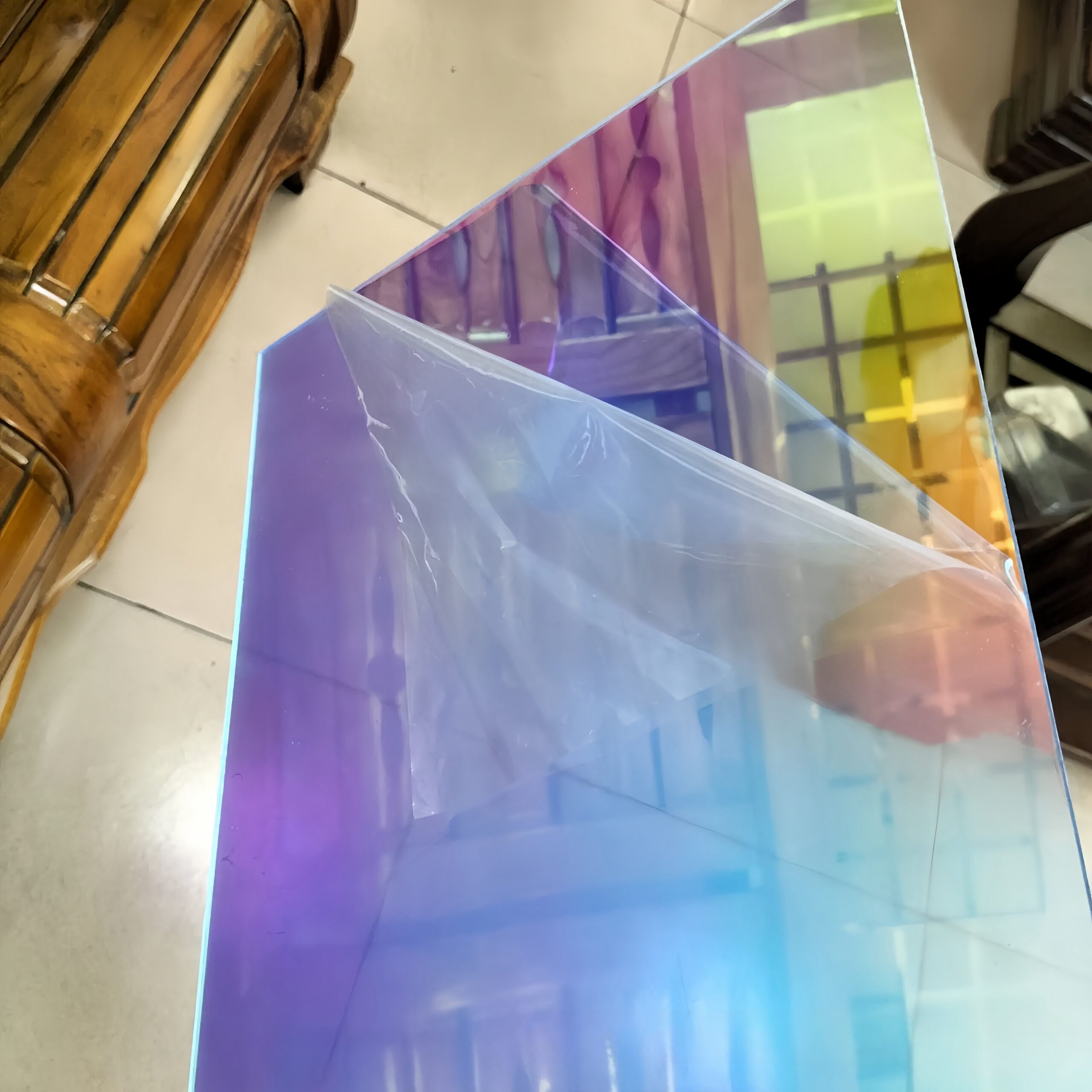
Approve at three angles, under two lights
The workable approval protocol: view the sample at 0°, 30° and 60° from normal, first under 4000 K ambient and then under the actual site lighting. Record which reference the client approved and keep that sample. Interference coatings are also sensitive to the light source spectrum — a panel that reads magenta under LED reads bronze under warm halogen, and no supplier can make both true.
Flat versus curved
On a flat panel the shift is uniform across the surface, which makes the effect read as a single colour that changes as you walk past. On a curved panel the angle changes continuously across the surface, so the panel shows a gradient from edge to centre. That gradient is the reason curved iridescent signage looks dramatic and flat iridescent cladding sometimes looks like a colour mismatch. Decide which behaviour the design wants before specifying the form.
Processing rules that protect the effect
The coating is a surface layer, so it is the first thing a saw burr or a protective film adhesive will damage. Cut from the back, keep the film on until installation, and never solvent-clean the face — alcohol dulls an interference coating permanently. Where a panel needs a coloured base rather than a coated face, colour and finish options sets out the alternatives, and coloured cast sheet covers through-colour grades.
Colour matching across panels is the second approval risk. Two sheets of the same interference coating read identically at the same angle but can differ at an oblique angle if the coating thickness varies across the batch. For a wall of adjacent panels, ask for panels cut from the same coating run and check them side by side at 30° before fixing.
Lighting design changes the effect more than the sheet does. A wash of 3000 K light pulls an interference coating toward gold; a 5000 K source pushes it toward blue-violet. If the design intent is a specific hue, specify it in terms of the light source and the angle, not in terms of a paint reference.
Sample control is the last step that protects the project. Keep the approved swatch, photograph it under the specified light at the specified angle, and attach both to the purchase order. When the delivered panels arrive, the comparison is then a factual check rather than a studio argument about what the client remembers approving.
Send the finish reference and the viewing angle to oversales@rpplexiglass.com and we will send physical swatches before you commit to a run.
Design teams normally need these three clarifications before specifying the finish.
Frequently Asked Questions
Q: Why does iridescent acrylic look different in the showroom and on site?
A: Because the effect depends on viewing angle and light spectrum. A swatch judged at one angle under one lamp will not predict a wall seen from several directions under site lighting.
Q: What is the difference between pearlescent and iridescent acrylic?
A: Pearlescent is a pigment effect with a subtle stable shift. Iridescent usually means a thin-film interference coating that changes colour strongly with angle.
Q: Can iridescent acrylic be cleaned with alcohol?
A: No. Solvents dull the interference coating permanently. Use a pH-neutral soap and a soft cloth, and keep the protective film on until installation.