
When a streetwear account in Rotterdam audited its wall of 96 pairs, the brief was blunt. The acrylic sneaker display shelf had to hold a full size 46 boot without visible bowing, keep every sole readable from 1.6 m away, and survive twelve floor moves a year without crazing at the brackets. The previous fit-out used 5 mm extruded sheet on 900 mm spans and had sagged 7 mm at the centre within four months. The replacement went to 8 mm cast acrylic, and that single material change decided the whole detail package.
What the acrylic sneaker display shelf actually carries
Display load is not the weight of one shoe. A tier of twelve pairs at 1.2 kg per pair plus a 300 mm steel riser lands roughly 18 kg on a 900 x 300 mm shelf, and the deflection limit the visual merchandising team will accept is about L/200, or 4.5 mm across the span. Cast sheet at 8 mm sits comfortably inside that; 5 mm does not once the riser load is eccentric.
- Shelf thickness: 8 mm cast acrylic for 900 mm spans, 10 mm above 1200 mm.
- Shelf geometry: 300 mm depth, 300 mm riser pitch, 15 mm upstand at the front to stop soles sliding.
- Edge finish: flame-polished or diamond-polished, never a raw laser kerf, which reads as a grey line under retail lighting.
- Weight per shelf with 8 mm sheet: about 9.5 kg/m2, so a 0.27 m2 tier adds 2.6 kg of its own.
Bonding, lighting and the two details that fail first
Most failures on this fixture type are not impact failures. They are solvent-bond failures at the riser joint and stress crazing where an LED strip was screwed directly into the sheet. A 25 mm square riser foot bonded with dichloromethane needs a 6 mm bond line, eight hours of clamp time and 48 hours before load; anything faster and the joint creeps under a full boot wall.
Lighting is the second one. An LED channel recessed 30 mm behind the front edge gives an even pool of light on the sole without hot spots, and it keeps the strip away from the acrylic surface. Screwing a strip into 8 mm cast acrylic at 150 mm centres introduces local stress that turns into fine cracks after two or three seasons of cleaning with ammonia-based glass spray.
Where the money actually goes
On a 20-tier wall the difference between a quote that lasts three years and one that lasts one is not the sheet price. It is the polishing, the jig-built bonding, and packing that keeps tiers from twisting in transit. Ask for the bond-line drawing, not just the thickness.
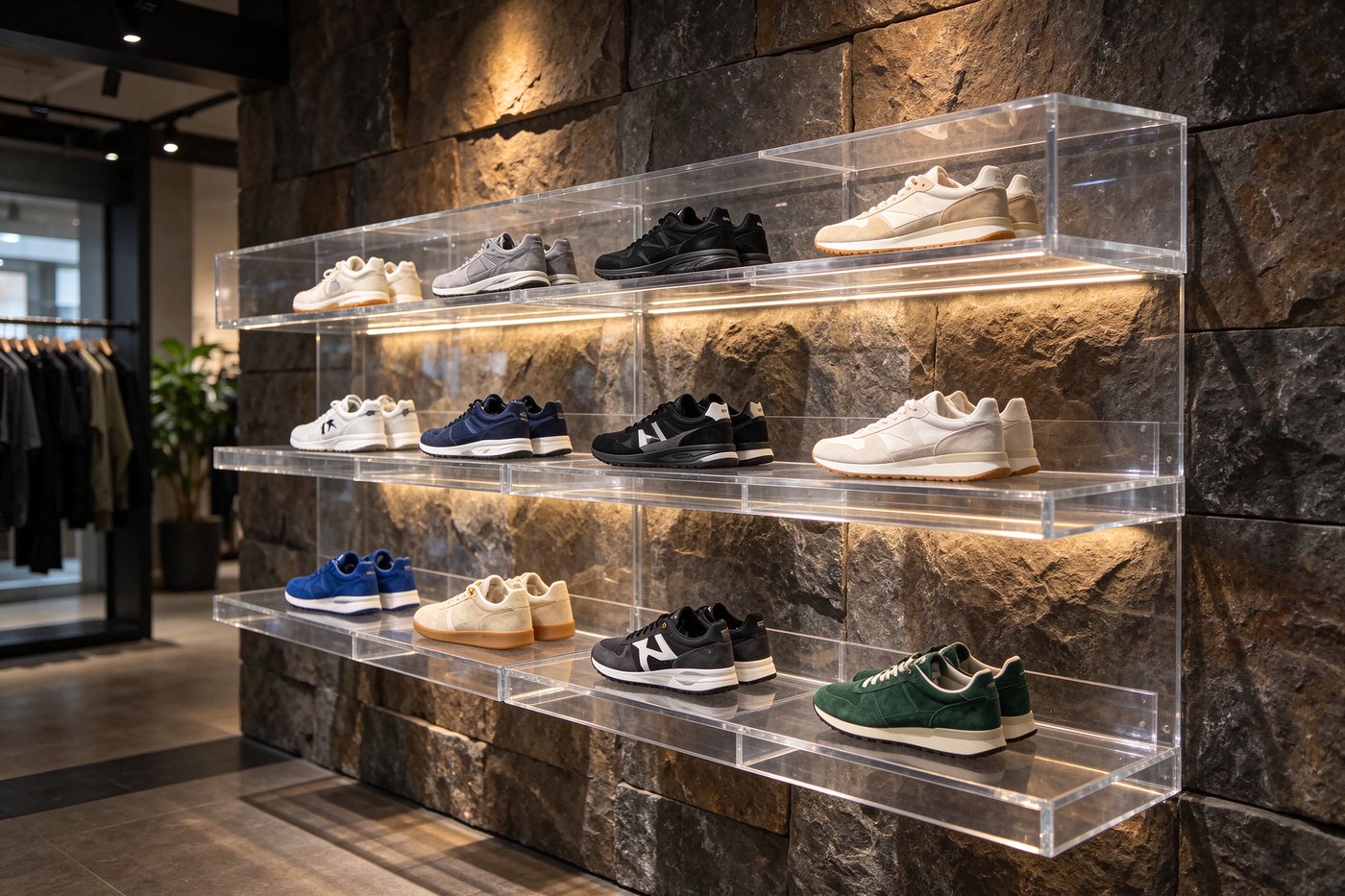
How River People builds to this specification
River People cuts 8 mm and 10 mm cast acrylic on a CNC router with ±0.5 mm positional tolerance, flame-polishes every visible edge, and bonds risers on flat granite jigs so a 20-tier set arrives within 1 mm of common plane. Batches of 20 to 200 tiers are routine, packed with foam cradles and a tier-by-tier lifting plan.
Send your wall dimensions and pair count to oversales@rpplexiglass.com and we will return a tier schedule with sheet thickness, riser pitch and packing weights.
A single-pair wall display follows much the same load logic, and our note on the acrylic shoe display shelf covers the smaller spans.
Frequently Asked Questions
Can an acrylic sneaker display shelf be used outdoors?
Standard cast acrylic will yellow and chalk outdoors within two years. For a covered entrance or a pop-up in direct sun, specify UV-filtering cast sheet and keep the fixture under a canopy; for permanent outdoor use polycarbonate is the more durable choice.
Is 5 mm enough if the shelves are short?
Below 600 mm span, 5 mm cast acrylic is workable for single pairs with a 150 mm riser. Above 600 mm, or once a tier carries more than eight pairs, the sheet bows and the front upstand starts to flex.
How are the tiers cleaned without crazing?
Use a pH-neutral acrylic cleaner and a microfiber cloth, never ammonia glass spray or alcohol on extruded sheet. Dry the joint lines last so solvent residue does not sit in the bond.