
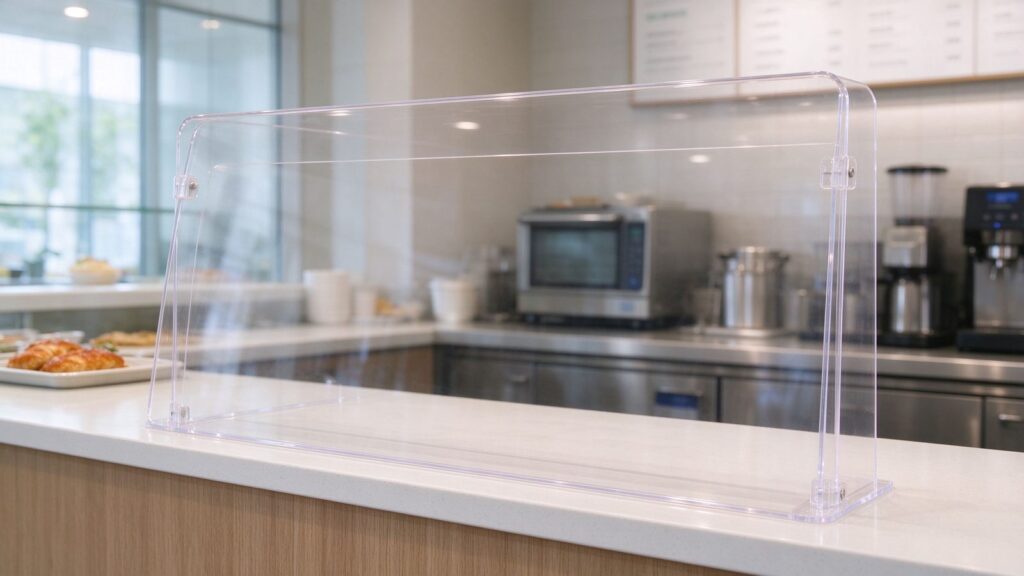
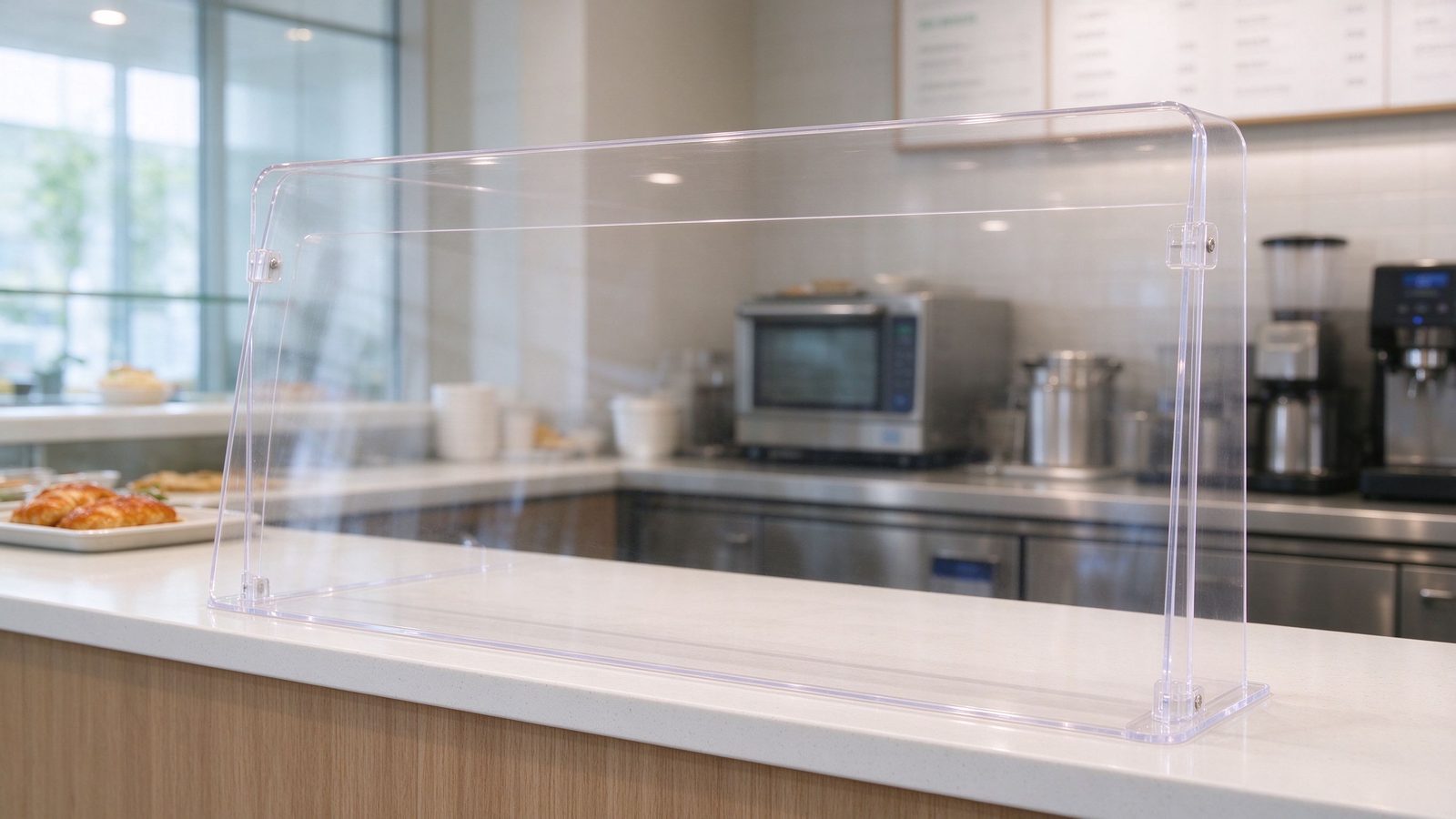
An acrylic sneeze guard is one of the simplest pieces of protective glazing to specify, yet it is easy to get wrong – too thin and it flexes, the wrong finish and it smears, the wrong fixing and it becomes a hazard. This guide covers what a food-service or clinic buyer should specify for an acrylic sneeze guard, and how RP River People supplies the material.
Thank you for reading this post, don't forget to subscribe!A case worth copying: the hospital cafeteria line
A hospital cafeteria fitted its self-serve line with acrylic sneeze guards on every station. The spec used 5 mm clear acrylic, slightly textured on the outer face to hide fingerprints, fixed with counter clamps and edges polished. Because the sneeze guard acrylic was flat, clean-edged and the right thickness, the barriers stayed rigid, wiped clean between services, and passed the hygiene inspection without complaint.
Why acrylic for sneeze guards
- Optical clarity – customers can see the food while protected.
- Easy to clean – smooth, chemical-resistant faces wipe with standard sanitisers.
- Light and safe – no sharp glass edges; acrylic is shatter-resistant.
- Machineable – cut, edge-polished and drilled for clamps and brackets.
- Options – clear, tinted or textured finishes to control smudges and glare.
What to specify: thickness, finish and fixing
- Thickness: 3-5 mm typical; taller and larger partitions move to 6 mm.
- Finish: clear for visibility; a matte or textured outer face hides fingerprints.
- Fixing: counter clamps, brackets or a full framed stand depending on the counter type.
- Edge: polished edges for a professional, safe finish.
- Size: cut to the counter or station dimensions with a pass-through gap where needed.
Fabrication and hygiene notes
- Cut and edge-polish so there are no sharp or cloudy edges at hand height.
- Drill fixing points before installation to keep brackets aligned.
- Keep masking film on until install so the face arrives scratch-free.
- Use radiused corners at the top to avoid sharp points.
- Specify anti-static or matte finishes where dust and smudges are a concern.
Market pain points – and our solution
The common complaints: guards that arrive flexing and out of square, edges that are sharp and cloudy, faces scratched from poor packing, or a supplier who cannot cut to the counter length. RP River People, as a sheet manufacturer, supplies acrylic sneeze guard material in the thickness and finish you specify, held to tight flatness and size tolerance, edge-polished, and packed with masking film and corner protection so it arrives install-ready.
Frequently Asked Questions
Q: What thickness should an acrylic sneeze guard use?
3-5 mm is typical for counters and kiosks; larger or taller partitions move to 6 mm for rigidity. Confirm with the panel size and fixing type.
Q: Can sneeze guard acrylic be cleaned with sanitisers?
Yes. Acrylic resists standard food-service sanitisers; wipe with a soft cloth and avoid abrasive pads and solvents that can cloud the surface.
Q: Do you supply acrylic sneeze guard sheet cut to size?
Yes. We supply clear and textured acrylic sneeze guard material cut to your dimensions, edge-polished and export-packed with masking film.
If you are specifying acrylic sneeze guard guide for a project, send us your sizes and requirements. Contact us for a quote and we will confirm grade, thickness, tolerance and lead time: oversales@rpplexiglass.com.