
A 2,400 mm diameter cylinder holding 1,800 mm of water looks like a tube order. It is actually a pressure calculation with a diameter attached, and the diameter is the number that decides whether the tube can be made at all.
Start from the ring stress, not the diameter
For a thin-walled cylinder the hoop stress is p × D divided by twice the wall. At 1.8 m of water the pressure at the base is 17.6 kPa. On a 2,400 mm diameter that gives 21.2 kN per metre of wall height, and at an allowable long-term stress of 6 MPa for cast acrylic in permanent water contact the wall works out at 35 mm, rounded to 40 mm for the joint allowance at the base.
That is the number buyers rarely see quoted, because catalogue tube is sold by outside diameter and wall, and a 2,400 mm tube at 40 mm wall is a bespoke casting, not a stock item. Stock acrylic tube for aquarium use realistically stops around 600–800 mm outside diameter; above that the tube is cast to order in a fixed-length mould.
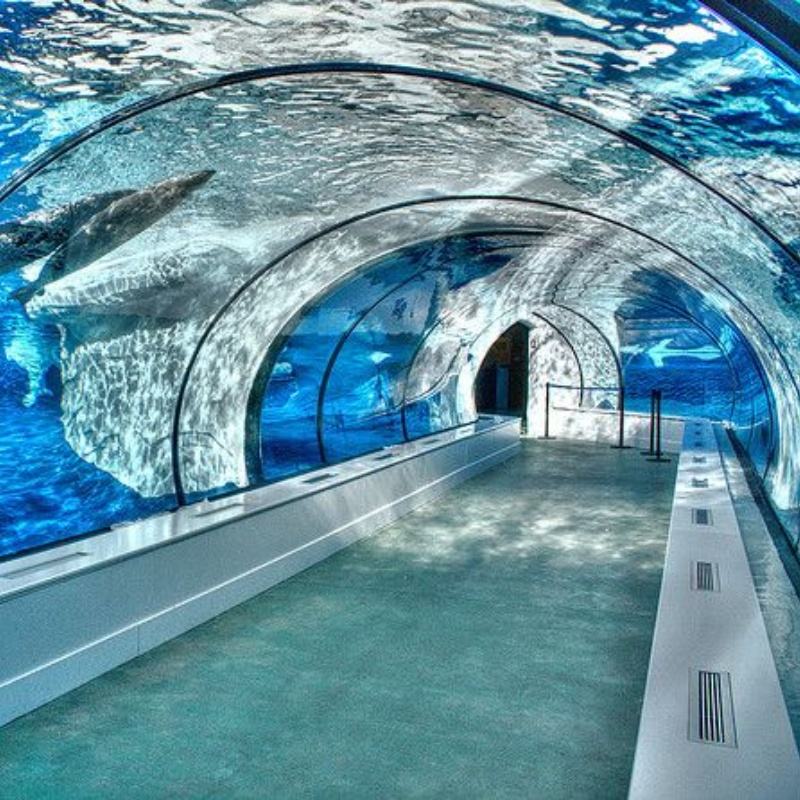
Where a tube wins over a flat panel
- Cylindrical tanks under about 3 m diameter — the ring carries the load, so no external frame is needed
- Viewing tunnels and walk-through sections, where the curve removes the corner joints that fail first
- Feature columns in shopping centres, where the tube is the display and the water is the contents
- Small-diameter standpipes and overflow housings inside a sump — tube is cheaper than fabricated box sections
End treatment decides the service life
A cast tube arrives with a moulded end and a saw cut at the other. The saw cut must be annealed before it is bonded, or the base joint will craze within a season. Anneal at 80 °C for one hour per 10 mm of wall, then cool at no more than 5 °C per hour. Bond the base with a two-part methacrylate rather than solvent cement: solvent on a 40 mm wall cannot evaporate from the joint line, and the trapped solvent is what turns the joint white six months later.
Ovality is the other silent failure. A tube that is 6 mm out of round will not sit flat on a base plate, so the bond line varies from 0 to 6 mm and the load sits on one arc. Specify ovality within 1% of diameter and check it with a calliper at four points before accepting the delivery. For a flat viewing window comparison, the cylindrical aquarium build notes cover the frame side of the same decision.
Lighting changes the tube specification more than buyers expect. A cylinder lit from below shows every internal scratch and every bubble in the bond line, because the light travels along the wall. Specify cast tube with a minimum of visible striae, inspect under a collimated light before bonding, and keep the bond line below the substrate so the light does not run into it.
Freight is the other hidden factor. A 2,400 mm tube at 40 mm wall weighs about 340 kg per metre, so a 2 m section is 680 kg and needs a cradle rather than a pallet. Price the crate and the lifting points at quotation stage; the tube is rarely the expensive part of a large cylindrical tank, the handling is.
If you need tube diameters, wall thickness and end finish quoted against a tank layout, write to oversales@rpplexiglass.com with the drawing and we will answer with a cut list.
Two questions decide most tube enquiries before a drawing is even opened.
Frequently Asked Questions
Q: What is the largest acrylic tube available for aquarium tanks?
A: Stock tube is practical to roughly 600–800 mm outside diameter. Larger cylinders such as 2.4 m are cast to order in a mould, with wall thickness set by water depth rather than by a catalogue.
Q: How thick should an acrylic tube wall be for 1.8 m of water?
A: About 35 mm at 2,400 mm diameter, rounded to 40 mm to allow for the base joint. The figure comes from hoop stress at 17.6 kPa, not from a wall-to-diameter rule of thumb.
Q: Why do tube tank bases turn white at the joint?
A: Solvent cement trapped in a thick joint line. Above roughly 20 mm wall the solvent cannot escape and crazes the bond; a two-part methacrylate adhesive avoids it.