
Two crews installed the same acrylic noise barrier design on the same highway, eight kilometres apart. One finished with eleven cracked panels. The other finished with none. The difference was not the sheet, the supplier or the weather. It was the order in which the two crews did four things, and the second crew did them in the right order.
The order that decides the outcome
On an acrylic noise barrier the panel is the last element to be fixed and the first element to be damaged. Everything before it exists to make sure the frame is flat, square and at the right centre distance when the panel arrives. That is why the sequence below is written as a sequence and not as a checklist: step 3 only works if step 2 actually closed.
- Post survey and centre-distance record — every post measured, not sampled
- Base plate shimming until the post is plumb within 2 mm over 3 m
- Panel set-out from a fixed datum, not from the previous panel
- Panel lift, locate, then fix — never fix while the panel is still on the sling
- Torque in two passes, outside in, after the panel has been in the sun for an hour
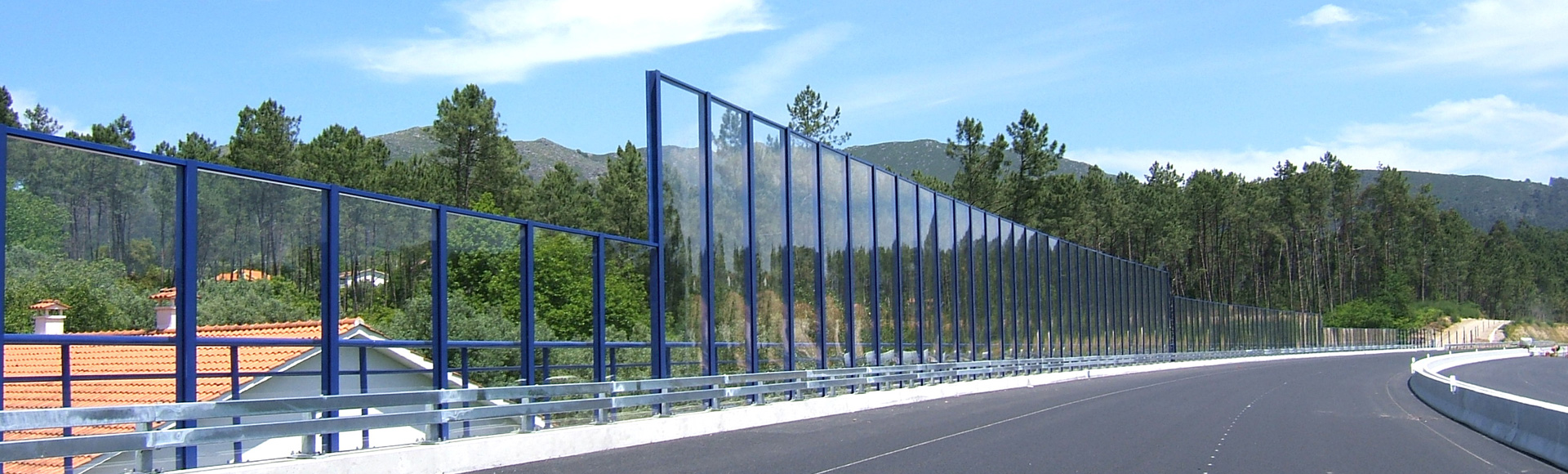
Why the 15 mm gap is not optional
Cast acrylic moves 0.065 mm per metre per degree Celsius. On a 2 m panel in a climate that swings from 5 °C at night to 35 °C in the afternoon, that is 3.9 mm of movement along the panel width, and the panel is held at both ends. A 15 mm expansion allowance at each vertical edge absorbs it. Crews that “close the gap for a cleaner line” convert that movement into compressive stress at the bolt holes, and the crack starts at the hole, not at the edge, which is why it is often blamed on the sheet.
Torque, and why two passes
M12 stainless bolts into an aluminium mullion are tightened to 40 N·m in the second pass. The first pass at 20 N·m exists to seat the panel without pre-loading one corner. A single pass at full torque pulls the panel into the frame before the neighbouring bolts are seated, and the resulting distortion shows up as a wavy reflection line that no amount of polishing removes.
Wind is a stop-work condition, not a comfort issue. Panels above 2.4 m² should not be lifted above 12 m/s, because the panel becomes an aerofoil on the sling and the edge takes the landing. On the reference job the first crew lost three panels to a gust at 14 m/s and then discovered the second failure was caused by the temporary clamp that was still attached when the panel was lifted.
The one detail that most installation drawings leave out is the fastener sequence around the vertical joints. If the two adjacent panels are bolted tight before the horizontal rails are set, the joint becomes a rigid point in an otherwise moving wall. Set the rails first, then the vertical joints, then re-torque the rails. A tested transparent barrier panel is only as good as this sequence, and our panels with embedded threads exist precisely to remove one threaded step from it.
Panel supply and panel fixing are two contracts that meet at the same hole. On the reference job the panels arrived with a 22 mm hole and the mullion was drilled at 20 mm on site, so every hole was reamed by hand and every reamed hole lost its edge protection. Agree the hole diameter, the bolt grade and the washer type on one drawing before either party cuts metal.
Acceptance testing is worth scheduling before the last panel goes in, not after. A 30 m test section with a sound level meter at 1 m and 100 m tells you whether the wall is performing as designed while there is still access to adjust the panel gaps. Waiting for the full run means any acoustic shortfall is a contractual argument rather than an adjustment.
For projects on a fixed installation window, send the barrier drawing, post spacing and site wind data to oversales@rpplexiglass.com and we will return panel sizes with a fixing schedule.
The questions that come back after every installation season are the same three.
Frequently Asked Questions
Q: What gap should be left between acrylic noise barrier panels?
A: About 15 mm at each vertical edge on a 2 m panel in a climate with a 30 °C swing. The allowance is calculated from 0.065 mm per metre per degree, not copied from a previous job.
Q: Can acrylic noise barrier panels be installed in wind?
A: Lift only below 12 m/s for panels over 2.4 m². Above that the panel behaves like an aerofoil on the sling and lands on its edge, which is where cracks begin.
Q: Why do cracks appear at the bolt holes after installation?
A: Almost always over-torque in a single pass plus a closed expansion gap. The panel is compressed between two fixed points and the hole becomes the stress concentrator.