
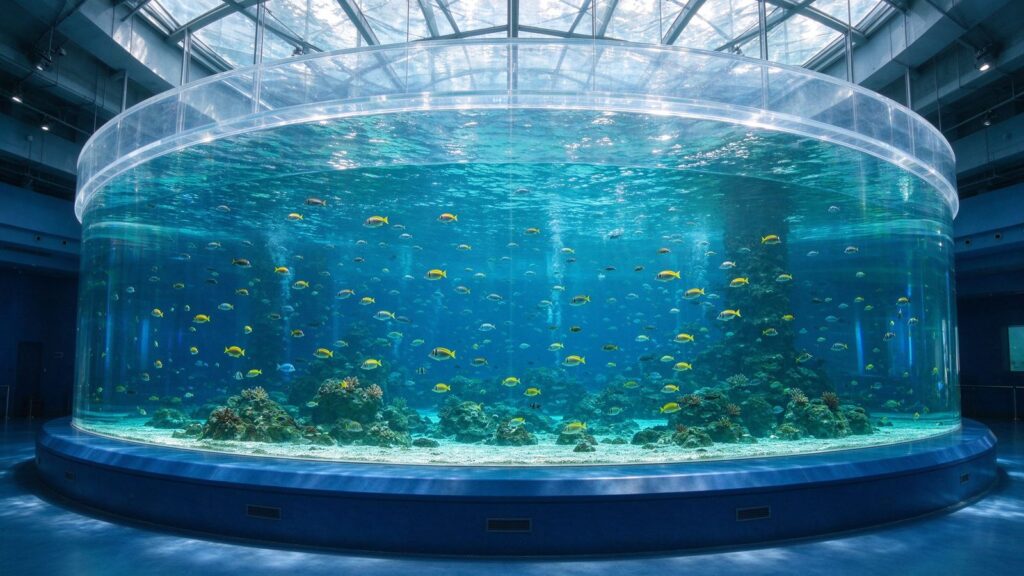
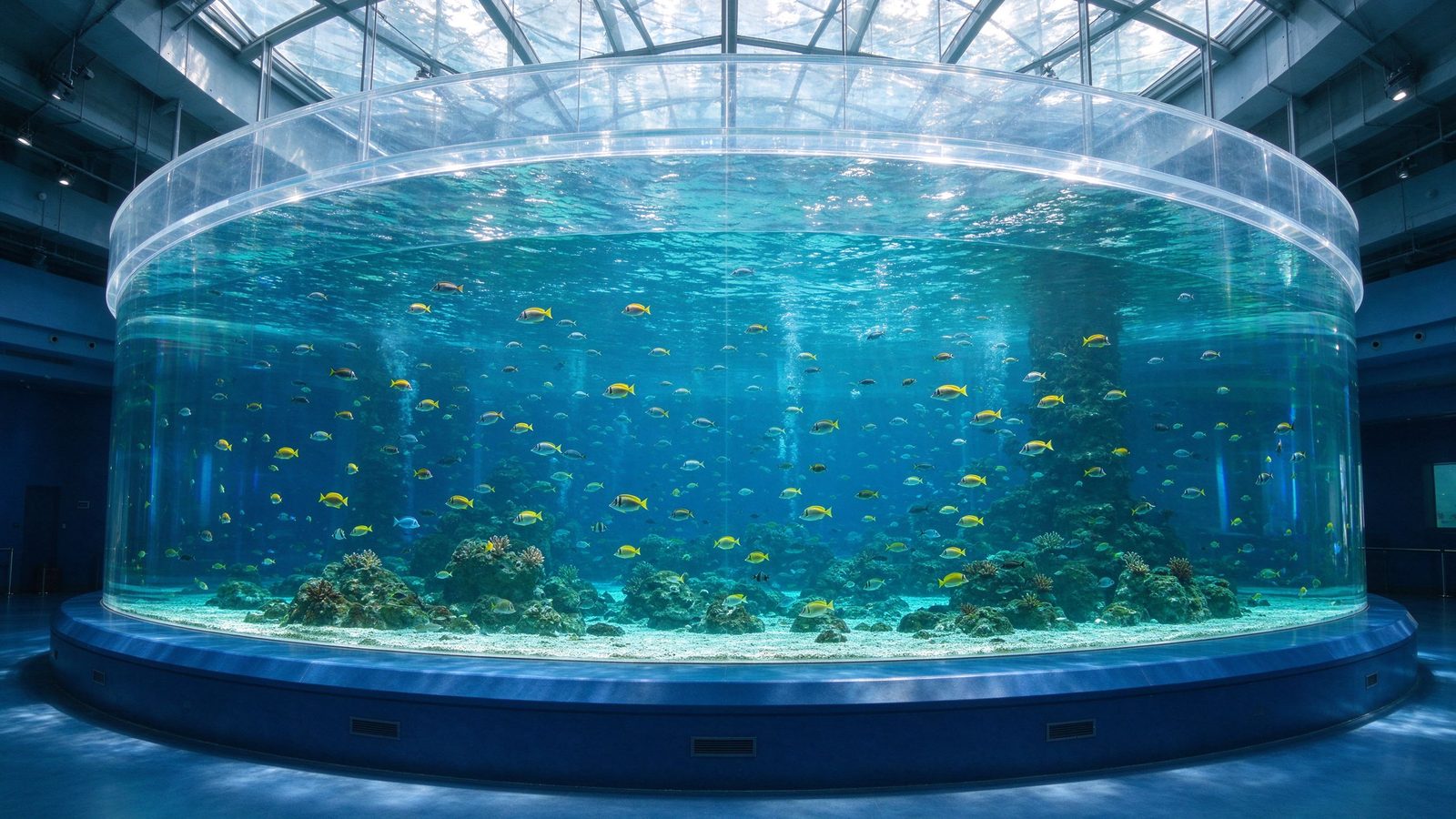
Large-format cast acrylic is what stands between visitors and the ocean in every serious public aquarium and oceanarium. A municipal aquarium’s viewing panel is not a thin sheet – it is an ultra-thick, ultra-large casting, typically 100-300 mm thick and spanning metres, engineered to hold back thousands of tonnes of seawater for decades. Getting this right comes down to the casting capability of your supplier. This guide covers the thickness, size, tolerance and sourcing that actually matter for aquarium and oceanarium projects.
Thank you for reading this post, don't forget to subscribe!Why cast acrylic, at this scale, for aquarium panels
Nothing else delivers the combination of optical clarity and structural strength that ultra-thick cast acrylic provides under permanent hydrostatic pressure:
- Optical clarity – low haze and high light transmission, even through 200-300 mm of material, for an unobstructed view of the exhibit.
- Hydrostatic strength – thick cast sheet distributes the enormous water load across the panel without shattering like glass.
- Seamless fabrication – thick panels are solvent-cemented into monolithic, oversized or curved assemblies where a single cast is not practical.
- UV stability – water-white grades resist yellowing and hazing for years in indoor and coastal installations.
Thickness: 100-300 mm is the real range
Forget thin retail sheet. A public oceanarium viewing panel is an engineering product whose thickness is calculated from water depth, unsupported span and the safety factor the exhibit demands. In practice, panels are cast 100, 150, 200 or 300 mm thick – and occasionally more for the deepest exhibits. Every additional 50 mm of thickness changes the hydrostatic design, the casting time, the machining and the transport, so the figure is agreed from your drawings, never guessed.
Size: ultra-large panels, 3 m x 10 m and beyond
The footprint is just as demanding as the thickness. Real aquarium panels commonly span such dimensions as 3000 x 10000 mm (3 m by 10 m) or larger. Such panels are produced either as a single jumbo casting – which demands a very large mould, long polymerisation and heavy lifting capability – or as precision cement-joined assemblies where single-piece casting is impossible to ship or install. This is the difference between a supplier who can genuinely deliver oceanarium glazing and one who only resells standard sheet.
Tolerance, machining and finishing that matter at this scale
At 200 mm thick and 10 m long, small errors become project-stopping problems. Confirm with your supplier:
- Tight thickness tolerance across the full panel, verified against your gasket and frame drawings.
- CNC edge finishing, access holes and radius work on ultra-thick material.
- Cement-bonded joints and curved panels for multi-panel or arched exhibits.
- Masking film kept on until installation to protect the optical surface.
- Heavy-duty steel-frame crate packaging built for sea freight, so a panel this size arrives square and unscratched.
Market pain points – and our solution
Sourcing ultra-thick, ultra-large aquarium acrylic, buyers usually hit the same walls: panels that come in undersized on thickness, yellowing after a few seasons, joints that leak under load, and – most often – suppliers who simply cannot cast or handle a 3 m x 10 m x 200 mm panel. This is exactly what RP River People focuses on. As a manufacturer of cast acrylic sheet, we support ultra-thick and ultra-large aquarium grades in custom size and thickness, hold tight tolerance through machining and cementing, protect every panel with masking film and export-grade steel crates, and walk you through samples, engineering confirmation and clear RFQ responses.
Frequently Asked Questions
Q: How thick does a public aquarium viewing panel need to be?
It is an engineering calculation based on water depth, panel span and the hydrostatic load. In real oceanarium projects, viewing panels are almost always cast 100-300 mm thick, with the exact figure rising with depth and unsupported width. We calculate the recommended thickness from your exact dimensions before quoting.
Q: Can you cast panels as large as 3 m x 10 m, or bigger?
Yes. Ultra-large panels in the range of 3000 x 10000 mm and larger are our focus – as a single jumbo casting where possible, or precision cement-joined where transport or installation makes single-piece impractical. Tell us your footprint and we will advise cast vs joined.
Q: What is your MOQ and lead time for ultra-thick, ultra-large panels?
MOQ depends on sheet size and thickness, and we supply samples for grade and optical quality confirmation first. Because jumbo thick castings are slow to cure and machine, lead time for these panels is typically 30-60 days plus sea freight, depending on thickness, size and fabrication.
If you are sourcing aquarium or oceanarium glazing – a 100-300 mm viewing panel, a 3 m x 10 m jumbo sheet, or a curved cement-joined assembly – send us your footprint, water depth and target thickness. Contact us for a quote and we will respond with an engineering recommendation, a price and a realistic lead time: oversales@rpplexiglass.com.