
A dental lab evaluates a petg clear aligner sheet on the model, not on the datasheet. The sheet either seats over the contacts without thinning at the incisal edges, or it pulls a web and the aligner is remade. Everything a lab needs to know about a sheet order follows from that forming behaviour.
Here is the four stage route we recommend to a lab setting up a new sheet supply.
Stage one: gauge and the petg clear aligner sheet forming window
- Gauge: 0.75 mm for minor movement, 1.0 mm for moderate
- Forming temperature: 120 to 140 C sheet surface, measured not guessed
- Drying: 4 hours at 65 C before forming in a humid climate
- Optical: haze under 1 percent on a 1 mm sample
- Biocompatibility: ISO 10993 statement plus lot traceability
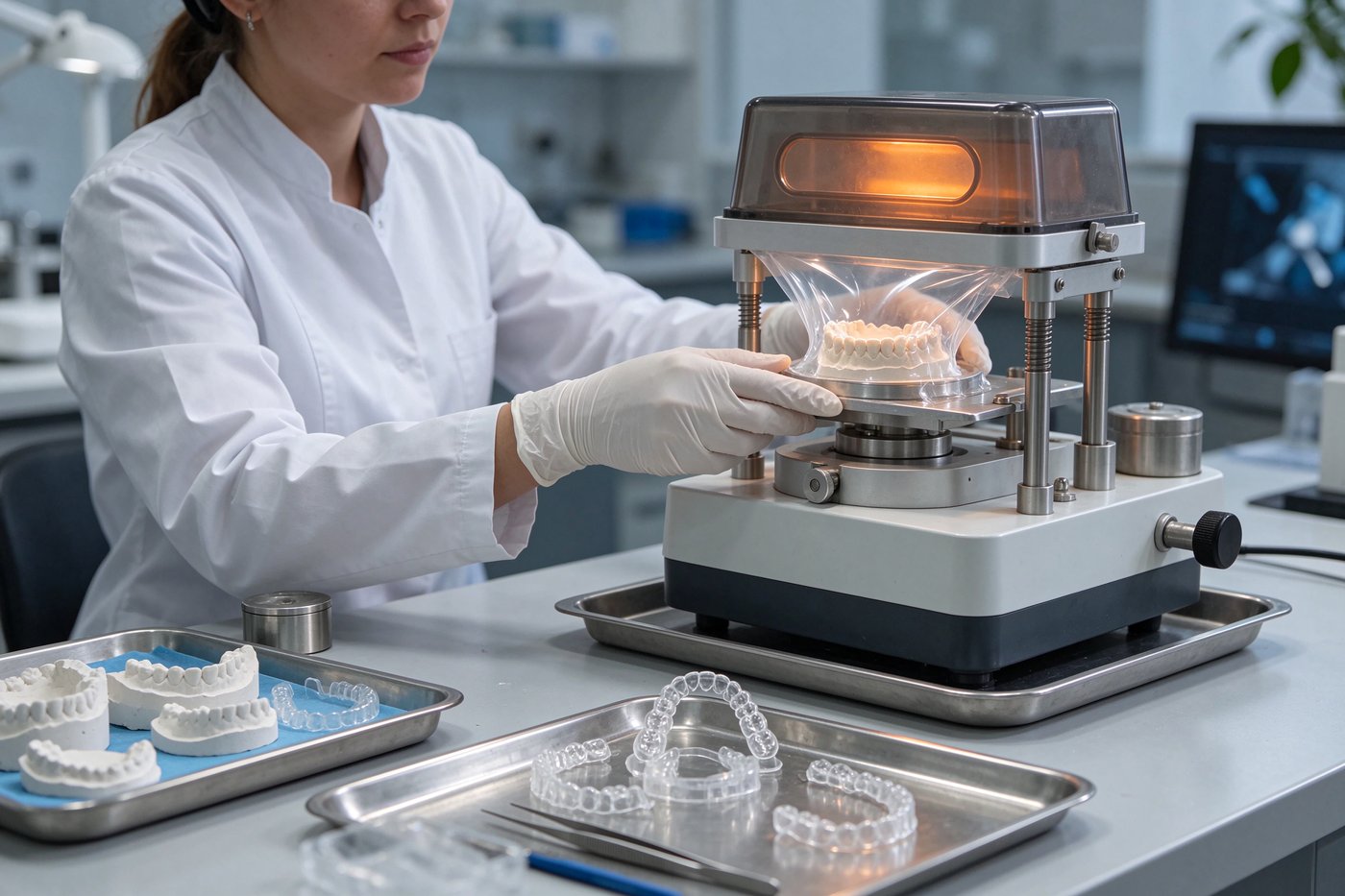
A lab that forms at 110 C gets an aligner that looks right and relieves within a day, because the sheet did not reach the temperature where it flows around a contact. The same sheet at 135 C seats cleanly. Surface temperature measured with a contact probe is the only reliable control, since oven settings vary by 15 C between units.
Stage two: model preparation and the petg clear aligner sheet seat
Seating depends on the model as much as the sheet. A printed model that has not been post cured releases residue that bonds to the sheet, and a stone model with a rough finish leaves the aligner tight in the wrong places. We recommend a light separation agent on stone and a fully cured print before forming.
Stage three: trim, polish and the petg clear aligner sheet edge
Trimming is where a formed aligner gains or loses comfort. A 0.5 mm margin above the gingival line is the target, cut with a burr at moderate speed so the edge does not melt. Polishing with a soft wheel and no heat keeps the edge clear; a hot edge turns white and a patient reads that as a defect.
Stage four: packing and the petg clear aligner sheet shelf life
Sheet absorbs moisture in storage. Sealed bags with desiccant hold properties for twelve months, and an open box on a bench in a humid clinic loses forming behaviour within weeks. We ship in 1 kg sealed packs with a lot label and a material statement, and can supply a forming trial pack of both gauges before a lab commits to a volume.
Send model dimensions, gauge and annual volume to oversales@rpplexiglass.com for a sheet specification and sample pack.
Labs that form aligners often form guards on the same machine, and the face shield article compares optical clarity and forming behaviour across PETG grades. PETG sheet for face shields covers that part of the specification.
Frequently Asked Questions
Which gauge for a first aligner?
0.75 mm for a first stage on a compliant patient, 1.0 mm where the movement is larger. Thicker sheet holds force longer but seats less accurately over tight contacts.
Does the sheet need a biocompatibility file?
Yes. A device maker needs a material statement covering ISO 10993 relevant parts, plus a batch traceability record for each lot used.
Why does an aligner turn cloudy?
Moisture absorbed during storage or forming below the recommended window. Sheet should be dried before forming and stored in a sealed bag with desiccant.