
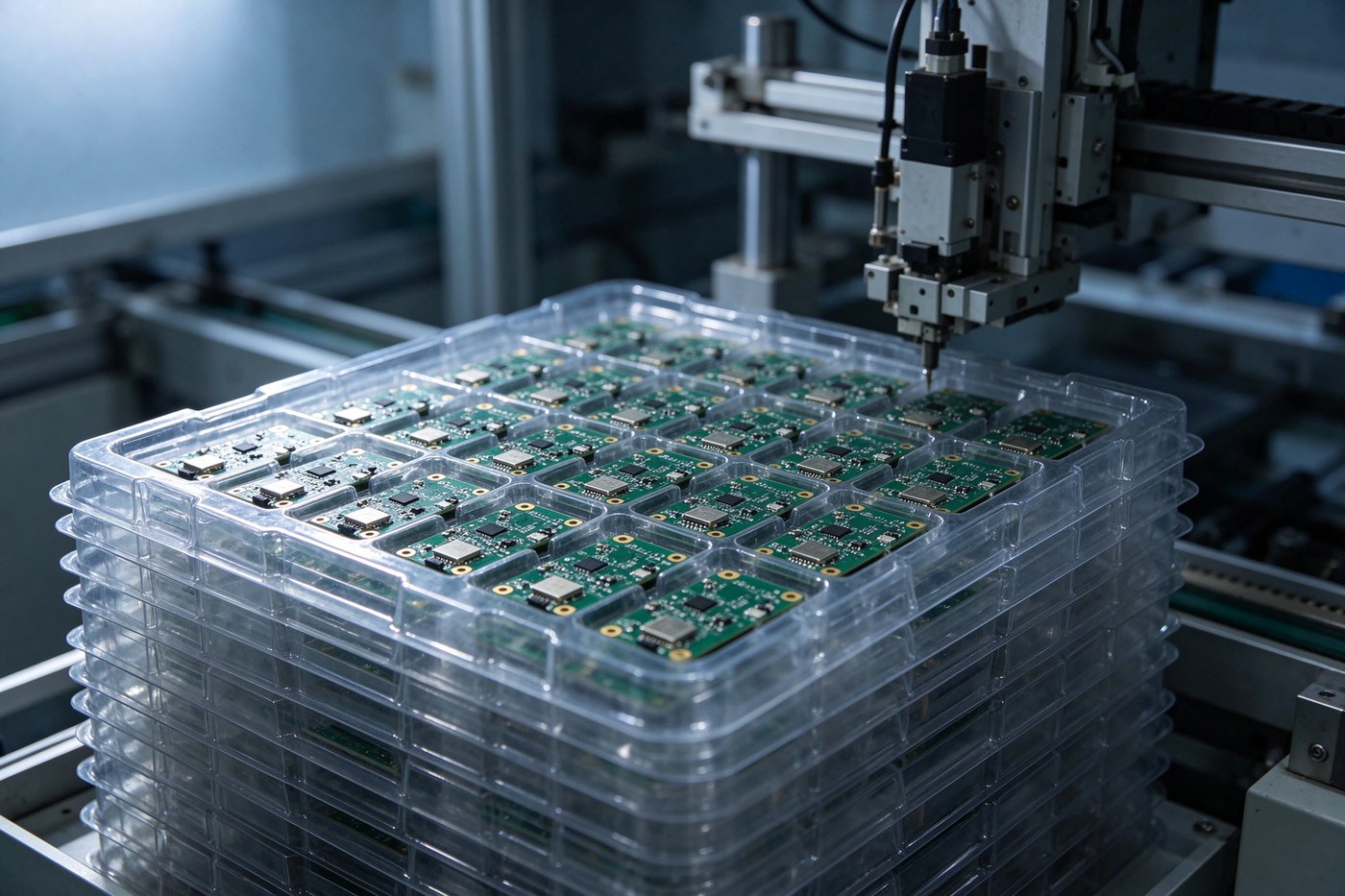
An electronics assembler in Penang stopped a pick and place line for three hours because the trays in the magazine had warped. The parts were within tolerance when they left the moulder and 2.4 mm out of flat a week later. The cause was residual strain in a petg electronics packaging tray formed at the bottom of the temperature window and stacked warm.
Circuit board handling rewards flatness over almost everything else, and flatness is a forming process outcome rather than a sheet property.
Sheet and process for a PETG electronics packaging tray
A 300 x 200 mm tray with 20 cavities for a 40 x 30 mm board is normally 1.0 mm PETG. The sheet must be dry, and the forming window sits between 115 and 125 C, with a plug assist over the cavities so the floor stays flat and the walls do not thin.
- Sheet: 1.0 mm PETG for trays to 400 x 300 mm; 1.2 mm above that or for deep cavities.
- Cavity tolerance: plus or minus 0.3 mm on the pitch, which is what the pick and place vision system needs.
- Flatness: 1 mm over the tray, measured after 24 hours, not at the press.
- Antistatic: surface resistivity of 10 to the 9 to 10 to the 11 ohm range for ESD-sensitive boards.
Warp control is a cooling problem
PETG relaxes for hours after forming. A tray stacked at 40 C in a pallet of 50 will bend under its own stack weight as the strain releases, and the bottom tray takes the worst of it. Two changes fix it: a cooled fixture that holds the tray to under 30 C before release, and a 24 hour flat stacking cure with a light weight before packing.
Thicker sheet does not fix warp; it stores more strain. The remedy is thermal, not mechanical.
ESD options and the cleaning question
Standard PETG is an insulator. For boards that need ESD protection, an antistatic grade or a permanent dissipative coating brings surface resistivity into the 10 to the 9 to 10 to the 11 ohm range. Coatings wear at the contact points, so a grade that is dissipative through the sheet is usually preferred for a tray that is handled 20 times a day.
River People supply
River People supplies PETG sheet for tray tooling in 1.0 and 1.2 mm, dry-packed, with gauge held to plus or minus 0.05 mm across the pallet so cavity depth repeats. Antistatic grades are available on request with a resistivity certificate, and lots are traceable to one extrusion run.
Send your board outline and cavity pitch to oversales@rpplexiglass.com for a sheet and process recommendation.
Tray programmes often extend to medical formats, and the cleanliness requirements are set out in our PETG medical tray guide.
Frequently Asked Questions
Can PETG trays go through a reflow oven?
No. PETG softens around 80 C and a reflow profile reaches 240 C. Trays for oven transit must be a high-temperature material such as a polyimide or a PEEK blend.
Is antistatic PETG permanent?
A dissipative grade is permanent through the sheet. A topical coating is not, and it wears at the points where the board touches the cavity.
Why specify 1.0 mm rather than 0.8 mm?
At 0.8 mm the cavity floors thin to 0.6 mm under a 20 cavity pattern and the tray flexes when loaded. 1.0 mm keeps the floor flat and the tray readable by a vision system.