
A medical device manufacturer came to us with a cost problem disguised as a sterilization problem. Their PVC trays were cracking after ethylene oxide cycles, and each cracked tray meant a re-pack and a re-cycle. The switch to petg sterile barrier packaging removed the cracking and shortened the cycle, and the reasoning is worth recording for other device makers.
Material behaviour in petg sterile barrier packaging
- Gauge: 0.8 mm for trays up to 60 mm draw
- Draw ratio: up to 3:1 before wall thinning passes 30 percent
- Sterilization: EO, gamma to 50 kGy, E-beam
- Seal: coated lid, 140 to 160 C, 0.3 to 0.5 MPa
- Colour: clear, with a blue tint option for visual inspection
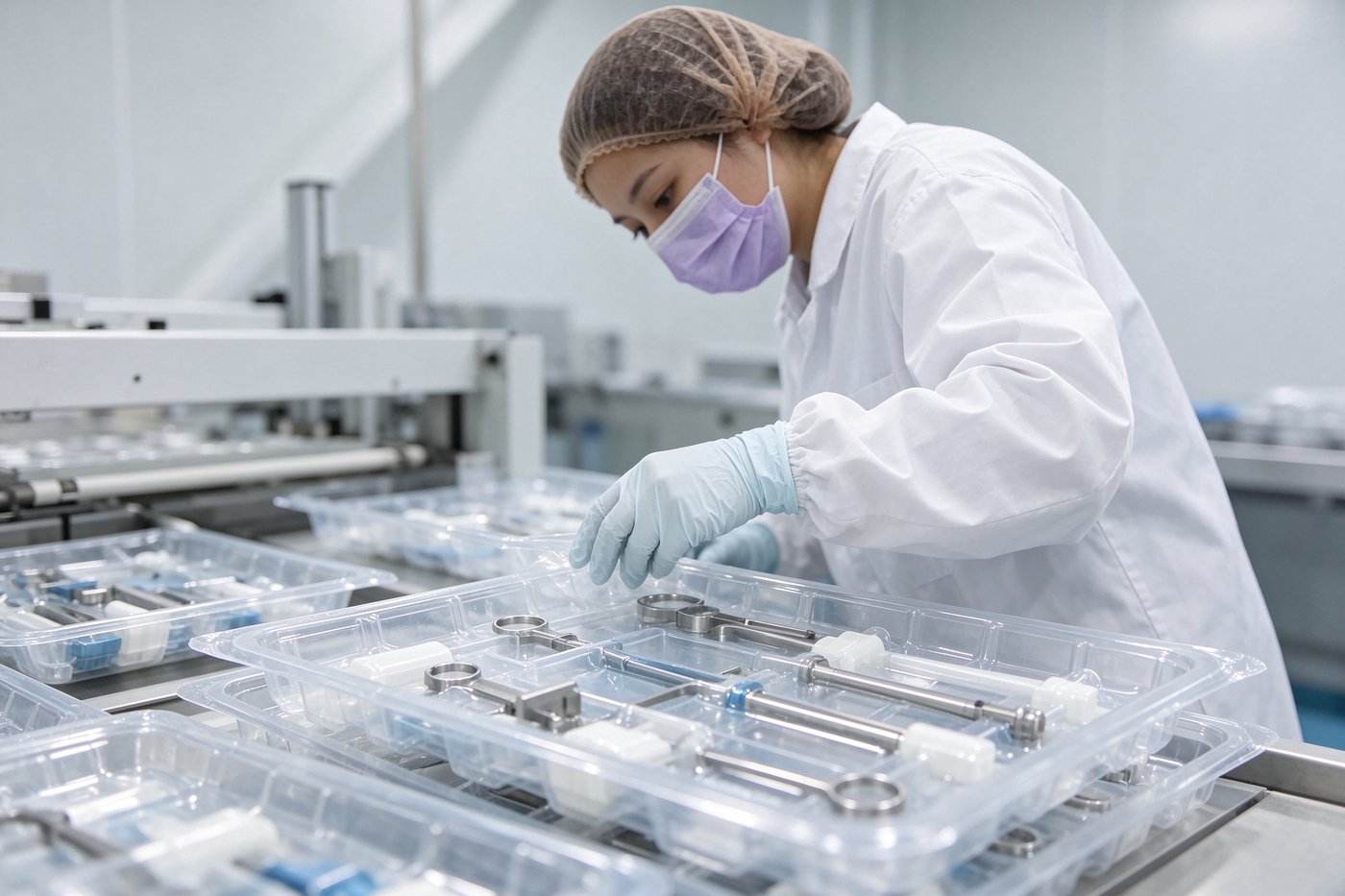
The draw ratio is the practical number. A 0.8 mm PETG sheet formed to a 60 mm tray holds wall thickness above 0.55 mm at the corners, which is what keeps a heavy instrument from punching through in transit. PVC at the same gauge thins further and has to be specified thicker.
Validation and petg sterile barrier packaging
A notified body will ask for seal strength, bubble emission and dye penetration on the finished tray, plus aging data at the intended shelf life. PETG is dimensionally stable, so the aged samples keep their seal integrity, which is a documented advantage over PVC in warm climates.
One processing detail causes most failures: the sheet is dried before forming. PETG absorbs moisture, and a wet sheet forms with haze and a weak flange. We supply sheet at a controlled moisture level with a drying recommendation for the thermoformer.
Sheet is supplied cut to the forming sheet size, in 0.6, 0.8 and 1.0 mm, with a stabilized grade for gamma.
Send device envelope, sterilization method and sealing equipment to oversales@rpplexiglass.com for a material and gauge quote.
Sterile presentation also drives tray design in hospital supply, covered in the PETG medical tray note covers that part of the specification.
Frequently Asked Questions
Why PETG rather than PVC for a sterile tray?
PETG has no chlorine, so it does not generate hydrogen chloride in a gamma or EO cycle, and it draws deeper before it thins out. That lets a tray hold a device envelope in 0.8 mm where PVC needed 1.0 mm.
Can PETG be gamma sterilized?
Yes, with a stabilized grade. Standard sheet yellows and embrittles after 25 kGy; the grade we supply holds colour and impact through 50 kGy.
What is the sealing window?
For a coated lid against a PETG tray, 140 to 160 C at 0.3 to 0.5 MPa for 1.5 to 2 seconds. Below 140 C the seal is incomplete, and above 160 C the tray distorts at the flange.