
Two photoluminescent sheets at the same thickness can differ in price by a factor of three, and the difference is not the acrylic. It is the phosphor: which one, how much of it, and whether the sheet was tested to a standard or simply looks bright in a dark room.
Grade one: escape route and life-safety
Life-safety photoluminescent material is specified by performance, not by colour. The figures that matter are the initial luminance after a defined charge, the luminance remaining after 10, 30 and 60 minutes, and the charge condition used. A grade intended for escape route marking should still deliver usable luminance at 60 minutes; a decorative grade may be at 10% of its initial value by then.
Grade two: decorative glow
Decorative photoluminescent acrylic is priced on appearance — brightness at one minute, colour, and how evenly the glow fades. It is a design product and it is priced per sheet, usually at 2–5 mm. It should never be substituted into a life-safety application, even where the colour matches, because the decay curve is not the same product.
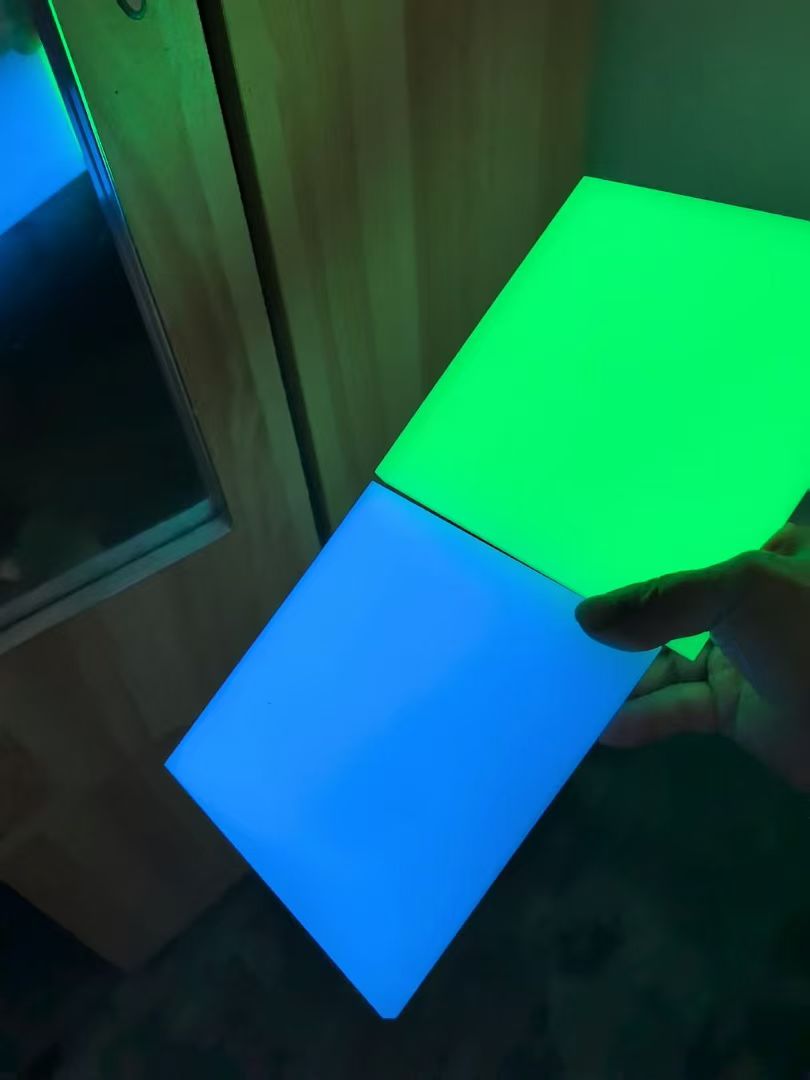
What drives the price on a life-safety grade
- Phosphor type and loading — the dominant cost, and the reason a “bright” cheap sheet fades
- Thickness — 3 mm is standard for signage, 5–8 mm where the panel must be rigid or edge-lit
- Testing — a report with decay data costs money and is worth asking for by name
- Cutting and finishing — photoluminescent sheet is usually supplied cut to shape with a sealed edge
The eighteen-month failure
Cheap photoluminescent sheet typically fails on the re-inspection, not on installation. The phosphor degrades with UV exposure and moisture ingress at the cut edge, and the panel that passed at handover is dimmer than the standard requires a year and a half later. Sealing the cut edge and choosing a grade with a stated UV stability is the cheap insurance.
For wayfinding applications where the glow panel sits beside conventional signage, wayfinding signage materials covers the assembly and fixing detail.
Charge condition is where quotations stop being comparable. A sheet charged for 15 minutes at high lux and one charged for 2 minutes at low lux produce the same headline brightness for very different reasons, and the second fades faster in service. Ask for the charge condition with the decay figures, and compare like with like.
Installation detail also decides whether the grade performs. A glow panel behind a glass cover loses luminance at the cover interface, and a panel mounted at a shallow angle collects dust that blocks the charge. Mount it where light reaches it during the day and keep the face clean, or the best grade on the market will underperform.
Cutting and sealing belong in the same quotation as the sheet. A photoluminescent panel cut with a dry saw leaves an open edge where moisture enters, and the glow degrades from the edge inward. Sealed edges, cut to shape and labelled with the batch, are part of the product rather than an optional extra.
Photoluminescent sheet is priced by grade and afterglow, so send the escape route plan and the required luminance duration to oversales@rpplexiglass.com.
Specifiers usually need these three points resolved before comparing prices.
Frequently Asked Questions
Q: Why do photoluminescent acrylic prices vary so much?
A: The phosphor grade and loading dominate cost. A life-safety grade with documented decay data costs several times a decorative glow sheet of the same size.
Q: What luminance should a life-safety photoluminescent sheet hold?
A: Ask for initial luminance plus the values at 10, 30 and 60 minutes after a defined charge. Usable luminance at 60 minutes is the figure that separates life-safety grades from decorative ones.
Q: Why does glow acrylic dim after a year?
A: UV exposure and moisture ingress at an unsealed cut edge degrade the phosphor. Specify UV-stable grade and a sealed edge.