
A cosmetics counter programme ran into a rework because the pearlescent panels matched the swatch in colour and not in sparkle. The pigment loading was right; the gloss level was eight units lower, and lower gloss flattens exactly the shimmer the design was bought for.
Pigment loading is a range, not a number
Pearlescent effects come from platelet pigments that align during casting. Loading is normally quoted as a percentage of resin, and the visual result shifts more between 1.5% and 2.5% than the numbers suggest. Below about 1.2% the effect reads as a faint tint; above 3% the platelets start to cluster and the surface looks grainy rather than pearlescent.
Gloss decides whether the shimmer reads
- Gloss 90+ — maximum sparkle, and maximum visibility of fingerprints and fine scratches
- Gloss 70–80 — the practical range for retail fixtures that are touched
- Gloss 30–50 — a satin pearl, softer and more architectural, with a much reduced shift
- Textured or brushed — the effect becomes a diffuse glow rather than a directional sparkle
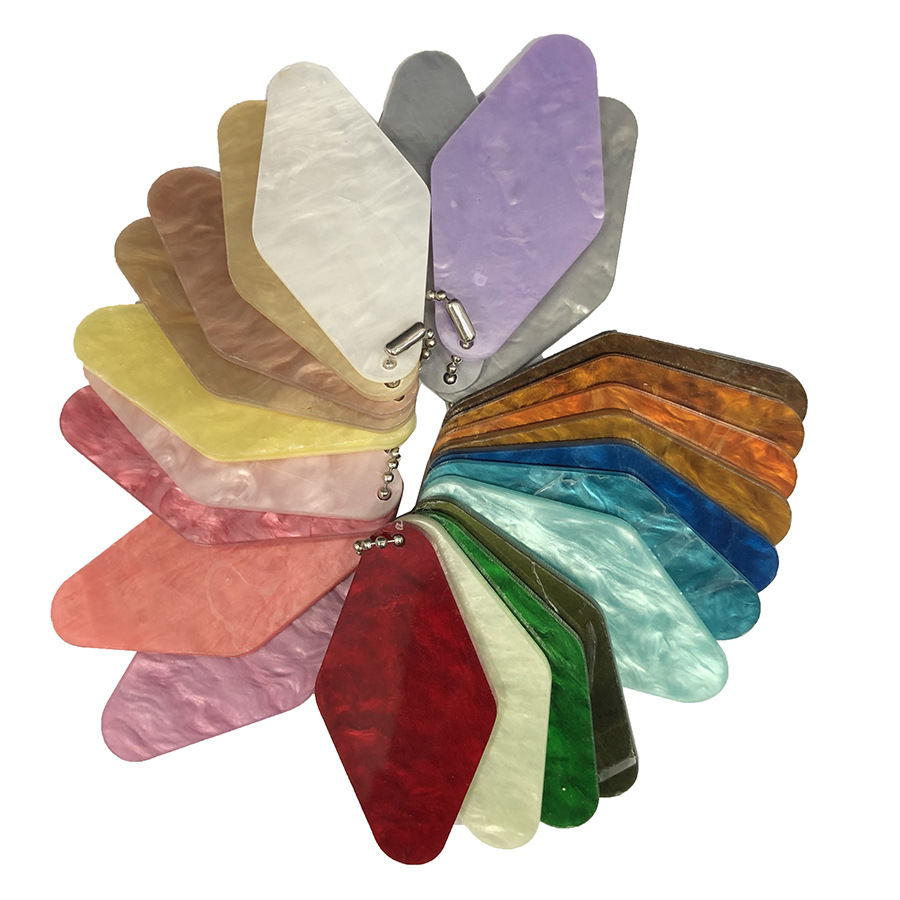
Batch shift, and how to control it
Two casts of the same formulation can differ visibly because platelet orientation depends on casting temperature and line speed. Reputable supply states a batch tolerance in ΔE and holds a retained sample per lot. If a programme runs for a year, ask for the retained swatch from each lot before shipment; a ΔE above about 1.5 is visible side by side on a single fixture.
The three-point sign-off
One: a physical swatch at production gloss, not a rendered image. Two: a signed reference under the actual retail light source, because pearlescent pigments are strongly angle-dependent and warm light pulls the effect toward gold. Three: an agreed ΔE limit with a retained sample per lot. With those three, the rework conversation never happens.
Where the display also needs a printed or laminated face, colours and finishes explains how a pearl base behaves under a print, and our coloured cast acrylic page covers through-colour options for the same fixture family.
Fingerprints are the practical complaint on glossy pearl. The same high gloss that makes the shimmer read also shows every touch, and a retail fixture is touched constantly. A satin pearl at gloss 40–50 removes most of that problem at the cost of some sparkle, and for a cosmetics counter that is usually the right trade.
Repair is the other consideration. Pearlescent pigment sits in the resin rather than on the surface, so a scratch is visible but a polished scratch is still pearlescent. That is the opposite of a coated iridescent sheet, where any polishing removes the effect entirely. If the fixture will be cleaned hard, through-colour pearl is the more serviceable choice.
Packing is a small but real risk on pearl. The effect reads differently when panels are stacked face to face, because the interleaving film changes the angle of incident light. Ask for a peel-off interleaf and inspect the top panel of each crate before signing, since a marked face cannot be polished back on a through-colour pearl.
To approve a pearlescent or metallic finish properly, ask for a swatch set at oversales@rpplexiglass.com and specify the light source you will judge it under.
Approval method is the question that decides most pearlescent orders.
Frequently Asked Questions
Q: How do I approve a pearlescent acrylic sheet?
A: With a physical swatch at the production gloss, signed under the real light source, plus a ΔE batch tolerance and a retained sample per lot. Photographs cannot convey the effect.
Q: What pigment loading gives a visible pearlescent effect?
A: Roughly 1.5–2.5% of resin. Under about 1.2% it reads as a faint tint and above 3% the platelets cluster and look grainy.
Q: Does gloss affect pearlescent acrylic?
A: Yes, strongly. High gloss maximises sparkle, satin gloss softens it into a glow, and a lower gloss than the approved swatch is the usual cause of a rejected run.