
A polycarbonate bulldozer window rarely fails in the way an operator expects. Nobody breaks one with a rock. The pane that comes out of service is the one that has gone milky in a band across the middle, or the one that has crazed from a bolt hole after the frame was re-tightened with an impact driver.
Three machines we re-glazed in the last year tell the same story in different words, so the pattern is worth writing down.
Abrasion and the polycarbonate bulldozer window coating
The first machine had 4,200 hours on a demolition site. Its front pane was original glass, and the wiper arc had polished a 200 mm wide band to a haze that read as fog at dusk. Hard coated polycarbonate at 12 mm resists that band because the coating carries a surface hardness in the 2H to 3H pencil range rather than the 5 Mohs of glass, and more importantly because it does not chip into a scatter layer when grit hits it.
Frame tolerance and the polycarbonate bulldozer window fit
- Thickness: 12 mm hard coated, 10 mm for side panes under 600 mm
- Frame clearance: 2 mm per side for thermal movement
- Seal: EPDM bulb gasket, 3 mm compression, no silicone bedding
- Fastener: M6 through a 8 mm hole with a bonded washer both faces
- Curvature: match the original pane radius, formed at 160 C
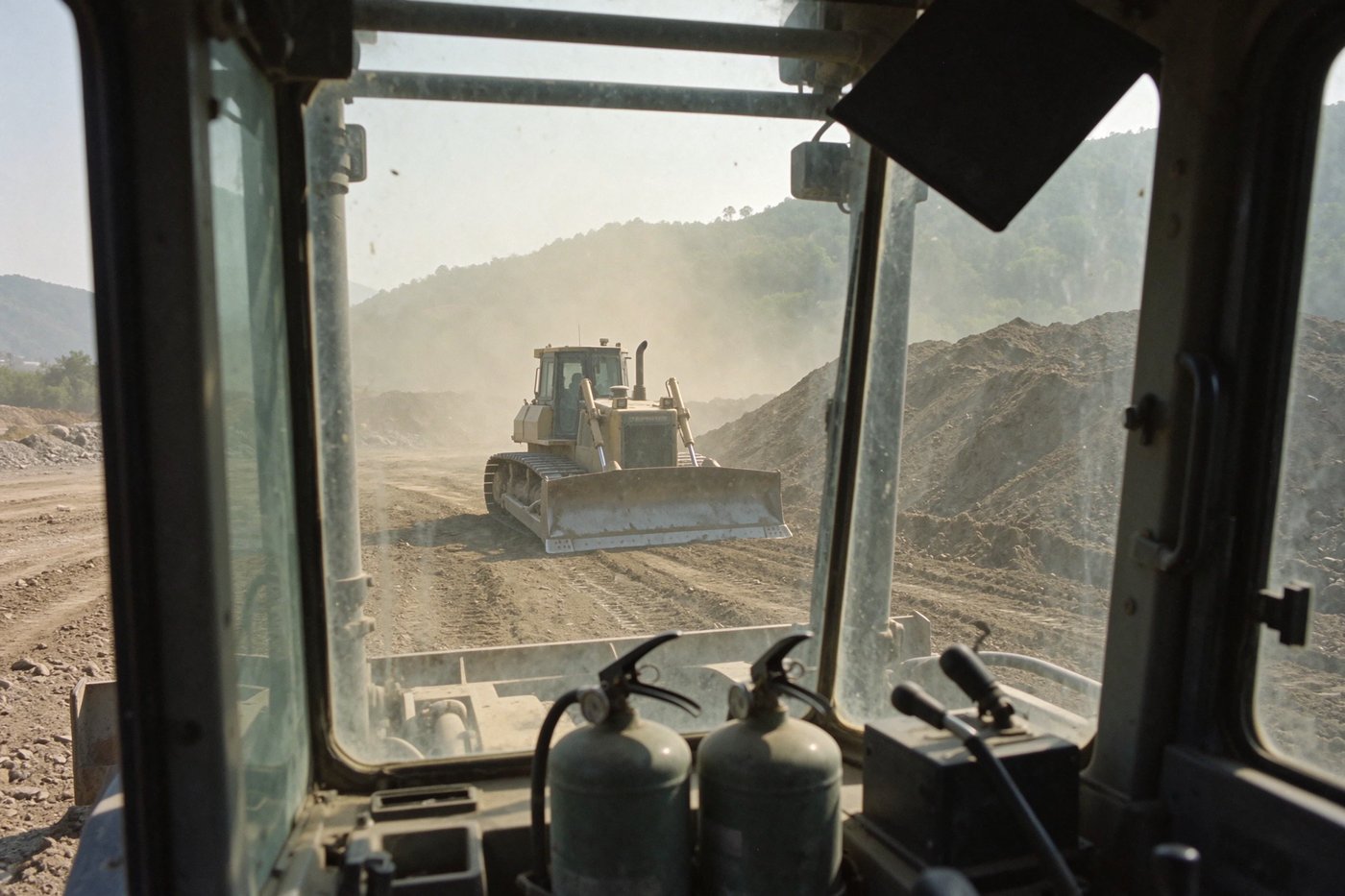
The second machine had been re-glazed with flat sheet cut to the frame outline. It lasted one season. A flat pane forced into a curved frame sits under bending stress from the day it is fitted, and every bolt hole becomes a stress riser. The crazing that followed started at the lower corner bolts and ran diagonally, which is the classic signature.
Wiper, washer and the polycarbonate bulldozer window surface
The third machine is the one worth copying. The owner had specified a wiper with a park position off the pane and a washer bottle that actually works, and the pane came back after 3,000 hours with only light surface marks. Dry wiping on a dusty pane is the single behaviour that destroys a coated face, and no coating survives it for long.
We supply dozer sets cut and formed to a cab drawing, with the front pane coated on both faces and side panes coated on the outside only. A spare front pane in the same crate is the practical recommendation for a machine on a remote site.
Send cab frame dimensions, glass thickness and machine hours to oversales@rpplexiglass.com and we will quote a coated 12 mm set with a spare front.
Earthmoving fleets that run dozers and excavators side by side can standardise the coated sheet and the gasket kit across both cabs, which is what the excavator note covers. polycarbonate excavator window replacement covers that part of the specification.
Frequently Asked Questions
Why not laminated glass for a dozer?
Grit blasts a glass face to opaque within a few thousand hours, and a cracked pane turns into a handling problem on site. Coated polycarbonate resists both, and a 12 mm sheet meets the EN 356 impact class usually specified for cab glazing.
How often does the wiper scratch a coated pane?
With a clean blade and washer fluid, not in normal service. The failures we see are dry wiping on a dusty pane, which abrades the coating in a band the width of the blade.
Can a curved dozer pane be replaced with flat sheet?
No. A flat pane will not seat on a formed cab frame, and forcing it introduces stress that shows as crazing at the mounting bolts within a season.