
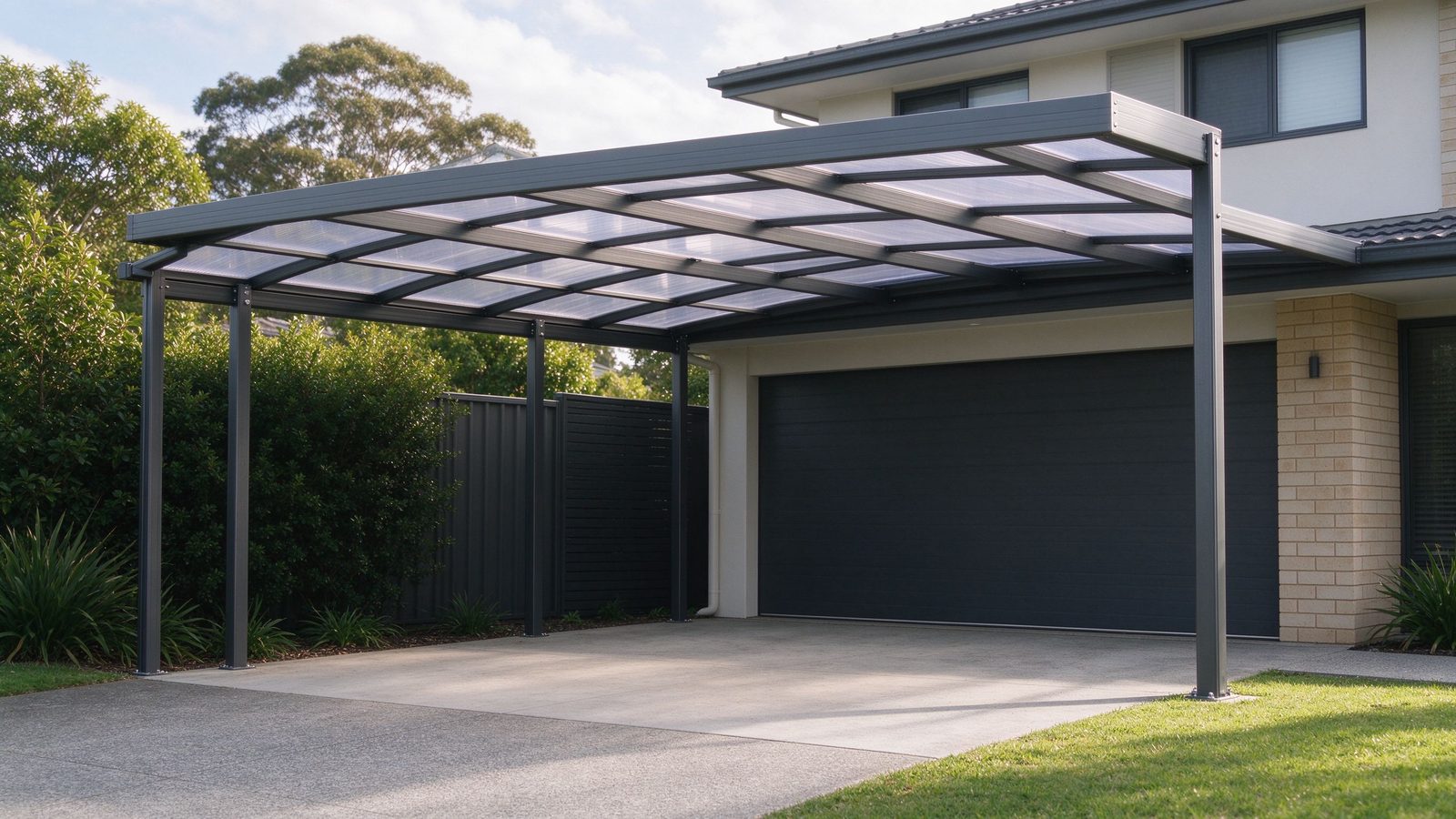
A polycarbonate canopy sheet is the cover on a structural assembly, and the assembly decides. A school in Manchester added a covered walkway along the front of the building: 18 m of canopy on 1.1 m glazing bar centres, 2.5 m clear width. The first winter it leaked at four bars and the panels went green along the lower edge. Both problems traced back to installation detail, not to the sheet.
A polycarbonate canopy sheet is the visible part of an assembly: bars, flashings, end closures and drainage decide whether it performs.
Polycarbonate canopy sheet: structure by span
- 8 mm twinwall: bars at 1.0 to 1.2 m, the standard walkway cover
- 10 mm twinwall: bars to 1.5 m, larger canopies and snow areas
- 16 mm five-wall: long spans and where a U-value is specified
- Solid 6 mm to 8 mm: impact-critical locations, no insulation value
The U-value of an 8 mm twinwall sits around 3.0 W/m2K; a 16 mm five-wall product is roughly half that. On an unheated walkway the difference is comfort, not cost, which is why most school canopies stay at 8 mm or 10 mm.
Bars are aluminium with a thermal break, screwed to the structural frame, and the sheet is clipped or capped rather than drilled. Every hole through a multiwall panel is a thermal bridge and a leak path, so the fixing should clamp the edge, not pierce the face.
Thermal movement, end tape and cleaning
Polycarbonate moves about 0.065 mm per metre per degree C, and an 18 m canopy sees close to 55 mm of movement across a year. The assembly must be fixed at one end and allowed to slide at the other, with the flashing detail designed for that movement. A canopy bolted tight at both ends will bow or crack at the bars.
End closure is the detail that decides whether the panel stays clear. Anti-dust tape on the upper end, breather tape on the lower, and both applied to a dry, clean edge. Once algae establishes in a flute it cannot be cleaned out and the panel has to be replaced.
Cleaning is a twice-yearly job: neutral detergent, soft brush, rinse from the top. Never a pressure washer at close range on the bar line, and never a solvent. The compatible agents are in our cleaning and maintenance guide.
Where the canopy also forms a roof light, the specification overlaps with the polycarbonate skylight roofing guide, which covers the same sheet families at roof pitches and with different flashing rules.
For a first cost check, the thickness decision guide walks through the span and load inputs that should be settled before any sheet is ordered.
Send your canopy plan, span and snow load to oversales@rpplexiglass.com for a twinwall sheet and bar schedule.
Frequently Asked Questions
What thickness of polycarbonate for a canopy?
8 mm twinwall for spans up to about 1.2 m between glazing bars, 10 mm to 16 mm beyond that. The span, not the area, sets the thickness, and the bar spacing has to come from the sheet supplier.
Which is better for a canopy, twinwall or solid sheet?
Twinwall gives insulation and stiffness per kilo, which suits an occupied walkway. Solid sheet is tougher and clearer, and is used where impact or vandalism matters more than heat loss.
Why does a polycarbonate canopy go green inside?
Algae in the flutes, usually from untaped ends or a damaged edge. Multiwall sheet must be closed with anti-dust tape and a breather tape at the low end, and any cut edge on site must be re-taped.