
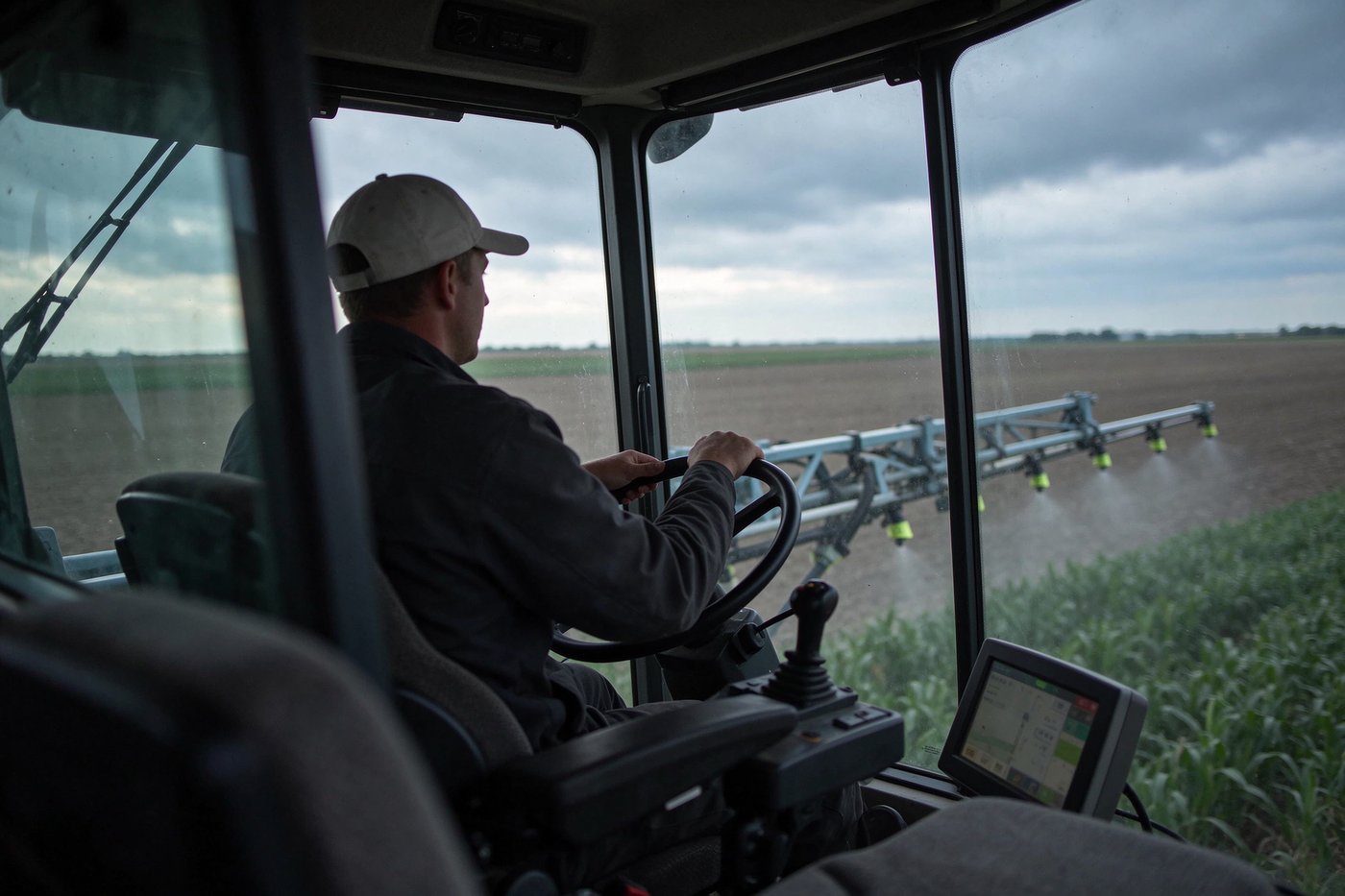
A self-propelled sprayer operator in Saxony reported that the side window of a Category 4 cab went milky within 14 months, while the windshield stayed clear. The difference was not the material batch. The side panel was bare polycarbonate, cleaned with the same solvent rag the operator used on the sprayer boom. The polycarbonate crop sprayer cab window that replaced it carried a hard coat on both faces and a solvent-resistant edge seal.
Agrochemical exposure is the design load here, and it is a chemical problem long before it is a mechanical one.
Chemical duty of a polycarbonate crop sprayer cab window
A Category 4 cab under EN 15695 is the highest classification for operator protection against pesticides, and it relies on positive pressure and carbon filtration rather than on the glazing alone. The glazing still has to survive spillage, condensate from spray drift, and cleaning products that are far more aggressive than a car wash.
- Sheet: 6 mm polycarbonate, hard coat both faces, for side and rear panels; 8 mm for the front windshield.
- Coating: abrasion-resistant coat that also resists aliphatic solvents at wipe concentration.
- Seal: EPDM gasket plus a closed-cell foam backer, so concentrate cannot pool against the panel edge.
- Frame: 20 mm engagement with 2 mm clearance, because the cab shell flexes on row-end turns.
Where the milky haze comes from
Bare polycarbonate absorbs aromatic and chlorinated solvents at the surface layer, and the attack shows as a white haze that cannot be polished out. Even a hard coat only buys time if the panel is wiped with the wrong rag. The practical rule is a pH-neutral detergent and water, with solvent only on metal parts.
Condensate is the slow path. Spray drift deposits a fine film on the outside of the panel, and the film concentrates as water evaporates. Over a season the deposit etches the coat along the wiper path. Rinsing the panel at the end of each shift removes the film before it concentrates.
Cab pressure and panel stiffness
A Category 4 cab holds a positive pressure of around 20 to 50 Pa to keep unfiltered air out. A panel that flexes under that pressure will pulse against the gasket and leak at the corners. At 6 mm on a 700 x 900 mm opening, deflection stays under 2 mm, which is inside the gasket travel.
River People manufacture
River People supplies hard-coated polycarbonate cut to cab drawings, with sealed edges and gasket-ready faces. Panels are CNC-cut to plus or minus 0.5 mm and can be supplied as sets for a sprayer model, so a fleet replacement does not mix generations. Orders of 50 to 500 panels ship in 15 to 20 days.
Send your cab opening dimensions and model year to oversales@rpplexiglass.com for a panel set quotation.
The same hard coat and gasket approach is used on tractor cabs, detailed in our polycarbonate tractor window guide.
Frequently Asked Questions
Does the glazing alone make a cab Category 4?
No. Category 4 under EN 15695 depends on cab sealing, positive pressure and carbon filtration. The glazing contributes chemical resistance and mechanical protection, not the classification.
Can a hazed panel be recovered?
Only if the haze sits in the coating and has not reached the substrate. Once the polycarbonate itself is attacked, the panel has to be replaced, since polishing removes the coat and exposes fresh material.
Why is the windshield specified thicker?
The front panel takes stone impact at road speed and carries the wiper load. 8 mm resists both; side panels see neither, so 6 mm is enough.