
A polycarbonate guillotine guard has to close the reach path without hiding the cut line.
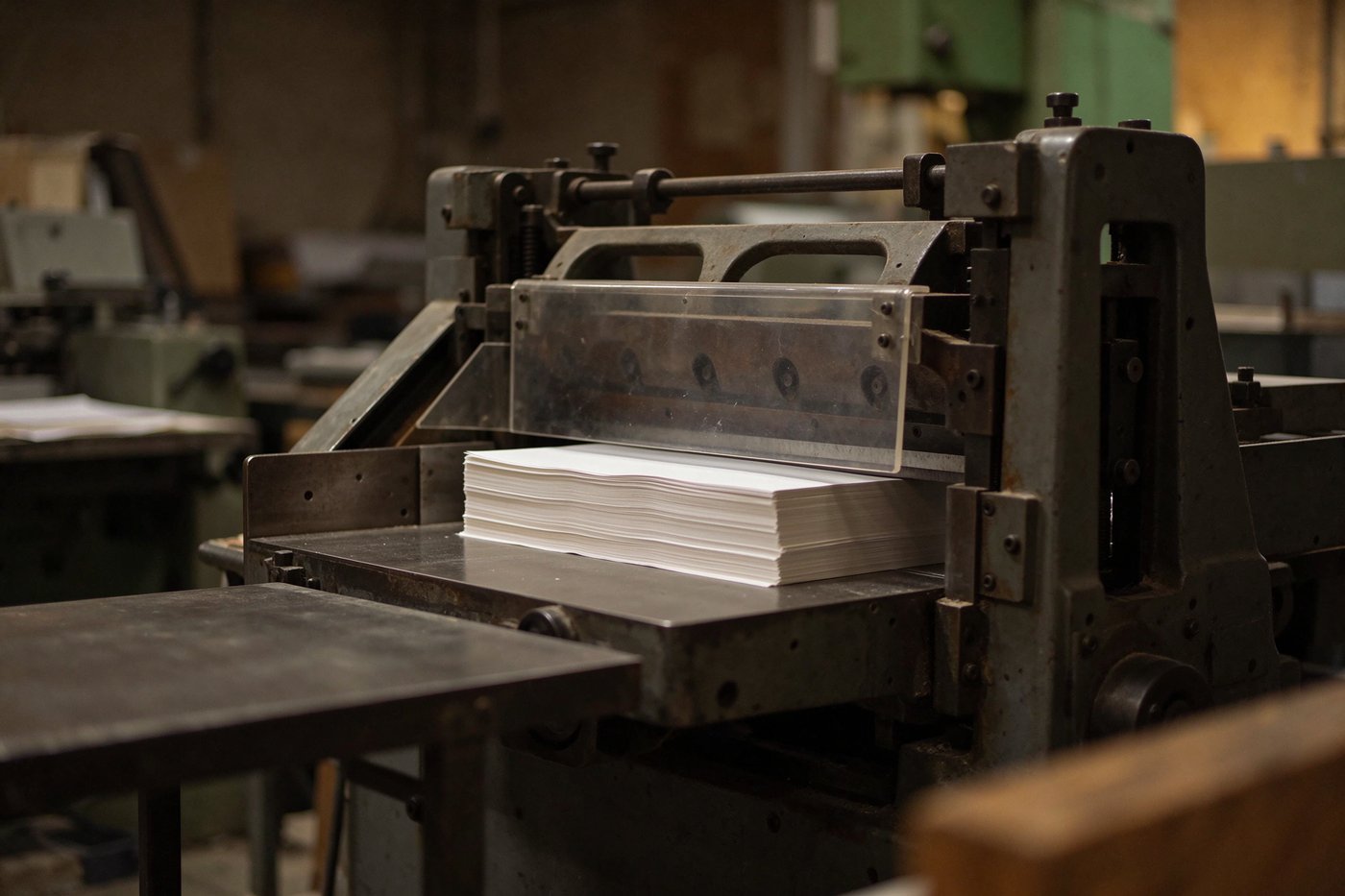
A print finishing shop in Leeds fitted clear guards to three guillotines after an audit. One guard was rejected by the inspector because the panel sat 60 mm above the cutting line, leaving a gap a hand could reach through while the clamp was down. The panel was the right material; the geometry was wrong.
A polycarbonate guillotine guard has to be low enough that a hand cannot pass under it and high enough that the operator can see the cut mark. Those two requirements define the design, and they are measured from the clamp and the blade path, not from the machine frame.
Guard geometry measured from the cut
On a typical paper guillotine, the guard should sit 15 to 25 mm above the clamp plate and extend 40 mm either side of the cutting line. That closes the reach path without hiding the back gauge scale. Five millimetre polycarbonate is stiff enough to stay in position when a stack of board is pushed against the clamp.
Where the guard is fixed and the clamp moves, keep 10 mm clearance from the clamp at its highest travel. A guard that the clamp hits will flex and eventually crack at the bracket, and the interlock will trip at the wrong point in the cycle.
Interlock linkage and the retrofit detail
- Actuate the interlock from the guard frame or a cam on the clamp, never from the panel itself
- Use a spring-return linkage so a jammed guard still trips the switch
- Leave the guard removable for blade changes, with a captive fastener rather than a loose screw
- Check the reach path with the guard fitted and the clamp down, using the audit gauge, not by eye
The Leeds rejection came from designing the guard around the frame rather than the cut. Moving the panel down 35 mm and extending it past the cutting line brought the reach path inside the standard without changing the machine.
Static, dust and paper finish
Paper running through a guillotine generates static, and a clear polycarbonate guard collects dust that then clings. Wipe the panel with an anti-static cloth rather than a solvent; alcohol wipes craze the surface and leave a haze that the operator reads as a dirty guard.
RP River People Plexiglass cuts guillotine guards to the machine opening, with edge polishing and bracket holes to your drawing. Send the cutter model and the clamp travel for a quotation.
Send the guillotine model, clamp travel and a photograph of the cutting line to oversales@rpplexiglass.com for a guard quotation.
Guards are cut from larger sheet, and the cut tolerance rules are in our polycarbonate cut-to-size note.
Frequently Asked Questions
How high above the clamp should the guard sit?
Typically 15 to 25 mm, measured so a hand cannot pass under it while the clamp is down. The exact figure comes from the reach standard your inspector applies.
Why must the interlock be off the panel?
A switch actuated by flexing plastic drifts and can fail to trip. Mount it on the frame or on a cam driven by the clamp.
What cleaner is safe on the guard?
An anti-static cloth or mild soap. Alcohol wipes craze polycarbonate and leave a haze.