
A polycarbonate lathe guard is a safety device with an optical job.
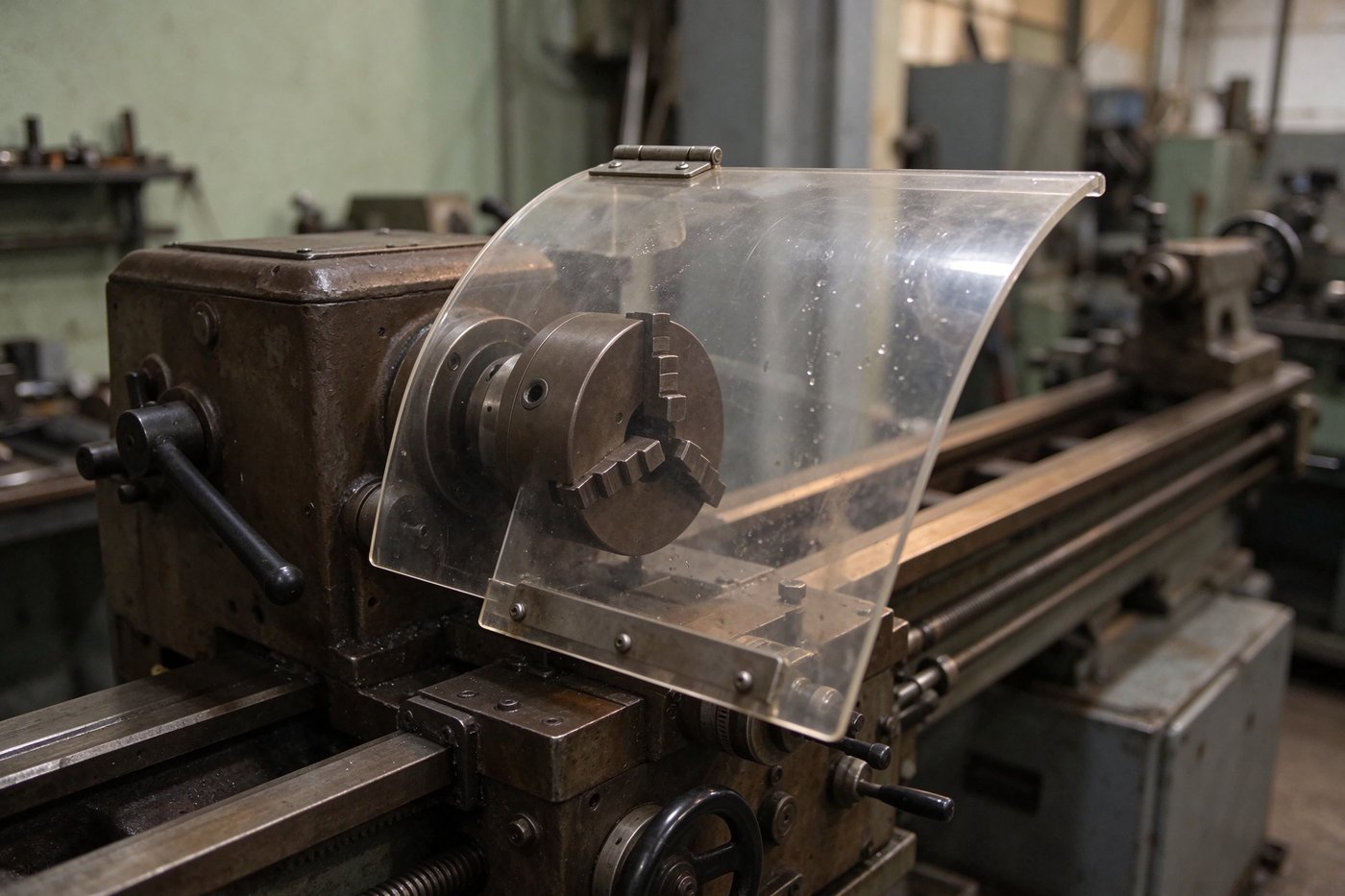
A jobbing shop in Sheffield fitted clear guards to six manual lathes after an incident. Two of the panels were crazed within four months, both on machines running a water-miscible coolant and both fitted with the guard clamped directly to the headstock casting.
A polycarbonate lathe guard is a safety device with an optical job. It has to be in the right place, stay clear, and not react with anything the machine throws at it. Polycarbonate resists impact; the coolant and the clamping decide the service life.
Guard envelope and the view it must not block
Six millimetre polycarbonate suits a fixed shield over a chuck up to about 300 mm. The shield should cover the chuck and the tool zone from the operator side, from the top of the chuck down to the chip tray, and it should be offset 100 to 150 mm from the rotating parts so nothing can be wound onto it.
A guard that covers the tool post but not the chuck looks protective and leaves the main hazard exposed. Map the chip throw cone from the tool before sizing, and keep the guard clear of the handwheel so the operator is not forced to reach around it.
Coolant, solvents and crazing
- Water-miscible coolant is usually tolerated; neat oils and chlorinated additives attack the surface
- Wipe the panel down at the end of a shift; coolant left to dry leaves a film that hides cracks until they are deep
- Do not use solvent-based degreasers on the guard; they craze polycarbonate on contact
- Choose a hard-coated grade where the guard is wiped daily around the tool zone
The Sheffield panels crazed where coolant pooled at the bottom of the shield and was left over a weekend. Changing to a neutral cleaner and a weekly strip-down moved the replacement interval past two years.
Fixing, interlock and the retrofit question
Clamp the guard in a bracket that spreads load along 80 to 120 mm of edge, not through four bolts. Where the guard is part of an interlocked system, the interlock switch belongs on the frame, not on the panel, because a switch pressed by flexing plastic will drift out of adjustment.
Retrofit guards on older lathes usually need a bracket on the headstock casting rather than on the sheet metal cover, which is too thin to carry a hinge. Measure the casting, not the cover, before designing the mount.
RP River People Plexiglass supplies lathe guards cut to the machine outline, with edge polishing, bracket-ready holes and hard-coated sheet where coolant is aggressive. Send the machine model and a sketch of the guard envelope for a quotation.
Send the lathe model and a sketch of the guard envelope to oversales@rpplexiglass.com for a cut guard quotation.
Where coolant is mild, acrylic is sometimes used for the same guard, and the trade is set out in our acrylic machine guard panel guide.
Frequently Asked Questions
Can polycarbonate be used next to coolant?
Usually yes with water-miscible coolant, if the panel is wiped down and not left wet. Neat oils and chlorinated additives attack the surface and should be kept off.
Why did the guard craze?
Coolant pooled at the bottom edge and dried over a weekend. The stress from clamping did the rest. A neutral cleaner and a bracket that spreads load prevent it.
Should the interlock be mounted on the panel?
No. Mount it on the frame. A switch actuated by a flexing panel drifts out of adjustment and fails the safety check.