
When a garden machinery brand moved its discharge shields from steel to transparent panels, the first prototype batch came back from field trials with two complaints: the shields flapped at full throttle and the operators could not see the chute. Both trace to one number, and it is not the thickness printed on the drawing. It is the unsupported span of the polycarbonate lawn mower guard.
This note is written as the five decisions a buyer actually has to make, in the order they affect tooling cost.
Decision one: gauge for a polycarbonate lawn mower guard
A ride-on mower discharges clippings and the occasional stone at 3,000 rpm blade speed, roughly 200 km/h at the tip. A 6 mm hard-coated polycarbonate panel stops a 20 mm stone at that speed without cracking, provided the span is under 300 mm. Above 300 mm the panel deflects enough to contact the blade housing.
- Gauge: 6 mm for spans to 300 mm; 8 mm for 300 to 450 mm.
- Coat: hard coat on the outer face, since clippings abrade at a shallow angle.
- Hinge: two 3 mm stainless pins in 12 mm acrylic blocks, or a nylon hinge rated for 8,000 cycles.
- Edge: 8 mm radius on all corners, so the panel does not catch a boot or a branch.
Decision two: how the panel is held open
A shield that is lifted for emptying must stay up. A spring or a detent at the hinge costs a few cents and prevents the panel from dropping onto a hand. Design the hinge so the load sits on the pin, not on a solvent bond, because a bonded hinge on a 6 mm panel will shear within a season.
Decision three: the field test that settles the argument
Bench testing a panel with a drop ball tells you very little. The useful test is 20 hours of mowing dry grass at full throttle with a 40 mm gravel patch, then a visual check for crazing at the hinge and for any crack at the mounting bolts. That test, not a datasheet, decides whether 6 mm or 8 mm goes into production.
Decision four and five: sealing and replacement parts
A discharge shield sits in dust and rain. An open bolt hole lets water into the panel edge and the coat lifts within a season. Bonded sealing washers and a sealed edge finish solve it for the life of the panel, and a shield designed as a single replaceable part keeps service simple: one part number, one hinge kit, no bonded sub-assembly.
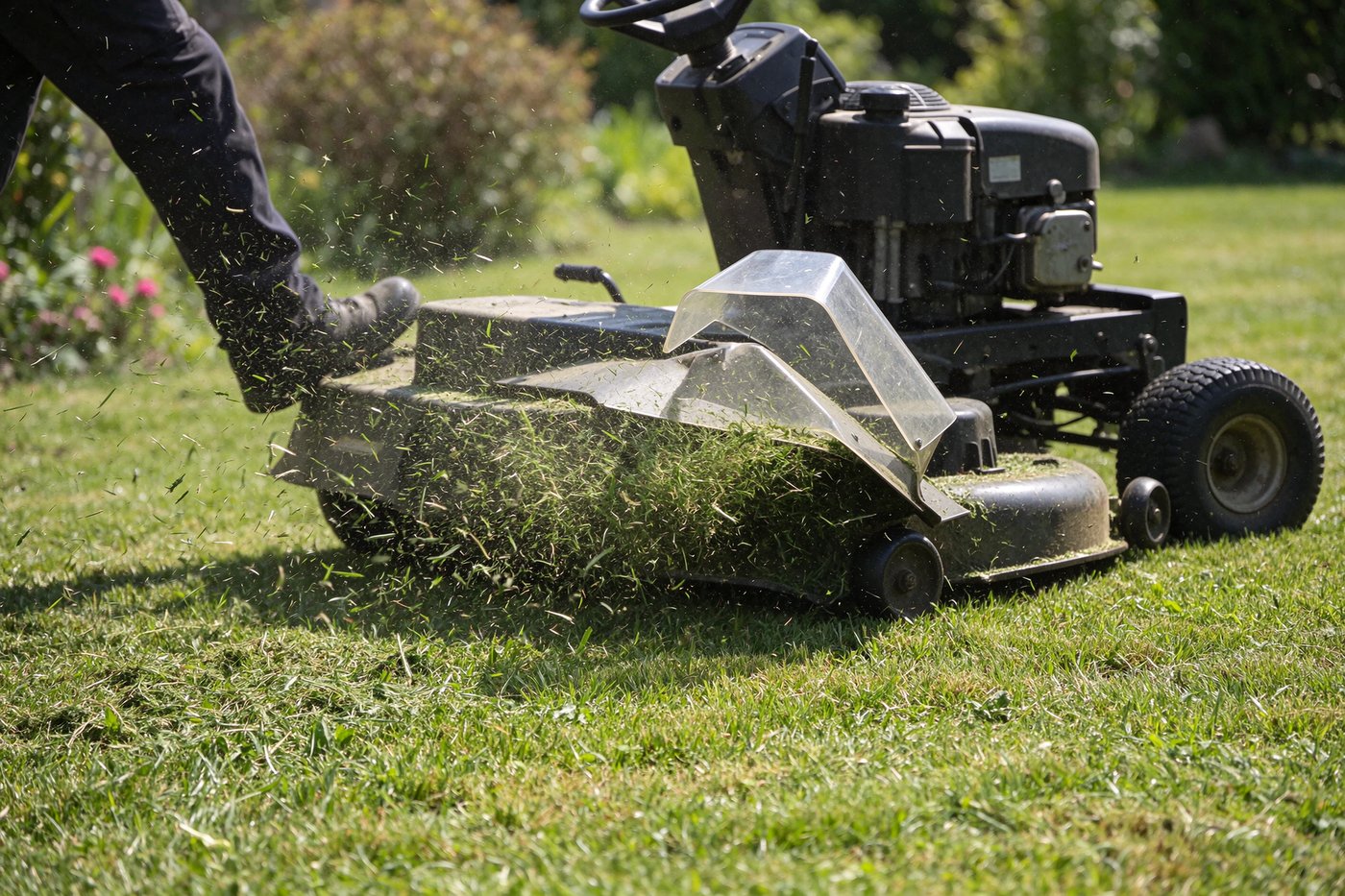
River People production
River People supplies hard-coated polycarbonate shields cut to a DXF, with sealed edges, pre-drilled hinge holes and a coat on the specified face. Production runs of 500 to 10,000 panels ship in 18 to 22 days, and panels can be supplied flat or pre-curved to the housing profile.
Send your chute drawing and span to oversales@rpplexiglass.com for a gauge recommendation and a per-panel price.
Guard design across outdoor equipment follows the same risk logic as factory barriers, reviewed in our polycarbonate machine guards and safety barriers guide.
Frequently Asked Questions
Does the shield need to be UV stabilised?
Yes for outdoor use. Polycarbonate is naturally UV resistant at the substrate level, but the hard coat carries the UV screen; specify a coat rated for outdoor exposure so the panel does not yellow in two seasons.
Can a 4 mm panel be used on a small push mower?
On a walk-behind with a span under 180 mm, 4 mm hard-coated sheet is common. The limit is span and stone energy, not the mower size.
What causes a shield to flap at speed?
An unsupported span that is too long, or a hinge with play. Stiffening the hinge and reducing the span fixes both, and neither requires a thicker panel.