
A polycarbonate marina gangway panel has to bend with a structure that deflects under every person who walks across it.
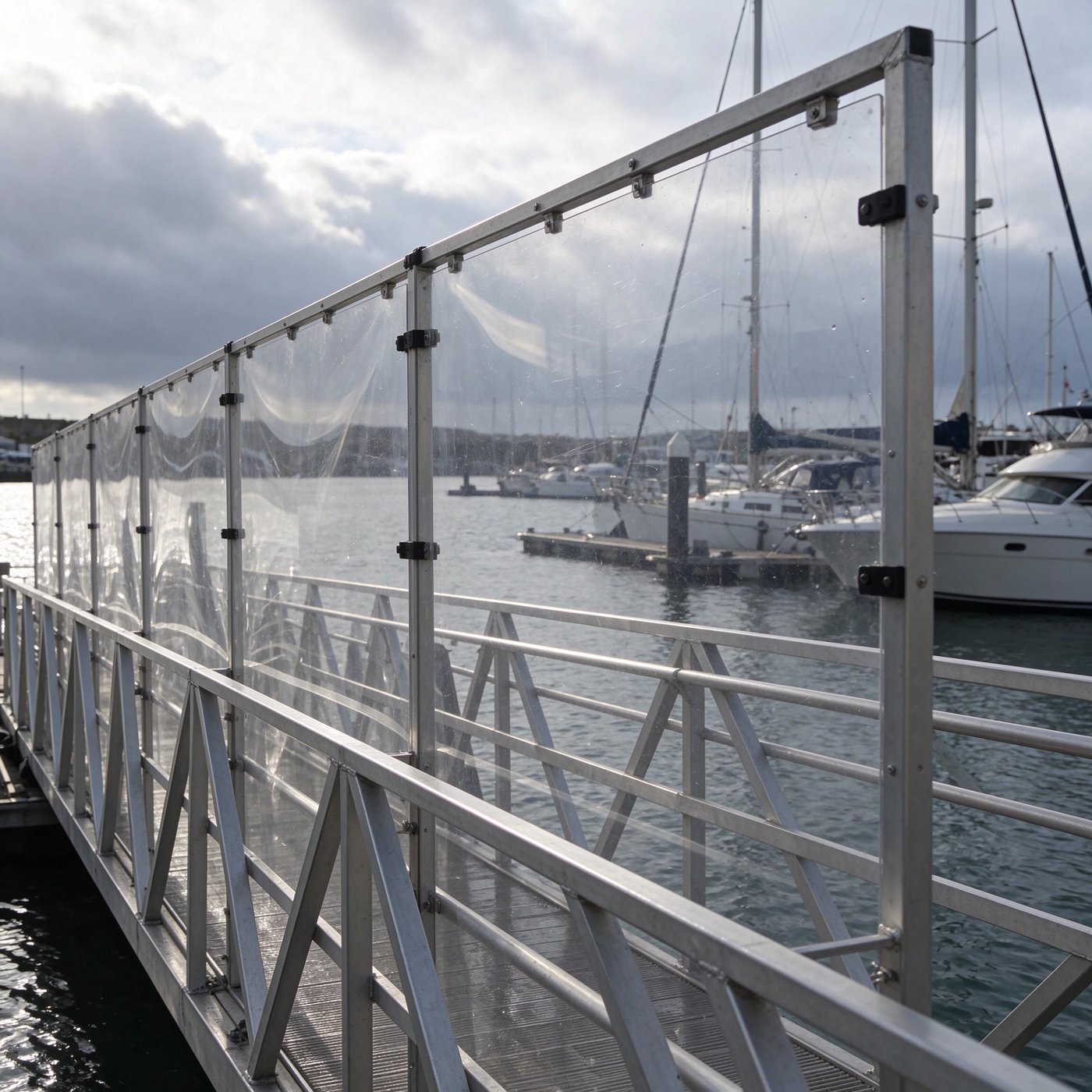
A marina in Plymouth fitted polycarbonate side screens to four aluminium gangways and lost two panels in the first gale. Both had been cut to the full rail length with no allowance, and both split from a fixing hole at the lower rail where the gangway flexes as a person walks onto it.
A gangway is a moving structure
An aluminium gangway deflects 15 to 25 mm under a single person walking at the midpoint, and considerably more when two people meet. Any panel fixed rigidly between top and bottom rails is loaded in compression and tension on every crossing, thousands of times a season. Polycarbonate tolerates that movement; the fixing detail decides whether it does so without cracking.
Six millimetre is the right thickness for a side screen on a gangway up to 2.5 m long, where the screen is a wind and spray barrier rather than a fall guard. It bends with the gangway, weighs about 3.6 kg per square metre, and does not add a rigid element to a structure that is designed to flex.
Polycarbonate marina gangway panel: how to let it move
- Thickness: 6 mm for wind and spray screens up to 2.5 m; 8 mm where the screen is also a hand-level barrier.
- Clearance: 8 mm each edge and 3 mm at the rail, because a gangway moves more than a building frame.
- Fixings: clamp bars with EPDM gaskets; where bolts are required, 14 mm clearance holes with rubber washers.
- Holes: none within 60 mm of the lower rail, which is where the bending stress peaks.
- Surface: UV-stabilised both faces; a marina screen sees reflected light from water all day.
Plymouth, and the second fit
The rebuilt screens were cut 8 mm under the rail length, clamped at 400 mm centres with EPDM gaskets and no through-bolts in the lower 60 mm band. Two winters on, all four screens are in place; one has a scuff where a mooring line was dragged across it.
The marina also changed the panel height. The original screens ran from the lower rail to 900 mm, which put the fixing line right where the gangway bends most. The new screens start 150 mm above the lower rail and run to 1.1 m, so the panel spans a flatter part of the structure and the lower rail stays clear.
Wind loading was the other consideration. A 6 mm screen 2.5 m long presents 2.2 square metres to a cross wind, and at 40 m/s that is a significant load on the clamps. The rebuild added a mid-span clamp at 1.25 m, which halved the unbraced span without adding a hole in the panel.
Ordering screens to a gangway drawing
Send the rail length, rail spacing, the deflection the gangway shows under load, and whether the screen is a wind barrier or a fall guard. Thickness and clamp spacing follow. River People PLEXIGLASS cuts 6 mm and 8 mm UV-stabilised polycarbonate to rail dimensions with clearance allowance and can supply clamp bars and EPDM strip. Send the rail dimensions and the guard requirement and we will quote the screens and the fixing set.
Send rail length and spacing plus whether the screen is a wind barrier or a fall guard, and we will quote 6 mm panels with clamps and gaskets: oversales@rpplexiglass.com.
Where the panel has to remain watertight as well as flexible, our yacht hatch guide covers the seal detail.
Frequently Asked Questions
What thickness polycarbonate for a marina gangway side screen?
Six millimetre for a wind and spray screen up to 2.5 m long, 8 mm where the screen also acts as a hand-level fall guard. The screen should bend with the gangway, not stiffen it.
Why did the gangway panels split at the lower rail?
The gangway deflects underfoot and the lower rail is where bending stress peaks, so a fixing hole there takes the full movement. Keep holes 60 mm clear of the lower rail and clamp instead of bolting.
How often should a 6 mm screen be clamped?
At 400 mm centres, plus a mid-span clamp where the screen exceeds 1.25 m. That halves the unbraced span without putting another hole through the panel.