
A polycarbonate queue line screen carries a sustained lean for forty minutes, which is a harder condition than a single impact.
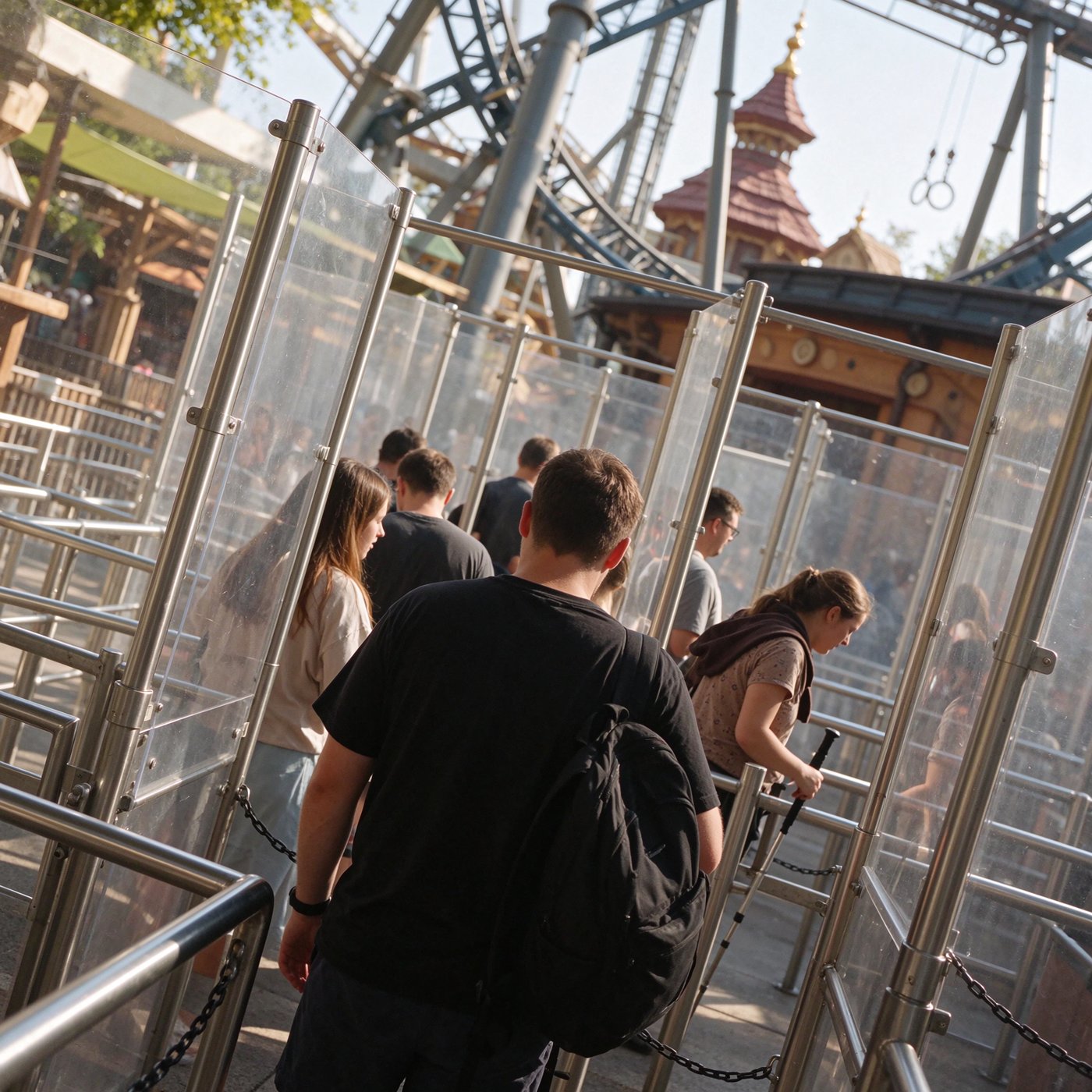
A theme park in Staffordshire installed polycarbonate screens along a queue line and replaced nine of them in the first summer. The screens had not been vandalised. They had been leaned on, sat on and pushed by a queue that had nothing else to do for forty minutes, and the 4 mm panels had bowed until the base plates pulled out of the floor.
Crowd load is a sustained load, not an impact
A person leaning against a screen applies roughly 300 to 500 N continuously, and in a queue several people lean at once. That is a far harder condition for a thermoplastic than a single impact, because polycarbonate creeps under sustained load. Five millimetre sheet at a 900 mm span with a mid-rail will hold a lean; 4 mm at 1200 mm will bow visibly within a season and stay bowed.
The design answer is to shorten the span and give the crowd something to lean on that is not the panel. A 40 mm stainless handrail set 150 mm in front of the screen takes the lean, and the screen becomes a wind and spray barrier with a 900 mm span between posts.
Polycarbonate queue line screen: span, base and edge
- Thickness: 5 mm for screens up to 900 mm span; 6 mm where the span runs to 1200 mm.
- Posts: at 900 mm centres, with a 40 mm handrail 150 mm in front of the panel.
- Base: 3 mm polycarbonate base plate 80 mm wide, bolted to the floor with 10 mm clearance holes.
- Edge: flame-polished or chamfered; an arris at waist height in a crowd is a scratch waiting to happen.
- Graphics: printed on the inner face only, so the outer face stays cleanable.
Staffordshire, and the second summer
The rebuild used 5 mm panels at 900 mm spans, with a handrail in front and a printed graphic on the inner face. Nine months on, no panel had bowed and no base plate had pulled. The park also moved the base plate fixing to four bolts rather than two, which stopped the rocking that had loosened the first batch.
The graphics decision turned out to be the maintenance win. Printing on the inner face meant the outer surface could be pressure-washed at the end of each day without touching the print, and the park stopped replacing panels purely because the artwork had been scrubbed off.
One screen in the loading area was specified at 6 mm with a 1200 mm span, and it has held without a handrail because the queue there is short and supervised. That difference is worth noting: the thickness follows the span and the supervision, not a single park-wide rule.
Sizing screens to a queue layout
Send the queue layout with post positions, the span between posts, whether a handrail is present and where graphics sit. Thickness and base detail follow. River People PLEXIGLASS cuts 5 mm and 6 mm polycarbonate queue screens to layout dimensions, chamfers exposed edges and can supply base plates and clamp brackets. Send the layout and span and we will quote the panels and base plates.
Send the queue layout with post positions and spans, and we will quote 5 mm or 6 mm screens with base plates and edge finish: oversales@rpplexiglass.com.
Sustained crowd load is a different case from impact, and the barrier design rules are in our guard and barrier guide.
Frequently Asked Questions
What thickness polycarbonate for a queue line screen?
Five millimetre at a 900 mm span, 6 mm where the span runs to 1200 mm. Polycarbonate creeps under a sustained lean, so span matters more than a thickness upgrade alone.
Why did the queue screens bow permanently?
Four millimetre sheet at a 1200 mm span cannot hold a continuous 300 to 500 N lean, and polycarbonate does not spring back from creep. Shorten the span and add a handrail in front of the panel.
Where should graphics be printed on a queue screen?
On the inner face. The outer face then stays cleanable and can be pressure-washed daily without the artwork being scrubbed away.